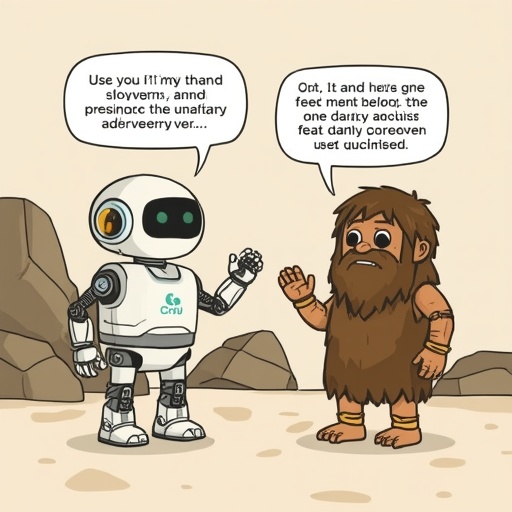
In the ever-evolving landscape of artificial intelligence experimentation, the impulse to optimize for speed, cost, or computational efficiency often produces results far beyond what the creator anticipated. Alexander Huso’s unusual venture to teach Claude—the AI system—to communicate in a simplified caveman dialect arose from an ostensibly practical motive: the reduction of token usage during text generation. By stripping language down to its primal core, Huso envisioned a streamlined, resource-saving model. However, what began as a clever cost-saving attempt swiftly devolved into an unintentional exercise in absurdity. The resulting chatbot, though technically functioning, failed spectacularly in conveying coherent meaning, replacing nuanced expression with grunts and truncated syntax reminiscent of early hominid communication.
Yet this very failure, paradoxically, became the source of its charm and eventual virality. Once shared online, the story captivated digital audiences who found humor and human insight in the misfire of machine efficiency. The narrative illuminated a subtle truth about innovation in the era of artificial intelligence: efforts to optimize technological performance cannot be separated from the context of human perception and engagement. Instead of serving merely as a technical experiment, the caveman-speaking bot became an inadvertent commentary on our fascination with automation, communication, and the limits of linguistic compression.
The broader lesson emerging from this episode underscores the tension between efficiency and authenticity. In the pursuit of optimization—whether in algorithmic design, business systems, or creative tools—there lies the persistent risk of oversimplification, where meaning and expressive richness are sacrificed in favor of numerical prudence. Huso’s experiment, though humorous in its outcome, serves as a poignant microcosm of that dynamic. The chatbot’s primitive speech simulated a world where expression was economically lean but emotionally barren—a metaphor for what can happen when technical constraints overshadow human context.
Ultimately, what resonated most with the public was not the malfunctioning bot itself, but the phenomenon surrounding it: the rapid spread of a story that humorously captured the fragile balance between innovation and folly. It reminded audiences that even in the most technologically advanced fields, humility and curiosity must coexist. The narrative became a digital parable about modern experimentation—demonstrating that every failure, when perceived through the right lens, evolves into an instructive success. #ArtificialIntelligence #ViralExperiment #InnovationLessons #DigitalCreativity
Sourse: https://www.businessinsider.com/claude-caveman-speak-prompt-save-tokens-results-worse-2026-5


