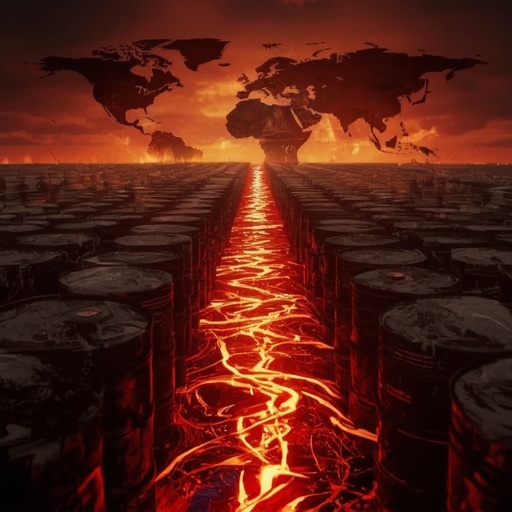
Global reserves of crude oil—the vital foundation of modern industry, commerce, and transportation—are diminishing at a pace never before witnessed in recorded history, largely as a direct consequence of the ongoing Iran war. This rapid depletion is not a minor fluctuation within the energy markets but rather a profound structural shift, one that reflects the precarious balance upon which global energy stability rests. The conflict has not only strained regional production capacities but has also disrupted critical trade routes, escalating uncertainty throughout the international supply network.
Central to this unfolding crisis lies the continued closure of the Strait of Hormuz, a narrow maritime corridor that functions as one of the most indispensable arteries for global oil transportation. Approximately one-fifth of the world’s petroleum supply ordinarily passes through this passage, connecting Middle Eastern producers to global consumers. With this chokepoint now obstructed, the world’s energy ecosystem faces a formidable accumulation of pressure. Tankers are immobilized, export terminals are congested, and refineries across distant continents are beginning to experience the ripple effects. The closure’s economic and logistical consequences extend far beyond regional boundaries, triggering volatility in commodity markets, destabilizing national reserves, and eroding investor confidence across both developed and emerging economies.
Experts, analysts, and policymakers are increasingly voicing warnings of an impending reckoning within the global energy landscape. Their prognosis suggests that if maritime flows remain halted, the resulting shortfall in oil supply could cascade into a full-scale crisis in a matter of weeks. This scenario could provoke soaring energy prices, widespread industrial disruption, and even geopolitical instability as nations scramble to secure dwindling resources. The alarm is not theoretical—it is grounded in precise data and reinforced by the growing consensus among energy strategists that the present path is unsustainable.
What the world is witnessing is not just a temporary dislocation but a seminal moment in the modern energy era—a sobering reminder of how deeply interconnected global security, economic stability, and energy accessibility truly are. The phrase ‘energy reckoning’ encapsulates more than a supply shortage; it denotes a potential recalibration of the global order, where dependence on vulnerable transit routes and concentrated production hubs becomes an existential risk. As the situation evolves, every hour that the Strait of Hormuz remains sealed amplifies the urgency for diplomatic negotiation, logistical ingenuity, and strategic diversification of energy sources. The world stands on the precipice of a transformative juncture, where the depletion of oil reserves intersects with geopolitical fragility to redefine the boundaries of global economic resilience.
Sourse: https://www.wsj.com/business/energy-oil/the-world-is-burning-through-its-oil-safety-net-ebf9d4fa?mod=pls_whats_news_us_business_f