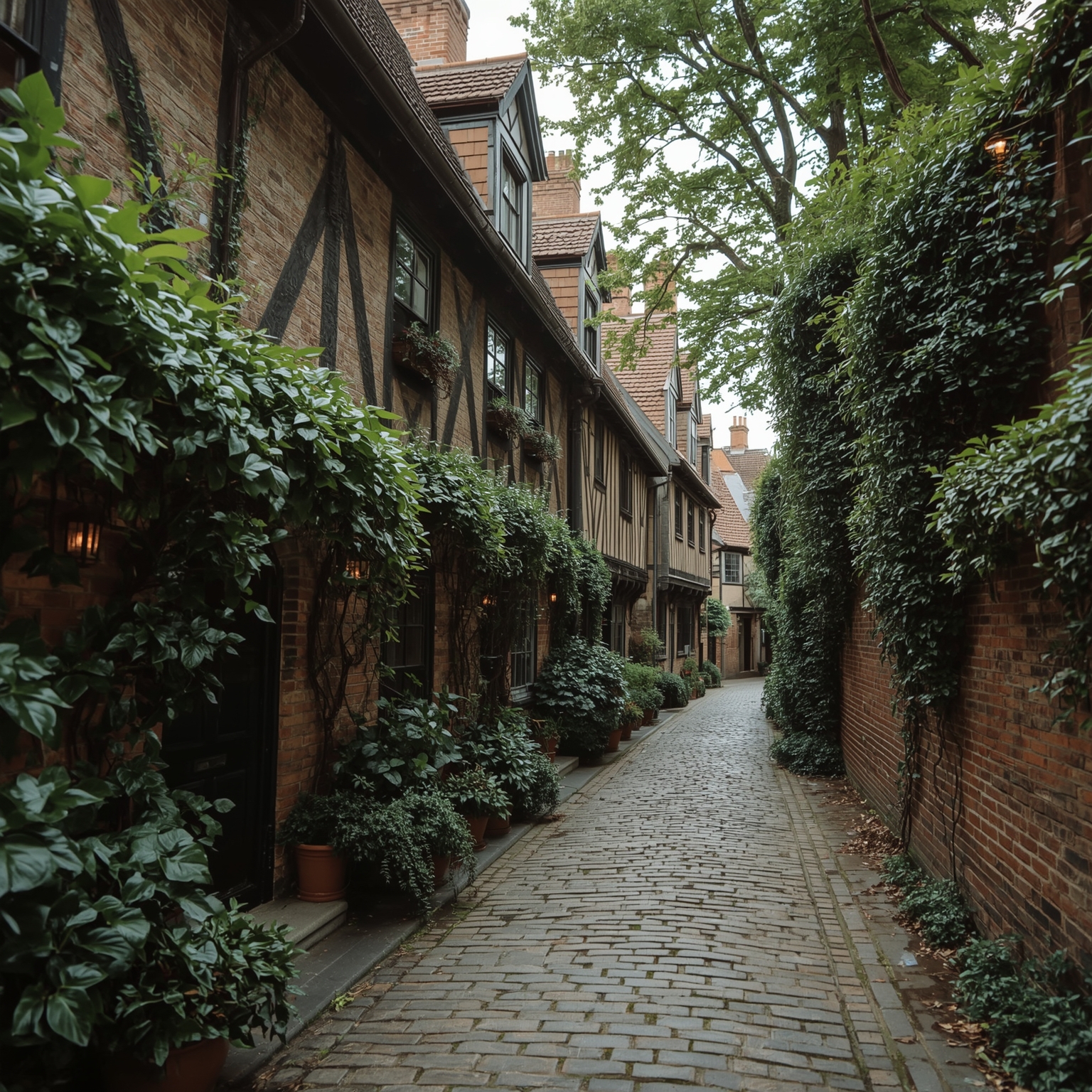
Conceived more than a century ago by an ambitious Irish immigrant, Pomander Walk is a remarkable and unexpected architectural gem nestled within the Upper West Side of Manhattan. Rather than resembling the wide, bustling streets that define much of New York City, this hidden enclave more closely evokes the atmosphere of a quaint European passageway — narrow, serene, and remarkably picturesque. The neighborhood’s storybook charm is heightened by its rows of Tudor-style facades and intricate details that transport visitors far from the typical urban landscape.
Encircled by 94th and 95th Streets and situated just a few blocks west of Central Park, Pomander Walk forms a small gated oasis that many lifelong New Yorkers have never discovered. Shielded from the constant rhythm of traffic by sturdy iron gates on both ends, it offers residents an almost village-like tranquility amid Manhattan’s vertical dynamism. While countless pedestrians pass within steps of its entrance every day, few realize that beyond those gates lies one of the city’s most enchanting and secluded residential enclaves.
At present, an exceedingly rare opportunity has arisen for discerning buyers to claim a piece of this quiet piece of architectural history. Two adjacent condominium units have entered the market at a combined asking price of $1.39 million. Each apartment—one on the second floor and the other positioned directly above it on the third—contains a single bedroom, a full bathroom, a comfortable living room, and an eat-in kitchen measuring approximately 500 square feet. Together, the units could easily be joined to create a two-level duplex, a transformation that has already been undertaken in several other structures throughout the community.
Listing agent Kim Shankman, speaking with Business Insider, aptly described Pomander Walk as a “hidden gem.” She noted that its ambiance is so distinct from the typical Manhattan environment that visitors often find it difficult to believe they remain within New York City’s boundaries. The enclave’s roots trace back to 1921, when Irish-born developer Thomas Healy—who had immigrated to the United States at the age of fifteen—sought to create something altogether unique. Healy drew his inspiration from the 1910 English stage play *Pomander Walk* by Louis N. Parker, which was set along the River Thames in Chiswick, West London. The play’s scenic design, evoking an idyllic, flower-adorned row of homes, became the direct visual muse for this Manhattan adaptation.
Originally, Healy intended to construct a single large residential building; however, financial constraints forced him to rethink his approach. Instead of one monumental structure, he delivered a cluster of individual Tudor-style houses—modest in scale yet rich in character—that lined a communal walkway. This decision inadvertently produced one of the most distinctive micro-neighborhoods in the city. Comprising a total of 61 apartments, some of which have been merged over time, Pomander Walk quickly gained admiration for both its architectural coherence and secluded atmosphere.
In 1982, decades after its completion, New York City formally recognized the development’s historic and cultural significance by designating it an official landmark. Subsequent renovations have preserved its integrity while ensuring modern livability. A major exterior restoration in 2009 earned Pomander Walk the “Building Rehabilitation” award from Landmark West, a nonprofit organization devoted to celebrating the architectural legacy of the Upper West Side. The distinction affirmed the community’s enduring importance as an example of early twentieth-century urban design dedicated to aesthetic pleasure rather than sheer density.
The individual buildings, most of them standing three stories tall, feature charming entrances framed by floral arrangements and latticework that emphasize the neighborhood’s European inspiration. Despite being located mere minutes from Broadway and a short stroll from Central Park, residents enjoy a sense of remove that is rare anywhere in Manhattan. Each property within the enclave possesses its own front door, enhancing a feeling of privacy and intimacy commonly absent from apartment living in the city.
Shankman explained that turnover within Pomander Walk is exceptionally infrequent. Homeowners tend to hold their properties for decades, drawn by the peace, beauty, and tight-knit community that the development fosters. The current owners of the two newly listed units, she noted, have cherished them for at least thirty years. Although the family has reluctantly decided that it is time to part with the homes, their emotional attachment remains profound; they hope a future resident will cherish Pomander Walk as deeply as they have.
Each of the for-sale apartments is priced individually at $699,000, an extraordinary value considering both location and exclusivity. According to public real estate records, only a handful of listings have appeared since 2009—merely six rental offerings and a few sporadic sales, some occurring privately outside the open market. The scarcity of inventory speaks to the residents’ loyalty and the intangible sense of belonging that life behind Pomander Walk’s gates seems to inspire. One of the most recent official transactions, a two-bedroom residence sold in 2023 for $900,000, reflected continued demand for these one-of-a-kind homes.
Inside, the interiors reflect a simple yet inviting charm that aligns with the neighborhood’s architectural spirit. Living rooms are filled with natural light filtered through casement windows, kitchens are cozy yet practical, and bedrooms exude warmth and intimacy enhanced by period details. The two available units mirror each other in layout, and together they represent an enticing opportunity for a buyer seeking both historical authenticity and creative potential in a coveted Manhattan location.
Pomander Walk has been described as resembling the set of a vintage film—a cinematic pocket of old-world character unexpectedly thriving in the midst of a modern metropolis. Its cobblestone-like pathways, storybook proportions, and quiet courtyards render it not merely a place to live, but an experience that evokes nostalgia for a slower, more graceful era. As Shankman succinctly summarized, “It’s just very unique, idyllic.” In truth, few phrases capture this extraordinary enclave more accurately. For those fortunate enough to step through its gates, Pomander Walk offers a rare journey backward in time—an enduring reminder that even in the heart of Manhattan, traces of pastoral charm and human-scaled beauty still persist.
Sourse: https://www.businessinsider.com/pomander-walk-hidden-nyc-street-central-park-photos-2025-10


