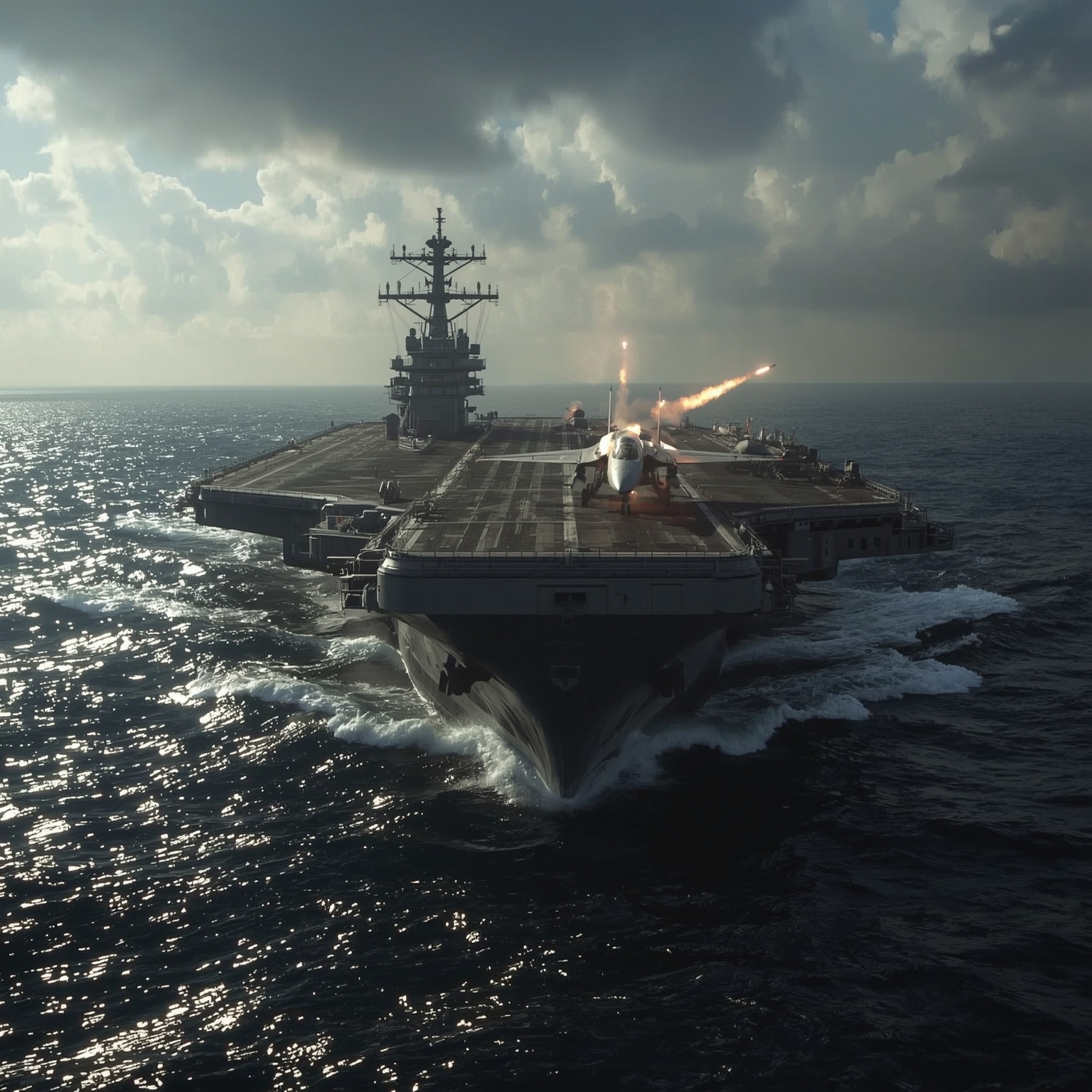
China is advancing at a remarkable pace in the field of aircraft carrier technology, making significant and visible progress in a domain long dominated by the United States. Recently, Beijing unveiled its newest and most sophisticated carrier, the Fujian, demonstrating the launch of fighter aircraft through electromagnetic catapult systems—a technological feat that, until now, had been a closely guarded hallmark of the U.S. Navy’s Ford-class supercarriers. Moreover, China showcased not just the catapult itself but the ability to launch stealth aircraft from its deck, achieving a milestone that even the United States has not yet fully demonstrated operationally.
However, while China’s carriers are rapidly closing the gap technologically, experts caution that parity in equipment does not automatically translate into parity in capability. The real determinant of effective naval power lies in experience, the skilled personnel who operate the vessels, and the strategic doctrines that govern their use in complex, high-stakes environments. Building the physical shipyard assets is, comparatively speaking, the simpler part; cultivating the human expertise and battle-tested methodologies that make these platforms effective in wartime is an endeavor that takes decades. As Bryan Clark, a retired U.S. Navy submarine officer and defense analyst at the Hudson Institute, succinctly explained, engineering and production can be achieved in years, but the intricate process of building cohesive, proficient crews with the capacity to maintain and operate such technologically advanced platforms takes far longer.
At present, China possesses three aircraft carriers. The first, Liaoning, and the second, Shandong, are operational, while the third and most advanced vessel, the Fujian, is still undergoing extensive sea trials. The Liaoning and Shandong are essentially derivatives of Soviet-era designs, each employing a ski-jump configuration that limits aircraft takeoff weight and payload. In contrast, the Fujian represents a comprehensive modernization: it eliminates those limitations through electromagnetic catapult technology. This development marks a leap forward comparable to the one the U.S. Navy made when it transitioned from steam-powered catapults to its newer electromagnetic variants aboard the Ford-class.
Despite these advances, the difference in fleet composition remains stark. The U.S. Navy currently operates eleven nuclear-powered aircraft carriers, all equipped with catapults—ten belonging to the Nimitz class, which employ steam-powered systems, and one, the USS Gerald R. Ford, utilizing cutting-edge electromagnetic catapults. In contrast, China’s carriers are conventionally powered. Although there are credible reports suggesting that Beijing is planning a nuclear-powered carrier in the future, none currently possess that long-range endurance advantage. Moreover, whereas only one of China’s ships currently features catapult launch capability, every carrier in the U.S. Navy’s fleet does.
China’s present air wing mainly comprises fourth-generation fighters, such as the Shenyang J-15, whereas the United States routinely deploys both fourth- and fifth-generation aircraft on its carriers. Yet the true differentiator between the two navies is not merely technological or operational—it is experiential. The U.S. Navy has mastered the art of carrier warfare over a century, from the earliest deck experiments of the 1920s through the fierce combat of World War II, the Cold War, and conflicts in Korea, Vietnam, and the Middle East. China, by comparison, is building its institutional experience from the ground up, having only entered the aircraft carrier arena within the last decade.
In a recent milestone, China released a state-produced video showing the Fujian launching a range of aircraft via its electromagnetic catapult systems. Among those seen were the J-35 stealth fighter, the J-15T carrier-based variant, and the KJ-600 airborne early warning aircraft. The footage depicted crew members coordinating complex launch and recovery operations—aircraft being prepared on the deck, then catapulted into flight before returning to land, caught by tailhook arresting gear. Observers highlighted how swiftly China’s navy progressed—from having no carrier capability, to using legacy Soviet ski-jump designs, to deploying a domestically conceived supercarrier featuring the latest launch technology—and notably doing so without ever building a steam catapult ship, effectively skipping an entire generation of technology.
The adoption of electromagnetic catapults enables China to deploy a more versatile air wing, capable of launching fully fueled and heavily armed aircraft, thereby expanding operational range and mission flexibility. Still, whether this system has reached full operational maturity under combat conditions remains uncertain. The footage, filmed under carefully managed testing environments, reveals little about long-term performance, reliability under unfavorable weather, or the crew’s readiness for real-world naval operations. As Bryan Clark observed, while achieving the technical milestone is impressive, China’s navy likely lacks the capacity to perform such complex, sustained flight operations at high tempo across extended missions.
The United States, for its part, continues to operate the F/A-18 Super Hornet and EA-18 Growler from its carriers, with a substantial history of combat operations supporting its training and doctrines. Moreover, its carriers have deployed with the fifth-generation F-35C Lightning II, giving American forces the unique advantage of fielding stealth aircraft proven in combat. China’s stealth fighter, the J-35, while visually comparable to U.S. models, remains largely untested and shrouded in secrecy, leaving analysts to question its actual performance metrics and maturity as a naval asset.
Another key dimension separating the two navies is the scale and complexity of their air wings. U.S. carriers typically embark between sixty and seventy aircraft, compared to smaller contingents on China’s ships. Nevertheless, the Fujian’s electromagnetic launch systems enable it to field not only fighters but also advanced support platforms such as the KJ-600, which provides airborne early warning and control. This capability allows a Chinese carrier strike group to detect and track distant threats well beyond the range of ship-based sensors, resembling the operational value of the U.S. Navy’s E-2D Hawkeye.
Operational experience, however, remains the elusive element that no amount of engineering can accelerate. The U.S. Navy possesses a deeply entrenched culture of carrier operations supported by multiple generations of sailors, pilots, and deck crews trained through rigorous schools, advanced simulators, and repeated deployments in both peacetime and combat. China, on the other hand, is only beginning to develop that institutional memory. Its carrier sailors—the first generation of such specialists—are only just beginning to ascend into senior leadership roles, bringing with them limited yet expanding practical knowledge. Experts like Clark emphasize that China’s naval crews currently operate with smaller, less experienced teams, sometimes assigning senior officers to roles that are filled by mid-level personnel in the U.S. Navy, a sign of a still-maturing skill base.
Moreover, a carrier’s effectiveness is not confined to flight operations alone. It also demands a reliable ecosystem of logistics, maintenance, and resupply—an intricate web that the U.S. Navy has refined over nearly a century of global operations. American carrier groups are supported by fleet oilers, supply ships, repair infrastructure, and pre-scheduled maintenance cycles designed to keep the colossal vessels and their air wings ready for decades of continuous service. China, despite its vast industrial capacity, has only begun establishing comparable systems, learning through incremental experience how to conduct prolonged blue-water operations and sustain fleet readiness under pressure.
Looking forward, the Fujian will soon complete its sea trials, at which point it is expected to join the Liaoning and Shandong to expand China’s naval reach in the Indo-Pacific. Analysts anticipate that Beijing will seek to enlarge its carrier fleet even further, a likely prospect given the immense production power of its shipbuilding industry. Yet before China can truly project sustained power across distant oceans, it must overcome a significant hurdle: propulsion. Because all of its carriers currently rely on conventional power, their operational range is inherently limited without overseas refueling support. For this reason, there is much speculation that China’s next carrier—a potential fourth vessel—may incorporate nuclear propulsion. Should this materialize, it would represent a monumental technological and strategic step, aligning China’s ambitions more closely with those of traditional blue-water naval powers. Even so, such advancement would undoubtedly introduce a host of new engineering, safety, and training challenges, demanding an even deeper pool of experienced personnel and a broader framework for sustained global operations.
In sum, China’s acceleration in aircraft carrier technology is both undeniable and strategically consequential. The Fujian marks a significant demonstration of progress, signaling to the world that Beijing aspires to operate at the same technological and operational level as its American counterpart. But technology alone does not win wars or guarantee mastery of the seas. The true test will be whether China can cultivate the enduring expertise, resilient systems, and operational culture required to transform its impressive hardware into a fully capable and reliable force on the world’s oceans.
Sourse: https://www.businessinsider.com/how-chinas-aircraft-carriers-are-stacking-up-to-us-navy-2025-10


