**Anker Solix F3800 Plus + 410W Solar Panels: In-Depth Overview of Strengths and Limitations**
**Pros and Cons**
**Advantages**
The Anker Solix F3800 Plus functions remarkably well as a versatile and expandable compact solar energy configuration. It is designed for individuals interested in establishing a reliable yet small-scale renewable energy source that can later be expanded as their energy needs grow. By integrating the F3800 Plus with solar panels, users can expect to offset their monthly electricity expenditures, typically achieving a reduction of approximately $12 to $25 depending on local electricity rates and the efficiency of sunlight exposure in their region. This makes it an appealing option for both cost-conscious homeowners and eco-minded users. Another major benefit lies in the flexible scalability of the system. This feature allows an incremental approach: rather than committing to a large upfront investment, one can begin with a smaller setup and add additional panels or capacity over time as budget and energy needs expand.
**Disadvantages**
However, the overall financial benefit and energy yield are influenced by several critical factors, including geographical location, sun exposure angle, and variable rate structures from local utility providers. The F3800 Plus also exhibits limited portability in comparison to smaller, more mobile battery units, due to its relatively substantial weight. While the system is considerably more affordable than a full-scale whole-home backup configuration such as premium models by Tesla or Generac, it still represents a significant financial outlay for users seeking a more modest renewable setup.
—
**Comprehensive Evaluation**
As daily temperatures rise seasonally, household power bills often increase in tandem. In response to this, I began experimenting with personal solar energy solutions to mitigate my own energy expenses. After exploring various configurations, I discovered a sustainable, realistic option: the **Anker Solix F3800 Plus**, an intelligently engineered battery capable of storing 3.84 kWh of energy. This device serves as a hybrid system positioned between a conventional gas-powered generator, a fixed home battery backup installation, and a heavy-duty portable power supply. Its design merges the reliability of a permanent energy reserve with the adaptability of mobile power stations.
Despite its integrated wheels, the Solix F3800 Plus is not primarily intended for light camping or outdoor portability, as its 136-pound body makes frequent relocation impractical. Nevertheless, its power output qualifies it as a functional whole-home backup solution. It possesses sufficient capacity to operate several high-demand appliances, ranging from refrigerators, sump pumps, air compressors, and power tools, to even smaller central air-conditioning units—essentially transforming a portable power station into an authentic residential backup generator.
—
**System Setup and Solar Integration**
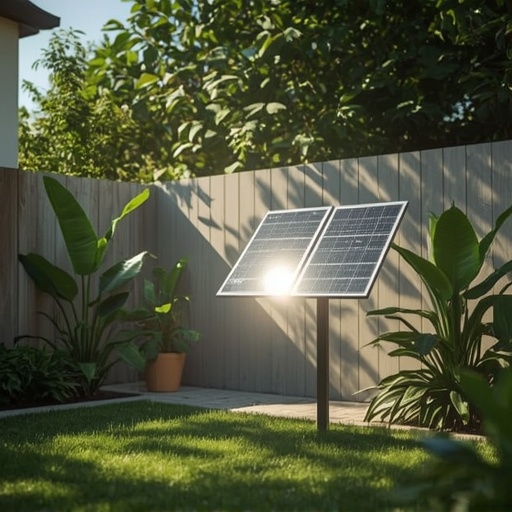
To test its full potential, I installed the Anker Solix F3800 Plus alongside two rigid 410W solar panels manufactured by Anker, purchased as a bundled set. Having previously tested both EcoFlow and Anker Solix portable panels, I approached this trial with optimism. Combined, these panels theoretically generate 820W; however, real-world solar output often falls below the rated maximum due to environmental conditions such as temperature, shading, and the sun’s angle.
There are multiple methods to configure the F3800 Plus for home backup purposes. The simplest technique involves directly plugging household appliances into the power station. For example, if one plans to keep the system in a permanent location, the solar panels can remain connected continuously, and an extension cord can be routed to essential devices like a refrigerator. Given that a typical full-size refrigerator consumes between 25 and 67 kWh monthly, this configuration can yield approximately $20 in monthly energy savings—equivalent to an annual reduction of nearly $240.
A more refined integration involves using a generator inlet connected to a transfer switch, which is particularly advantageous for homes already wired for backup power. This setup, which I personally adopted, allows the F3800 Plus to act as an automatic replacement for a traditional gas generator. When the power grid fails, flipping the transfer switch instantly reroutes power from the Anker system to selected circuits. The process is not only cleaner than fuel-based generators but also safer and quieter, emitting no fumes or heat.
For users seeking a seamless automation experience, the most advanced solution involves connecting the F3800 Plus to a smart home panel or whole-home power management system. Anker’s proprietary **Smart Home Power Panel** can automatically detect grid outages, immediately switching to stored battery energy and controlling solar input for recharging. Although this configuration demands professional installation and incurs additional cost, it functions comparably to higher-end alternatives such as the Tesla Powerwall, EcoFlow Smart Home Panel, or Generac PWRcell.
—
**Performance and Output**
Under favorable sunlight conditions, pairing two 410W panels with the F3800 Plus yields a continuous “essential loads” solar system that can generate roughly 3.7 kWh daily under average circumstances. With optimized positioning and ideal sunlight throughout the day, production can climb to approximately 5 kWh. The battery stores this energy efficiently, allowing it to run essential devices or equipment when solar generation dips. In daily practice, the stored energy has powered my outdoor tools and other electronics during household projects.
Although my current setup rests temporarily on a base improvised from reclaimed wood, my partner has plans to upgrade it using wood, casters, and adjustable brackets. This new foundation will allow for easier directional adjustments and mobility to follow optimal sunlight angles, further maximizing efficiency.
—
**Energy Balance and Consumption Strategy**
In principle, if one’s average daily electricity demand remains lower than the solar energy produced, it becomes theoretically possible to live entirely on self-generated solar power. Nonetheless, this remains challenging with small backyard installations, particularly considering that the average U.S. household consumes about 30 kWh per day. For instance, maintaining an average consumption of 3.5 kWh daily while continuously generating 4 kWh will keep the battery fully charged. Conversely, drawing more energy than is stored results in gradual depletion.
Despite this limitation, the scalability of the F3800 Plus permits users to incrementally extend their infrastructure to offset a large portion of continuous background energy usage. This includes powering the numerous household devices that operate perpetually, such as routers, TVs on standby, smart home hubs, or charging stations. However, high-demand appliances like electric ovens, water heaters, large HVAC systems, or dryers should not be connected on a continuous basis unless additional panels are incorporated, as they consume substantial amounts of energy and could swiftly outpace the solar generation capacity.
—
**Practical Buying Guidance**
For anyone venturing into the realm of personal renewable energy, the most realistic initial objective should be to create a dependable baseline reduction rather than to power an entire house outright. The duo of the **Anker Solix F3800 Plus and its rigid solar panels** achieves precisely that—offering an approachable, scalable entry point into home solar energy without the prohibitive cost of full-system installations. Over time, as savings accumulate, one can gradually expand capacity to cover a larger portion of energy needs. This incremental method balances affordability with sustainability, providing a meaningful step toward energy independence and long-term financial relief.
Sourse: https://www.zdnet.com/article/anker-solix-f3800-plus-410w-solar-panels-review/