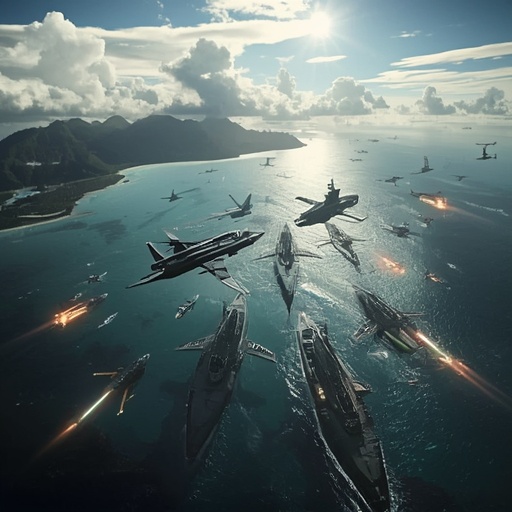
In a sweeping demonstration of evolving military precision and strategic cooperation, United States forces recently conducted a series of comprehensive war games across the Pacific region. These exercises were not limited to routine tactical rehearsals; rather, they served as an intricate showcase of the country’s growing ability to deploy and coordinate advanced, layered defense systems designed for rapid response and long-range deterrence. At the core of this operation was a historic milestone — the Army’s Typhon missile system launching a Tomahawk missile overseas for the very first time. This singular event symbolized far more than the debut of a new capability; it illustrated a tangible shift in how the United States integrates different branches of its armed forces to project strength and maintain stability in a region increasingly vital to global security.
The tests underscored how America’s strategic emphasis has evolved from traditional, single-system operations to a networked defense ecosystem capable of dynamic coordination among sea, land, air, and digital domains. By blending precision-guided long-range weaponry with robust command-and-control intelligence, the drills replicated the complex conditions of modern conflict — situations where timing, adaptability, and collaboration determine not just victory, but long-term deterrence. The inclusion of the Typhon system — capable of deploying a Tomahawk missile with exceptional accuracy — demonstrated both technological innovation and strategic foresight. It validated how dispersed missile networks could operate jointly to reinforce allies and strengthen deterrence without direct escalation.
Beyond its technological significance, the exercise communicated a broader geopolitical message. In a world where alliances and regional partnerships play a defining role in collective security, this display of power was a deliberate affirmation of the United States’ commitment to defending its allies in the Indo-Pacific. The Pacific theater, characterized by vast maritime distances and complex geopolitical dynamics, remains a testing ground for 21st-century defense readiness. As these coordinated drills unfolded, they reinforced the vision of an Indo-Pacific defense architecture built not solely on offensive strength, but on adaptability, cooperation, and seamless integration among different service branches.
Ultimately, the Pacific war games marked a profound step toward a future in which layered firepower and advanced interoperability define defense strategy. From precision-missile technology to multi-domain synchronization, every component of the exercise illustrated the balance between cutting-edge innovation and disciplined operational planning. This was not merely a demonstration of military might — it was a vivid preview of the United States’ evolving approach to ensuring stability, deterrence, and enduring security partnerships across one of the world’s most strategically significant regions.
Sourse: https://www.businessinsider.com/us-forces-tactics-and-weapons-for-pacific-fight-2026-5