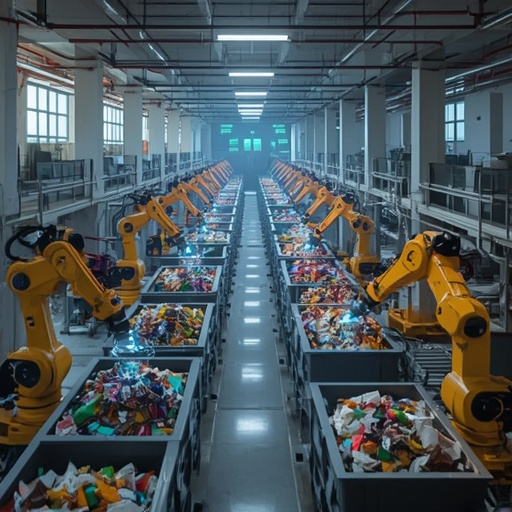
At Stony Brook University, an ambitious team of researchers is redefining the concept of recycling by merging artificial intelligence with environmental science. Their groundbreaking project centers on the creation of an advanced AI-driven system capable of recognizing and sorting contaminated recyclable materials with unparalleled precision. Traditionally, recycling facilities have relied heavily on manual labor and basic mechanical methods, both prone to error and inefficiency when distinguishing clean recyclables from those tainted by food residue, plastics of the wrong grade, or non-recyclable waste. The introduction of machine intelligence in this domain thus represents a transformative leap toward cleaner, more efficient, and more sustainable waste management practices.
The system currently under development leverages sophisticated computer vision models trained to interpret millions of visual data points collected from real-world recycling streams. By analyzing micro-level details—such as texture differences, subtle color variations, or recognizable patterns of contamination—the AI can identify problematic items that human observers or traditional sensors might overlook. In effect, this technology provides recycling facilities with the ability to automate one of the most challenging stages of the waste-handling process: the consistent separation of suitable materials from contaminants.
Beyond its technical ingenuity, the initiative embodies a broader commitment to sustainability and global ecological responsibility. The anticipated outcome extends well beyond mere operational enhancement; it promises a future in which the proportion of recyclable waste that actually reenters the production cycle increases substantially. Improved purity in recycled streams ensures higher-quality recovered materials, minimizes landfill overflow, and decreases the carbon footprint associated with manufacturing new products from raw resources. Such outcomes align perfectly with the urgent demand for environmental stewardship in the era of climate change and rapid urbanization.
The implications are vast. Recycling plants augmented with AI vision could dramatically cut costs associated with sorting and disposal, reduce the necessity for manual labor in hazardous conditions, and bolster the economics of clean technology industries. Moreover, by demonstrating how algorithmic intelligence can tangibly advance sustainability goals, the researchers at Stony Brook are shaping a replicable model for other institutions and industries around the world. What they are building is more than a machine—it is a blueprint for how applied artificial intelligence can become an indispensable ally of environmental restoration and resource efficiency.
As artificial intelligence continues to evolve, this partnership between technology and ecology exemplifies how innovation can serve the planet rather than exploit it. Smarter recycling, driven by data and guided by human ingenuity, brings us closer to a world where clean, sustainable living is not an aspiration but a well-engineered reality.
Sourse: https://www.businessinsider.com/ai-recycling-waste-sorting-technology-stony-brook-university-2026-05