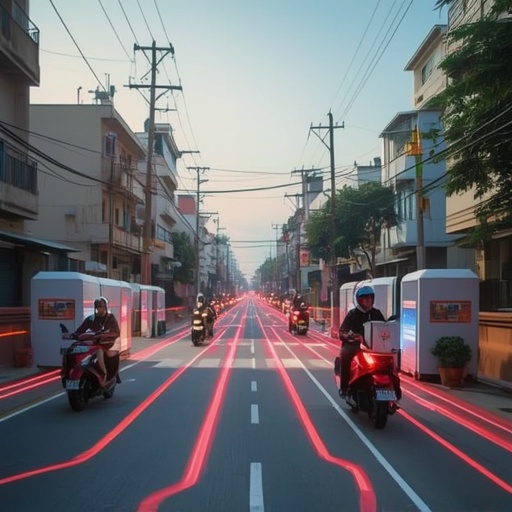
In contemporary India, a remarkable transformation is unfolding within the rapidly evolving landscape of retail and urban logistics. What was once an aspirational idea—receiving your groceries nearly instantaneously—is now an everyday reality for millions of consumers across the country. It has become increasingly common for residents in bustling metropolitan centers to have their daily essentials, such as milk, fresh produce, or packaged goods, delivered to their doorstep in less time than it takes to brew a fresh cup of coffee. This striking shift illustrates not merely a change in convenience but a profound reconfiguration of the retail supply chain and consumer behavior at large.
Driving this revolution is an intense competition among both global giants and local innovators. On one side, corporations such as Amazon bring to the table advanced technological infrastructure, data-driven logistics, and deep financial resources. On the other, nimble Indian startups like Blinkit, Zepto, Swiggy Instamart, and BigBasket’s quick-commerce divisions are leveraging local expertise and adaptability to capture the hearts and habits of urban consumers. Together, they are locked in a race defined by speed, efficiency, and customer satisfaction—each striving to reduce the gap between order and delivery to mere minutes.
At the core of this new delivery paradigm lies a novel infrastructural strategy: the micro-warehouse. Unlike traditional warehouses that exist at the city outskirts or in industrial zones, these compact, strategically located facilities—sometimes nestled within residential neighborhoods or commercial clusters—act as localized fulfillment centers. Stocked with high-turnover grocery and household items, micro-warehouses position inventory close to consumers, enabling delivery personnel to complete an order almost immediately after it is placed. This closeness drastically reduces transportation time and minimizes logistical dependencies, ensuring consistently prompt service regardless of traffic conditions or city congestion.
The implications of this phenomenon reach beyond mere convenience. Ultrafast grocery delivery signals a broader cultural and economic shift in how time, technology, and consumption intersect in modern urban life. For working professionals managing hectic schedules, for families balancing household responsibilities, and even for small vendors who rely on just-in-time replenishment, this model redefines expectations surrounding accessibility and immediacy. It encapsulates a new era of ‘fast commerce,’ one that prioritizes agility and proximity over scale alone.
With every micro-warehouse added, the invisible network powering Indian cities becomes more intricate and intelligent. Advanced algorithms determine inventory levels, predictive analytics forecast customer demand based on time of day or weather patterns, and coordinated routing systems optimize delivery pathways in real time. These technologies collectively transform what might seem like a simple grocery order into a display of logistical precision and data-driven orchestration.
Ultimately, India’s embrace of micro-warehouses and lightning-speed delivery exemplifies a pivotal moment in the evolution of global commerce. The nation, long recognized for its entrepreneurial energy and technological innovation, is now demonstrating how densely populated, fast-growing urban markets can pioneer radically efficient retail ecosystems. As a result, grocery shopping is no longer merely a routine errand—it has become a marvel of modern efficiency. In this new reality, the simple act of replenishing your pantry embodies the spirit of innovation, proving that in India today, the race against the coffee pot has already been won.
Sourse: https://www.wsj.com/business/logistics/in-india-you-can-get-milk-delivered-faster-than-it-takes-to-make-coffee-aa211a54?mod=rss_Technology