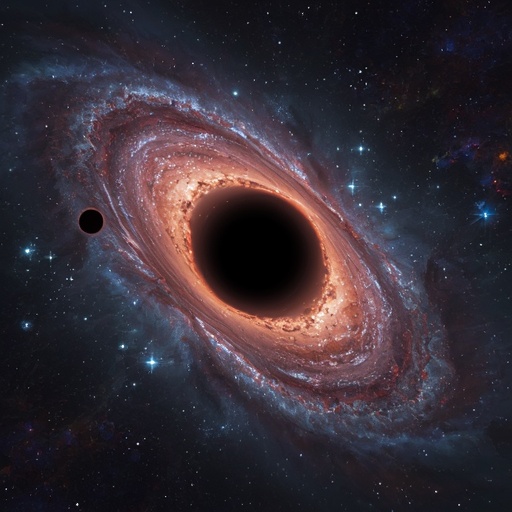
For decades, astronomers have wrestled with what seemed to be one of the cosmos’s most unsolvable riddles—the puzzling existence of so-called ‘impossible’ black holes. These celestial objects are too enormous to have emerged from the remnants of a single collapsing star, yet they fall far short of the colossal scale associated with supermassive black holes that sit in the hearts of galaxies. Their mere presence seemed to contradict everything astrophysicists knew about how stars live, die, and transform into these infinitely dense gravitational wells.
A recent scientific breakthrough has now shed new light on this long-standing mystery, providing the first coherent framework for understanding how these enigmatic mid-sized black holes—often termed intermediate-mass black holes—could have formed naturally within the dynamic ecosystems of the universe. By combining years of theoretical modeling with high-resolution observational data, researchers have pieced together a narrative suggesting that these objects arise from repeated mergers of smaller stellar black holes in dense star clusters. Each successive collision yields a more massive remnant, gradually building these middleweight cosmic giants.
This discovery does far more than merely fill a gap between the smallest and largest black holes. It presents a crucial missing link that informs scientists about the growth habits of cosmic structures over billions of years. For example, if intermediate black holes serve as the seeds from which supermassive black holes eventually grow, then the processes driving their formation might also govern the evolution of entire galaxies. The physical mechanisms involved—gravitational waves, stellar interactions, and matter accretion—tell an intricate story of balance and violence that defines much of the universe’s hidden architecture.
In many ways, the research is also a triumph of observational innovation. Using next-generation telescopes and gravitational-wave detectors, scientists can now capture cosmic events once thought eternally invisible. When two black holes merge, they release ripples in spacetime itself, and by detecting these faint vibrations, researchers can trace the ancestry of these extraordinary objects. The latest data strongly supports the theory that repeated black hole mergers within crowded stellar nurseries account for the ‘impossible’ examples that baffled astronomers for so long.
Beyond its scientific implications, this revelation rekindles a sense of awe about humanity’s place in the cosmos. We now know that what once appeared as an astrophysical contradiction is in fact a natural outcome of the universe’s restless creativity. It reminds us that creation and destruction are interwoven forces shaping the galaxies, the stars, and even the dark void between them. Each new insight into black holes—those silent architects of cosmic order—deepens our understanding of both the visible and the unseen, marking an extraordinary leap forward in the story of astrophysical discovery.
Sourse: https://www.wired.com/story/the-universe-is-full-of-impossible-black-holes-now-scientists-know-why/