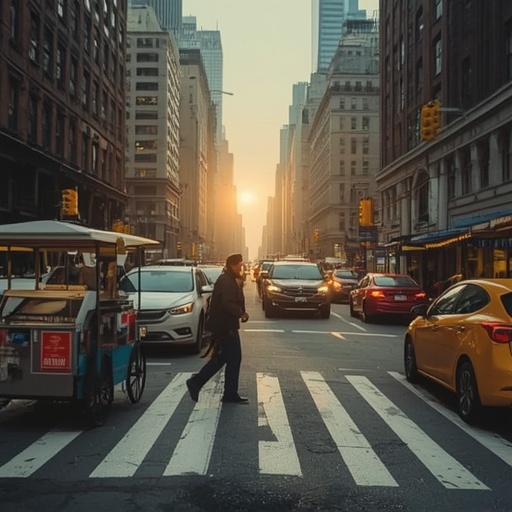
New York City’s ambitious congestion pricing initiative, designed to alleviate the gridlocked traffic that has long plagued its bustling streets, is reshaping urban life in ways few anticipated. While the central goal of this policy is to promote cleaner air and smoother mobility by discouraging excessive vehicle use in the heart of Manhattan, its ripple effects are being felt most acutely by the city’s small-scale street vendors—especially halal cart owners whose livelihoods depend on daily access to these very areas.
For many of these entrepreneurs, each additional cost can reverberate through already delicate financial structures. Rising fuel prices, increased ingredient costs, and now the looming congestion tolls have compounded the pressures of operating in an increasingly expensive city. A few dollars in tolls may appear minor in the grand scheme of urban development, yet for vendors whose profit margins are already razor-thin, these charges can represent the difference between breaking even and falling behind.
Consider the typical halal vendor: they often travel from boroughs outside Manhattan, hauling supplies, equipment, and ingredients each morning. Under this new toll system, that commute now carries an added daily price tag, transforming the everyday act of conducting business into a strategic calculation of expenditure versus survival. For some, it may mean reconsidering whether operating in Manhattan — with its dense pedestrian traffic and lucrative lunchtime crowds — remains financially sustainable.
Beyond the individual struggles, this unfolding situation highlights a broader dilemma intrinsic to well-intentioned policy reforms. Initiatives designed to advance environmental responsibility or urban efficiency sometimes inadvertently expose the vulnerability of small businesses woven into the city’s economic and cultural fabric. Street vendors are not merely peripheral to New York’s economy; they embody its dynamism, diversity, and accessibility. Their carts fill the air with the fragrances of global cuisine, offering affordable meals to millions while anchoring public spaces in authenticity and community.
Thus, the introduction of congestion tolls forces a difficult question upon policymakers and residents alike: how can a metropolis pursue environmental innovation and social equity simultaneously? The challenge lies not in the ambition of the clean-air movement itself, but in its uneven impact — a reminder that progress, when viewed through an economic lens, is rarely uniform. The struggle of these vendors, emblematic of countless small entrepreneurs, urges a more nuanced consideration of municipal planning, where ecological sustainability does not come at the expense of human livelihood.
Ultimately, the story unfolding across New York’s streets is both economic and existential. It is about more than fees or traffic reduction — it is about the survival of local enterprise within the larger narrative of urban transformation. As the city balances between climate-conscious change and economic inclusivity, its most modest workers continue to shoulder the cost of progress, reminding us that every policy, however visionary, must be measured not only by its intentions but by the realities it creates on the ground.
Sourse: https://www.businessinsider.com/congestion-pricing-is-squeezing-nyc-street-vendors-budgets-2026-5