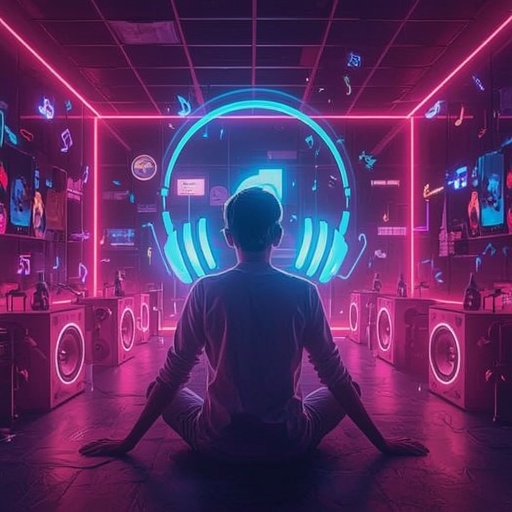
Across the rapidly evolving landscape of modern creativity, a new and somewhat paradoxical phenomenon has begun to surface—one that blurs the line between artistic creation and self‑consumption. Increasingly, individuals who rely on artificial intelligence to compose songs are not only generating original tracks but also choosing to immerse themselves exclusively in these self‑produced soundscapes. In doing so, they drift away from the shared, communal experience that has long defined music culture and instead inhabit highly personalized auditory spaces. What once functioned as a collective form of expression—a means to connect across boundaries of culture, geography, and emotion—is gradually transforming into an introspective exercise centered entirely upon the self.
This behavior reveals a deeper shift in how technology mediates creativity and identity. The capacity to instruct algorithms to fabricate melodies tailored precisely to one’s preferences grants listeners an unprecedented level of control over their sonic environment. Yet that same control may inadvertently isolate them from the spontaneity and diversity that once made listening to music a social act. Whereas traditional fans sought novelty and resonance in the works of others, today’s AI composers cultivate a recursive relationship with their inventions: they author what they later consume, their playlists populated exclusively by the echoes of their own digital imagination.
Such a transformation raises profound philosophical and cultural questions. Does this inward turn represent the purest manifestation of creative autonomy, or does it signal a retreat into solipsistic echo chambers where self‑validation replaces artistic dialogue? By continuously reinforcing personal taste through algorithmic reproduction, the listener risks narrowing their emotional and aesthetic vocabulary. Music, once a language of exchange and empathy, could become a closed circuit—an algorithmic mirror reflecting only the contours of its creator’s psyche.
This emerging trend, therefore, serves as both a marvel of technological empowerment and a cautionary reflection of our digital era. It demonstrates how innovation can simultaneously expand and contract the boundaries of human expression. As artificial intelligence becomes ever more capable of composing with emotional nuance and stylistic depth, society must grapple with a central paradox: in gaining the ability to generate infinite personalized sounds, we may lose the shared rhythm that once united us. The age of AI‑driven music promises unlimited creativity, but it also invites a future in which each listener hears only themselves resonating through an impeccably engineered silence.
Sourse: https://www.theverge.com/ai-artificial-intelligence/937059/nobody-wants-to-tell-me-why-they-only-listen-their-own-suno-slop