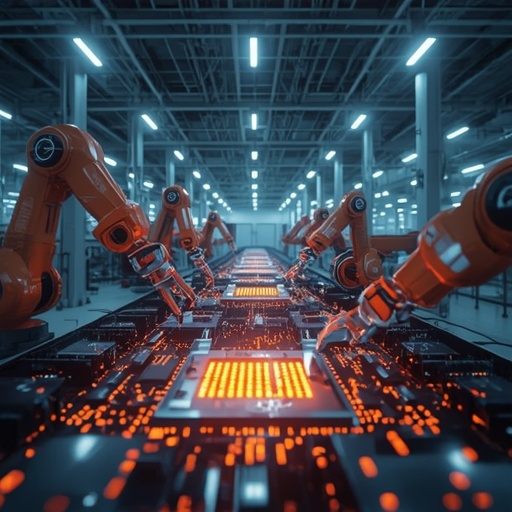
Huawei’s recently unveiled strategy to develop and expand its own capabilities in semiconductor manufacturing has introduced a significant ripple effect across the global technology landscape, particularly within the highly competitive field of artificial intelligence. What might appear on the surface as a bold business maneuver is, upon closer examination, a carefully calibrated step that has the potential to redefine the contours of the AI race. Major technology corporations around the world are intensifying their investments in computational resources, recognizing that the next wave of innovation—especially in deep learning, automation, and large-scale machine intelligence—will be determined by who can generate, control, and optimize the greatest processing power.
Against this backdrop, Huawei’s entrance into advanced chip design and production introduces an intriguing shift in industrial dynamics. Investors and analysts alike are treating this move not merely as a national or corporate milestone but as a potential inflection point that could gradually disrupt the established equilibrium of global semiconductor markets. The company’s technological ambitions signal a broader narrative: as access to high-performance chips grows increasingly critical, market dominance will hinge not only on innovative software solutions but also on the mastery of hardware ecosystems that support ever more demanding AI workloads.
The surge in demand for cutting-edge semiconductors has created a fiercely competitive environment where every strategic decision—from sourcing components to developing proprietary fabrication methods—carries immense weight. Within this rapidly evolving context, Huawei’s initiative could represent both an assertion of technological independence and a challenge to the status quo of international supply chains. For investors, the implications are far-reaching: while the promise of growth and innovation is alluring, the risks tied to geopolitical tension, production scalability, and intellectual property remain substantial factors to consider.
Ultimately, Huawei’s chipmaking strategy encapsulates the ongoing transformation of an industry that sits at the very heart of modern digital progress. As nations and corporations vie for supremacy in artificial intelligence, the ability to engineer increasingly sophisticated processors may determine not only who leads the next generation of computing but also how the global balance of technological power is defined. Huawei’s movement into this domain, therefore, is more than a corporate initiative—it is a reflection of the accelerating intersection between innovation, investment, and the collective pursuit of computational excellence in the age of AI.
Sourse: https://www.bloomberg.com/news/articles/2026-05-27/what-to-know-about-huawei-s-new-ai-chipmaking-plan-logicfolding-tech