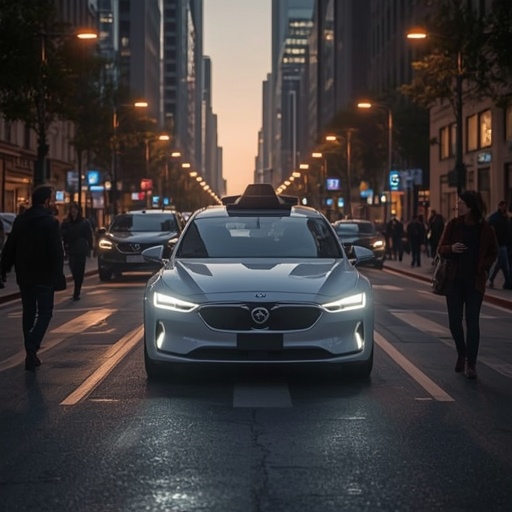
In a striking moment that underscores both the promise and the fragility of cutting-edge technology, a Waymo self-driving vehicle in San Francisco unexpectedly terminated a trip mid-route and politely instructed its passengers to seek an alternative form of transportation—specifically, to book an Uber. This incident, while seemingly minor, vividly captures the intricate balance that exists between technological innovation and real-world reliability.
Waymo, a pioneer in the field of autonomous driving, has long stood at the forefront of the mobility revolution. Yet, this event serves as a reminder that even the most sophisticated artificial intelligence systems remain works in progress. The abrupt end of the journey not only startled its passengers but also reignited broader public debate about how far self-driving technology has truly come—and how far it still must go before it earns complete trust on the road.
Autonomous vehicles are extraordinary feats of engineering, utilizing advanced sensors, machine learning, and complex decision-making algorithms to navigate environments once thought controllable only by human intuition. Still, the pragmatic challenges of scaling this innovation to a diverse and unpredictable urban landscape reveal the difficulties of ensuring consistent and safe performance under all conditions. Every unpredictable scenario—a malfunctioning traffic light, a suddenly changing route, or ambiguous road signs—tests the system’s limits and resilience.
For the everyday rider, the situation highlights an intersection between convenience and vulnerability. Imagine expecting a seamless, futuristic experience only to find yourself stranded mid-destination, shifting from awe to inconvenience in moments. Such experiences remind the public that progress, especially in autonomous mobility, is seldom linear—it ebbs and flows, gaining wisdom from each misstep.
In a broader sense, this event raises profound questions for technologists, policymakers, and consumers alike. How can society harmonize innovation with accountability, safety, and public confidence? What level of transparency should be required when these systems make critical decisions on our behalf? As artificial intelligence increasingly shapes transportation, moments like this compel developers to refine both the technology’s reliability and its relationship with human trust.
The Waymo incident, therefore, is not merely a technical hiccup but a pivotal teaching moment. It invites us to appreciate the immense complexity of creating vehicles capable of perceiving the world as humans do—and to remember that even extraordinary machines must, at times, learn from their own detours. While the road toward full autonomy may still hold unseen turns, each challenge along the way continues to drive forward the collective quest for safer, smarter, and more adaptive mobility.
Sourse: https://www.businessinsider.com/waymo-robotaxi-stalls-rider-advised-to-use-uber-or-lyft-2026-5