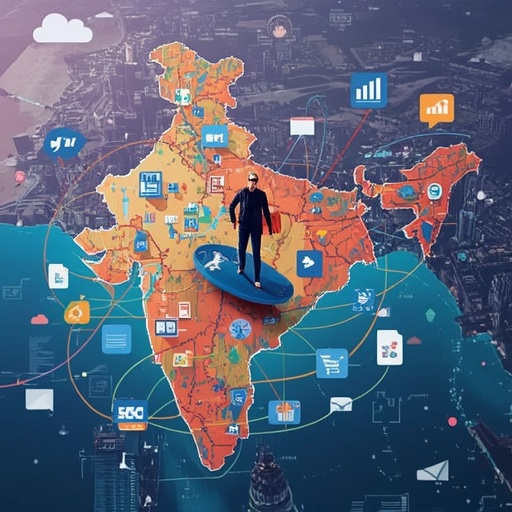
More than a decade after entering India with great anticipation and a wealth of global experience, Amazon continues to find itself entangled in a complex and highly competitive marketplace where local champions such as Flipkart fiercely defend their dominance. Despite Amazon’s immense technological infrastructure, deep pockets, and worldwide reputation for innovation, its expansion in India has not been as straightforward or as triumphant as one might expect from a global leader of its scale. This ongoing struggle underscores a central truth about emerging economies: global dominance, while impressive on paper, can falter when it confronts the intricate web of cultural nuances, local preferences, and regulatory complexities that define such vibrant markets.
In India’s e-commerce landscape, competition extends far beyond simple price wars or promotional campaigns. The country’s digital retail environment is shaped by a mosaic of regional languages, diverse consumer expectations, and logistical challenges that differ profoundly from those in Western economies. Companies like Flipkart, deeply embedded in India’s domestic market, possess an intuitive understanding of local consumer behavior—knowing, for example, how to tailor product selections for cities versus small towns, or how to build trust among first-time online shoppers who may be hesitant to order digitally. Amazon, while globally sophisticated, has had to continually adjust its playbook to meet these region-specific demands, often learning through trial and error.
Moreover, India’s regulatory framework adds another layer of complexity. Restrictions on foreign investment in multi-brand retail, evolving e-commerce laws, and the government’s emphasis on protecting local entrepreneurship create an environment where agility and adaptation become essential. Amazon’s experiences in India thus serve as a vivid case study for other global brands striving to enter emerging markets: success depends not merely on resources or reputation, but on deep localization, patience, and an authentic engagement with the social, cultural, and economic rhythms of the region.
Ultimately, Amazon’s ongoing challenge in India reflects the broader tension between global ambition and local reality. It illustrates how even the most powerful multinational corporations must confront the limits of their influence when faced with markets that resist homogenization. The story is not one of failure but of continuous learning—a reminder that sustainable success in emerging markets demands not only capital and technology, but also humility, empathy, and a long-term commitment to understanding the people who make each marketplace unique.
Sourse: https://www.bloomberg.com/news/features/2026-06-04/amazon-has-struggled-to-crack-the-world-s-most-populous-nation