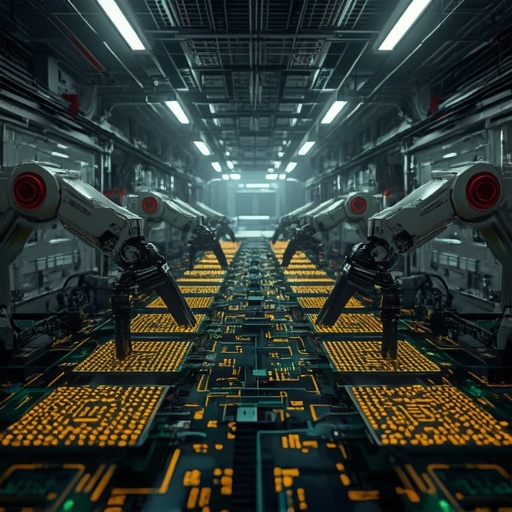
Amid the relentless wave of artificial intelligence innovation, the Taiwan Semiconductor Manufacturing Company (TSMC) finds itself confronting an extraordinary surge in demand—particularly from its U.S. clients—unlike anything witnessed in the firm’s history. The world’s most prominent chipmaker, long regarded as the backbone of modern computing infrastructure, now faces the difficult reality that its production capabilities are being stretched to their outermost limits. Even though the company is actively building new fabrication plants, including major facilities in the United States, its executives acknowledge that expanding physical capacity cannot immediately resolve the mounting imbalance between demand and supply.
This unprecedented tension in the semiconductor sector symbolizes the dramatic pace of the ongoing AI revolution. Artificial intelligence applications—from large-scale training models to advanced data processing systems—are driving chip consumption at a rate that outpaces the industry’s capacity to manufacture them. Each new advancement in AI algorithms requires an exponential increase in processing power, prompting a surge in high-performance chip orders that existing global supply chains can scarcely fulfill.
TSMC’s situation exposes both the promise and the fragility of this technological age. On one hand, it demonstrates the enormous appetite for innovation within the United States and the global tech ecosystem as companies race to deploy ever more capable AI systems. On the other, it underscores a structural limitation: even the most advanced semiconductor manufacturer in the world cannot instantaneously expand its fabrication infrastructure to keep up with skyrocketing demand. The construction of new facilities, although strategically essential, entails vast investments, complex logistical planning, and extended timelines before operational output can meet the industry’s needs.
The company’s acknowledgment that it ‘can only do so much’ serves as a sober reminder of the physics, economics, and time constraints that govern manufacturing at nanometer-scale precision. It also raises important questions about the long-term sustainability of the AI boom—will technological advancement continue to accelerate faster than the capacity to produce the chips on which it depends? While new U.S. fabs testify to a renewed effort toward supply chain resilience and geopolitical diversification, they also highlight the practical reality that fabrication technology and skilled workforce expansion cannot materialize overnight.
Ultimately, TSMC’s challenge encapsulates a defining paradox of the modern era: the faster innovation advances, the more pressure it exerts on the material foundations of progress. For now, the company stands as both the enabler and the bottleneck of the AI economy—a testament to human ingenuity racing against the limits of its own tools, seeking equilibrium between visionary ambition and the tangible constraints of production.
Sourse: https://www.theverge.com/tech/943066/tsmc-ai-demand-struggles