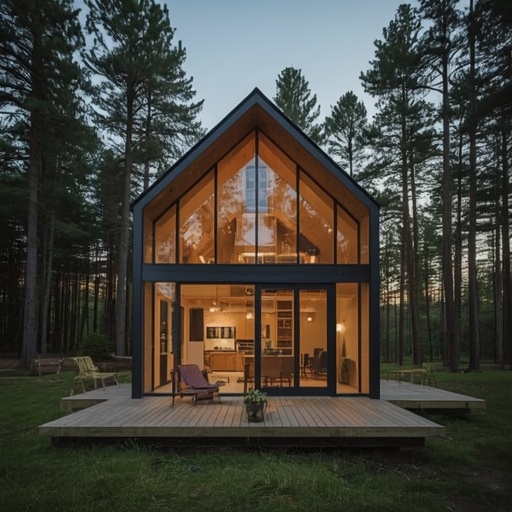
During my recent travels across Germany, I had the remarkable opportunity to immerse myself in the experience of living within an exceptionally compact yet ingeniously conceived dwelling: a two-story tiny home encompassing no more than one hundred square feet. Those two nights offered a vivid lesson in how design, when executed with thoughtfulness and precision, can transcend physical limitations and elevate even the smallest of spaces into something functional, livable, and inspiring.
Every element within this small residence revealed a deliberate sense of purpose. The staircase, for example, ingeniously doubled as a series of drawers and hidden storage compartments, transforming what might seem like wasted vertical space into a solution for organization. Multi-functional furniture pieces unfolded, collapsed, or tucked neatly away, allowing the same area to serve as a living room, dining space, and bedroom, depending on the hour or need. The layering of functions within such a narrow footprint demonstrated the sheer power of creative engineering and design foresight.
Despite its modest size, the home never felt cramped. The tall windows, strategically positioned to invite natural light throughout both floors, generated a sense of spaciousness and calm. The use of pale wood and clean, minimalist finishes created continuity between surfaces, making the interior feel unified and open rather than confined. This subtle interplay between form and light struck me as quintessentially German — disciplined, harmonious, and quietly efficient. Even outside the architectural considerations, the surrounding environment contributed immensely to the experience: the soft rustle of the countryside, distant church bells, and the tranquility of the forest merged to form a living environment that evoked both simplicity and serenity.
The most striking insight from those nights was not just the physical design itself but the shift in perception it inspired. In a world that often equates comfort with abundance and scale, the tiny home served as an elegant counterpoint, proving that a reduction in size does not equate to a reduction in quality of life. Instead, it invites introspection — forcing one to prioritize essentials, to recognize the value of space, and to embrace mindfulness in everyday living.
From a practical standpoint, the structure exemplified sustainability in both material and energy efficiency. Recycled wood, excellent insulation, and an intentionally small footprint reduced environmental impact while maintaining a cozy, modern aesthetic. The compact kitchen contained only what was necessary, yet never felt insufficient. The absence of excess technology or ornamentation emphasized a human-scaled intimacy often lost in larger, more impersonal dwellings.
Ultimately, what began as a curiosity – two brief nights in a 100-square-foot experiment in design – evolved into a profound reflection on the intersection between architecture, lifestyle, and personal values. The home challenged assumptions about what one truly needs to live comfortably and beautifully. It reminded me that elegance lies not in excess but in purpose, and that innovation often emerges from constraint. My stay reaffirmed that intelligence in design can make even the smallest space feel vast in possibility.
Would you, I wonder, dare to exchange the expansiveness of modern convenience for the refined restraint of tiny living, even if only for a weekend?
Sourse: https://www.businessinsider.com/slube-tiny-home-hotel-germany-photo-tour