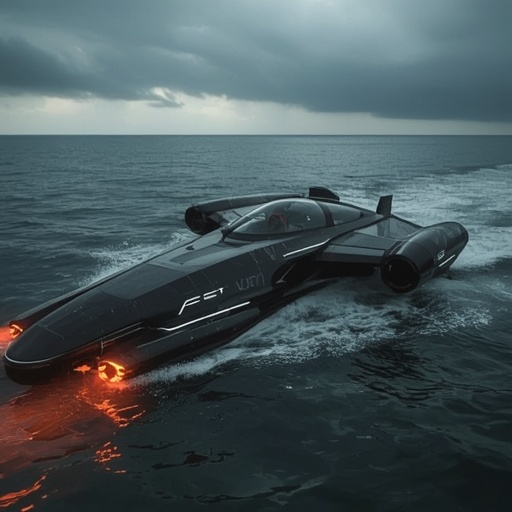
Saronic, a groundbreaking startup valued at an astonishing $9.3 billion, has recently demonstrated a remarkable advancement in the field of unmanned maritime technology. Its state-of-the-art Corsair drone-boat achieved what many would have considered a preview of the future—executing a successful rescue mission of two stranded aviators in the strategically significant Strait of Hormuz. This achievement is not merely a technological demonstration but an emblem of the growing potential of autonomous systems to perform humanitarian and safety-critical tasks that were, until now, the exclusive domain of manned operations.
The Corsair, Saronic’s flagship autonomous vessel, operated entirely without a human crew, navigating challenging maritime conditions with precision and purpose. It identified, approached, and assisted the distressed aviators with efficiency that rivaled, and in some respects surpassed, traditional rescue operations. The Strait of Hormuz, known for its dense maritime traffic and geopolitical importance, presents a complex setting where the success of such an autonomous rescue underscores both the reliability and resilience of Saronic’s platform.
This breakthrough comes as part of a broader evolution in oceanic technology, where artificial intelligence and robotics are revolutionizing the principles of safety, speed, and coordination at sea. The Corsair’s success provides a tangible example of how autonomous systems can extend human capability, especially in hazardous or time-sensitive environments. It also highlights how maritime industries—ranging from defense to commercial shipping—stand on the brink of transformation as machines begin to assume more critical operational roles traditionally dominated by human crews.
Beyond its technical merits, the rescue carries vast symbolic significance. It illustrates that innovation can transcend theoretical design and translate into life-saving action, affirming that the boundaries of technological progress are expanding rapidly. For investors, technologists, and maritime professionals alike, Saronic’s accomplishment signals a future where unmanned vessels serve not just as experimental novelties but as indispensable assets in global safety infrastructures.
In short, Saronic’s Corsair has proven that the next era of maritime rescue has already begun—one led by intelligent, self-directed systems capable of acting decisively in the most demanding conditions. The company’s success story captures both the spirit of innovation and the promise of a safer, smarter oceanic frontier driven by autonomous technology.
Sourse: https://www.wsj.com/tech/what-to-know-about-drone-boat-maker-behind-iran-helicopter-crew-rescue-aa55d445?mod=pls_whats_news_us_business_f