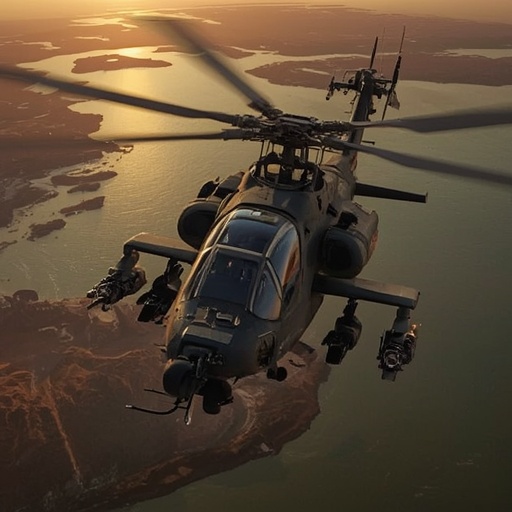
Near the strategically critical Strait of Hormuz, a U.S. AH-64 Apache attack helicopter recently went down—a striking reminder of both the capabilities and the dangers inherent to advanced military operations in one of the world’s most sensitive regions. The Apache, widely recognized as one of the most formidable combat helicopters ever engineered, stands as a masterpiece of modern military aviation.
The AH-64 was designed from its inception to dominate the battlefield through a combination of speed, resilience, and lethality. Its twin engines give it the power to maneuver in extreme environments—a crucial ability in desert climates or densely contested airspaces. Outfitted with advanced sensor arrays and night-vision systems, the Apache operates effectively in complete darkness or adverse weather conditions, providing allies with round-the-clock air superiority.
Its primary weaponry, which includes a 30mm chain gun mounted beneath the fuselage, guided Hellfire missiles, and powerful Hydra rockets, allows the aircraft to engage multiple targets simultaneously with surgical precision. Each armament system is meticulously integrated into the helicopter’s targeting suite, enabling pilots to identify, track, and neutralize threats within seconds. This makes the Apache not merely a defensive platform but a tool of strategic offense, capable of shifting the momentum of ground battles.
Beyond its weaponry, the AH-64’s armor and redundant flight systems grant it remarkable survivability. Its reinforced airframe and self-sealing fuel tanks were conceived to withstand direct hits while maintaining flight capability. This level of durability has made it indispensable not only to U.S. forces but also to many allied militaries around the globe.
The incident near the Strait of Hormuz draws renewed focus to the geopolitical significance of the region itself—a maritime corridor through which a major portion of the world’s oil supply transits daily. The presence of Apaches there underscores how seriously the United States regards the stability and security of these waters. Every deployment of such an asset reflects complex layers of strategic calculation, balancing deterrence, defense, and diplomacy.
The AH-64, though designed decades ago, continues to evolve. Modernized avionics, digital data integration, and improved engines ensure that it remains a match for emerging threats in twenty-first-century combat scenarios. Its reputation for precision and resilience is not merely the product of its engineering, but of its role across decades of global conflict—from Middle Eastern deserts to urban warfare theaters.
As investigations continue into the recent downing, the Apache’s enduring legacy endures unshaken. It remains a symbol of technological mastery and military preparedness—a potent blend of engineering sophistication and combat readiness that defines modern aerial warfare.
Sourse: https://www.businessinsider.com/apache-attack-helicopters-weapons-capabilities-photos