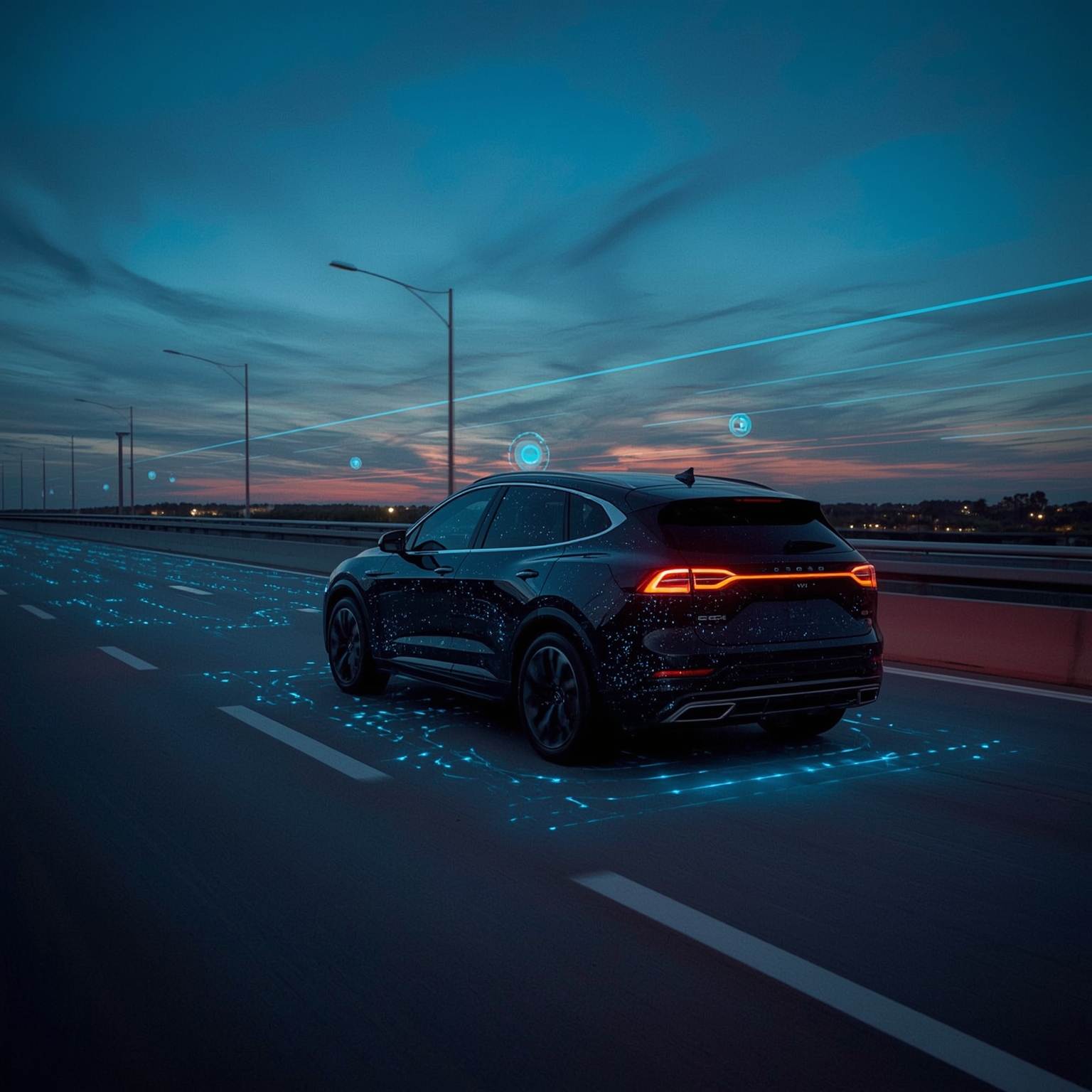
Rivian’s chief executive officer, RJ Scaringe, recently articulated a perspective that diverges considerably from Tesla’s stance regarding the use of LiDAR technology in the pursuit of fully autonomous driving. Speaking on The Verge’s “Decoder” podcast, Scaringe explained that Rivian views LiDAR not as a redundant or outdated component, but as a powerful and beneficial sensory tool capable of strengthening a vehicle’s understanding of its surrounding environment. He emphasized that Rivian’s broader philosophy toward sensor development centers on building its foundational model at the fastest possible pace, integrating as much relevant data as modern hardware can provide.
During his discussion with guest host and journalist Joanna Stern, Scaringe elaborated on the tangible advantages that LiDAR can bring to self-driving systems. He described it as offering a “real benefit,” noting that he remains open to including LiDAR as a key part of a vehicle’s multi-sensor configuration. Rather than viewing the technology as optional or obsolete, Scaringe suggested it could prove instrumental in achieving the reliable perception required for safe, scalable autonomy. He also recalled that much of the skepticism surrounding LiDAR began in earlier stages of the industry’s evolution, when emerging machine-learning models struggled to process simultaneous inputs from multiple sources—particularly when combining data streams from cameras, radar, and LiDAR sensors.
However, he noted that this limitation belongs largely to the past. “We no longer run the models like that,” he explained, referring to Rivian’s refined approach to model training. Modern systems, he added, now thrive on diverse data inputs rather than being hindered by them. In other words, the more sensory information available at the model’s front end, the better the resulting performance and contextual understanding. Furthermore, Scaringe highlighted a dramatic reduction in the cost of LiDAR units. Once priced in the tens of thousands of dollars, these sensors have become far more affordable in recent years—now costing only a few hundred dollars apiece. This combination of accessibility, precision, and unique capabilities makes LiDAR a highly effective complement to conventional cameras, particularly since it can perform certain functions that cameras alone cannot replicate. As Scaringe put it succinctly: it remains a remarkable sensor that adds valuable dimensional insight and robustness to perception systems.
When contacted for additional comment by Business Insider, representatives from Rivian did not immediately respond. Nevertheless, Scaringe’s viewpoint stands in marked contrast to that of Tesla’s CEO, Elon Musk, who has been famously dismissive of LiDAR for years. Musk has consistently argued that the technology introduces unnecessary complexity and even potential risk. In an August post on X (formerly Twitter), Musk claimed that using LiDAR and radar in combination with cameras produces what he called “sensor contention” or “sensor ambiguity.” According to his explanation, the overlapping signals and differing data interpretations from multiple sensors can confuse the vehicle’s model rather than clarify its surroundings. He suggested that this confusion leads to an increased risk of error, arguing that purely vision-based systems offer a cleaner, more scalable route toward autonomy—a philosophy underpinning Tesla’s camera-only “Autopilot” and “Full Self-Driving” programs.
Musk’s critique went further, as he referenced the limitations he perceives in competitors like Waymo, the autonomous-vehicle division of Alphabet, Google’s parent company. In that same post, Musk asserted that the presence of such multi-sensor platforms is one reason why Waymo’s robotaxis struggle with highway navigation. Waymo, however, continues to rely confidently on a blended sensor suite that includes LiDAR, radar, and high-resolution cameras, using data fusion to render precise three-dimensional maps of the vehicle’s environment. The clash between these philosophies—Tesla’s camera-only approach versus the multi-sensor methodology favored by companies like Rivian and Waymo—has become one of the most defining debates in the race toward autonomous transportation.
Tesla’s reliance on vision-based systems dates back several years. During its 2019 “Autonomy Day,” Elon Musk infamously characterized LiDAR as both “expensive” and “unnecessary,” claiming that once a company successfully solves computer vision—enabling cameras to interpret the world as effectively as the human eye—any additional sensor becomes redundant. He dismissed LiDAR’s automotive applicability in strong terms, suggesting that while it may serve certain niche purposes in industrial or mapping contexts, its use in cars is “foolish” and “wasteful.” In Musk’s view, perfecting vision is the only path consistent with scalability and long-term cost control.
Scaringe, however, is far from alone in challenging that assertion. Other industry leaders have echoed a similar willingness to integrate LiDAR into their perception stacks. For example, Ford’s CEO, Jim Farley, publicly championed the technology earlier this year during his remarks at the Aspen Ideas Festival. Farley described LiDAR as “mission critical” for achieving dependable autonomous driving, especially under challenging environmental circumstances. He illustrated this by contrasting LiDAR’s performance with that of cameras when driving through areas with intense or direct sunlight: in such conditions, camera sensors may become temporarily blinded and fail to register relevant visual details, whereas LiDAR continues to function effectively by measuring distances via laser-based reflections instead of relying on visible light.
Farley also underlined Ford’s cautious approach to innovation, noting that when a legacy brand with deep public trust embraces a new technology, it must do so responsibly and transparently. He emphasized that preserving this trust requires a commitment to safety, thorough testing, and careful integration rather than chasing technological novelty for its own sake. In this way, the ongoing discussion around LiDAR represents not merely a technical disagreement but a broader philosophical divide within the automotive industry—one that pits minimalist, vision-centric models against multi-sensor strategies rooted in redundancy, resilience, and safety.
Taken together, Scaringe’s remarks underscore Rivian’s intention to pursue a balanced, data-rich pathway toward autonomy. While acknowledging the historical challenges associated with integrating multiple sensing modalities, he highlighted that advances in machine learning and hardware efficiency have transformed those problems into new opportunities. With LiDAR now more affordable and adaptable than ever, Rivian’s openness to leveraging it marks a thoughtful and pragmatic stance—one that prioritizes accuracy, flexibility, and long-term capability over ideological rigidity. In an era when the automotive landscape is defined by competing visions of what “autonomous” truly means, Scaringe’s comments remind us that progress often lies at the intersection of innovation, humility, and technological diversity.
Sourse: https://www.businessinsider.com/rivian-ceo-tesla-cameras-self-driving-cars-need-lidar-2025-10