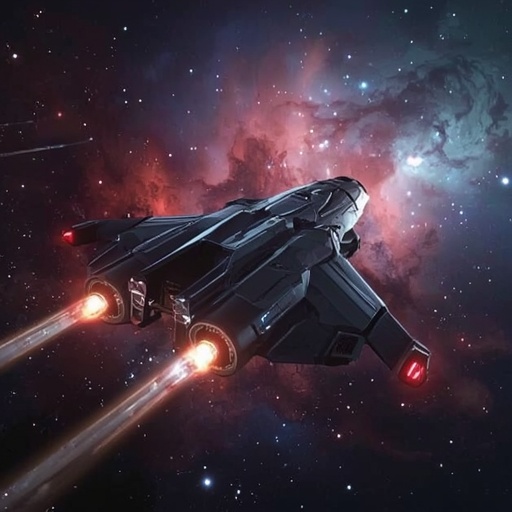
Humanity has long relied on rockets, chemical propellants, and ion thrusters to pierce the boundaries of our own planet’s atmosphere and venture outward into the cosmos. Yet beyond these comparatively primitive engines lies a frontier of propulsion technology so advanced that, if mastered, it could redefine the very notion of distance in space: antimatter propulsion. Unlike any conventional system, which depends on the expulsion of mass or ionized particles, antimatter engines are theorized to harness the immense energy released when matter encounters its mirror opposite — antimatter — resulting in total annihilation and an unparalleled conversion of mass into energy.
In essence, scientists are now daring to explore how this remarkable phenomenon might be tamed, contained, and made safe enough to power crafts capable of reaching neighboring star systems — journeys measured not by centuries but by decades. The idea remains largely conceptual, but serious scientific research is underway in the fields of plasma physics, quantum containment, and high-energy particle manipulation. For example, breakthroughs in magnetic confinement and cryogenic storage bring researchers incrementally closer to the possibility of stabilizing and controlling antimatter particles long enough to study their behaviors and energy potentials.
Antimatter propulsion, were it to become viable, would represent not just a technical innovation but a philosophical turning point for humanity. It challenges us to transcend physical limits imposed by classical propulsion and imagine a civilization no longer chained to its local star. Much like the transition from sail to steam revolutionized seafaring, so too could antimatter engines grant us interstellar mobility. However, the obstacles are formidable: generating antimatter requires extraordinary amounts of energy, storing it demands containment systems with flawless precision, and even a single microgram mishandled could unleash energy rivaling a nuclear blast.
Nevertheless, the ambition persists because the reward is so profound. With sustained advances in materials science, computational modeling, and quantum technology, the once-impossible dream of antimatter-driven exploration grows incrementally more plausible. This pursuit unites physicists, engineers, and visionaries in a shared endeavor to push the limits of what humanity can imagine — and, eventually, what it can achieve. If we succeed, the stars will no longer seem unreachable points of light, but destinations within the grasp of human ingenuity. In that moment, imagination will merge with reality, heralding the dawn of true galactic travel — the next epoch of exploration inspired by science, driven by curiosity, and powered by the most fundamental forces of the universe itself.
Sourse: https://gizmodo.com/nasa-chief-and-elon-musk-are-dreaming-of-antimatter-propulsion-2000775363