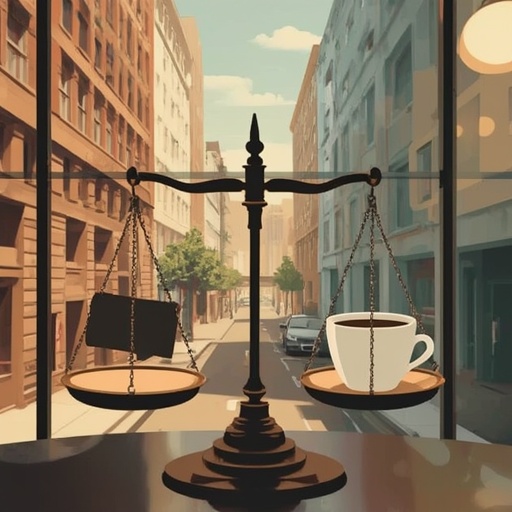
The United States Department of Justice has initiated an in‑depth civil rights investigation following reports that a well‑known New York City coffeehouse barred a sitting politician because of that individual’s publicly declared position on Israel. What began as an apparently local dispute over ideological alignment between a business and a customer has now expanded into a significant national conversation about constitutional freedoms, discrimination, and the boundaries of commercial decision‑making.
At the heart of the case lies a profound legal and ethical dilemma: to what extent may privately owned businesses allow their political or moral convictions to guide whom they serve, particularly when those decisions intersect with federally protected classes and civic participation? Supporters of the café’s action might argue that companies, much like individuals, possess freedom of expression and have the right to define their brand identity according to certain moral or political values. They may view corporate activism as a legitimate form of speech—a reflection of social consciousness that resonates with like‑minded patrons.
Critics, however, interpret the situation quite differently. From their perspective, denying a public official service because of political views risks crossing the line from expression into unlawful discrimination. They contend that when a business opens its doors to the general public, it assumes a duty to provide goods and services without bias, regardless of whether a customer’s ideological stance aligns with the owner’s. Such actions, they warn, could erode foundational principles of equal access and lead to a slippery slope in which political litmus tests become normalized within commercial spaces.
The Justice Department’s investigation underscores the gravity of these competing considerations. Federal investigators are expected to determine whether the café’s policy or behavior constitutes a violation of civil rights statutes that prohibit discrimination in public accommodations. Their findings may set an important precedent for how American law reconciles the tension between freedom of speech and the right to receive service free from ideological exclusion.
Beyond the courtroom, this episode invites deeper reflection on contemporary corporate culture. Over the past decade, many brands—from multinational corporations to local shops—have increasingly adopted overt social or political positions as part of their public identity. In doing so, they hope to connect with conscious consumers and demonstrate moral leadership. Yet this strategy can also expose companies to accusations of hypocrisy, polarization, or performative virtue signaling. The New York café case now symbolizes this broader debate about whether commercial spaces should remain neutral or act as arenas for moral expression.
For the public, the result of the investigation will likely influence not only future business practices but also the evolving relationship between citizenship and commerce. It challenges both business owners and consumers to consider how democratic values of tolerance and free exchange coexist in an era when politics permeates nearly every aspect of daily life. Whether the Justice Department ultimately concludes that the café’s decision constituted a legitimate act of conscience or an unlawful act of discrimination, the case will undoubtedly prompt renewed dialogue about fairness, inclusivity, and the practical meaning of free speech in the marketplace of modern America.
Sourse: https://www.businessinsider.com/doj-investigates-coffee-shop-ban-dan-goldman-over-israel-support-2026-6