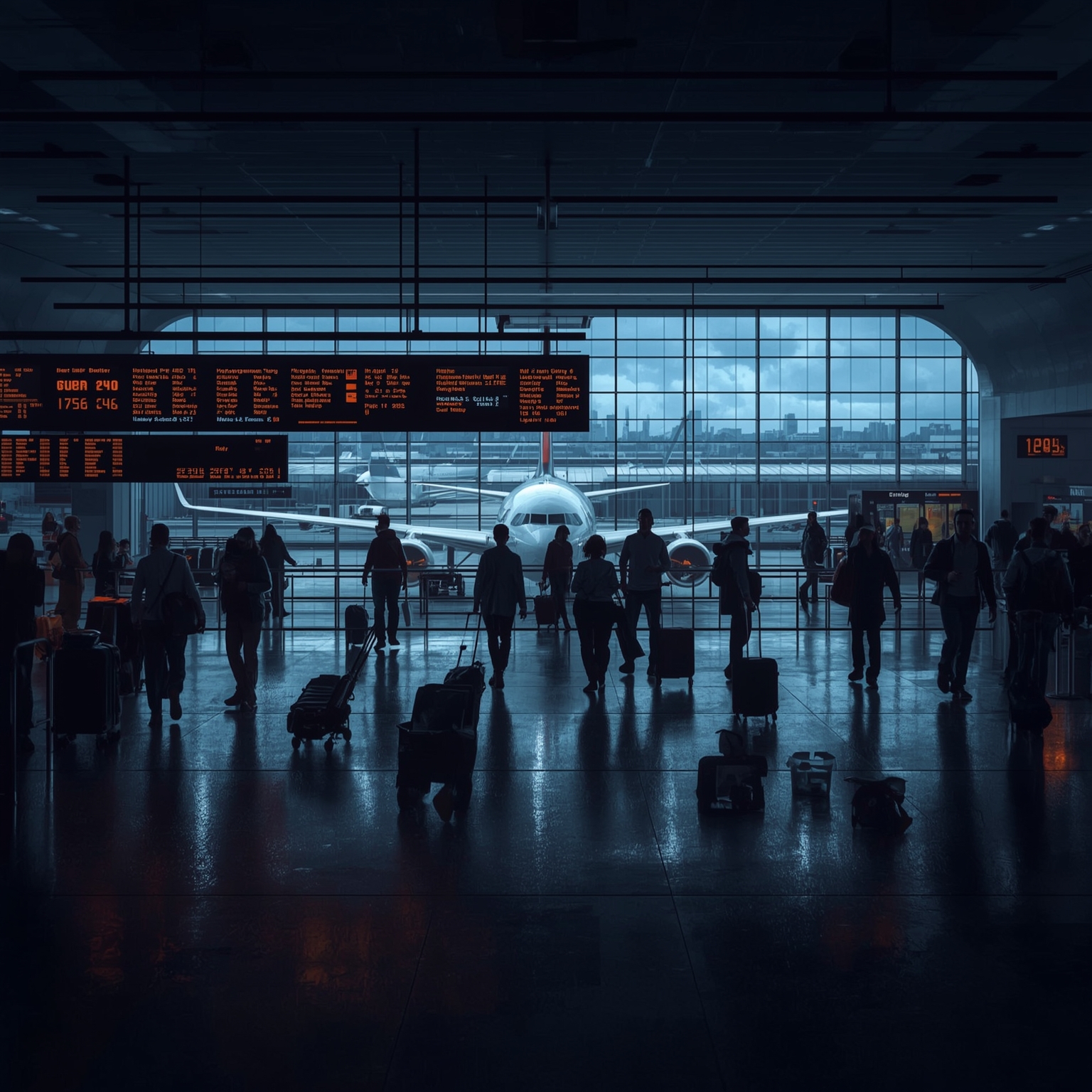
As of October 7, 2025, widespread travel disruptions have begun to ripple across the United States, illustrating the profound effect of operational shortages within the aviation industry. Delays are proliferating at airports nationwide, caused primarily by an escalating deficit of air traffic controllers—a situation directly associated with the ongoing government shutdown, which continues to reverberate through essential public services. Major aviation hubs that serve as critical nodes in the nation’s transportation network—among them Nashville International Airport, Chicago O’Hare International Airport, and Dallas–Fort Worth International Airport—are reporting especially severe interruptions, with travelers confronting substantial wait times before departures and arrivals can resume their regular pace.
For many passengers stranded in terminals on Tuesday evening, the frustration of waiting for several hours amid uncertainty has become all too familiar. The shortage of qualified air traffic controllers, responsible for managing the intricate choreography of aircraft in the nation’s skies, has deepened noticeably, creating a bottleneck that slows nearly every stage of the flight process. Many of these professionals are continuing to report for duty despite not receiving their salaries as the shutdown endures. According to official timetables, a significant number of controllers will likely miss their first paycheck by the coming Tuesday, compounding financial strain and eroding morale within a workforce already stretched thin.
Federal Aviation Administration (FAA) data confirm the gravity of these staffing deficiencies, showing measurable slowdowns at major airports such as Nashville and Dallas–Fort Worth. By 5:30 p.m. Eastern Time on Tuesday, arriving flights into Nashville were experiencing average delays of roughly two hours—reportedly about 126 minutes—underscoring how quickly operational disruption expands when staffing levels fail to meet critical thresholds. This marks the second consecutive day that the shortage has reverberated throughout the aviation system, a clear indication that the problem is evolving from a temporary inconvenience into a persistent national issue.
The previous day, Monday, saw more localized disturbances, particularly affecting Hollywood Burbank Airport in Los Angeles County, where flights were delayed but the scope of the disruption remained relatively confined. However, aviation analysts and federal officials alike warn that the situation is likely to deteriorate further if the government remains shut down. Historical precedent strengthens this expectation: during the 35‑day government closure of 2019—the longest in U.S. history—many air traffic controllers, forced to continue working without compensation, resorted to calling in sick, amplifying the delays and posing risks to the reliability of the entire aviation network. The current conditions appear to be following a strikingly similar trajectory as the shutdown drags on.
When reached for comment, a representative of the Federal Aviation Administration stated that routine media inquiries cannot be answered at present owing to the ongoing lapse in federal funding. Instead, the agency directed travelers, journalists, and industry stakeholders to its online platform at www.fly.faa.gov, where real‑time information regarding airport staffing levels, weather‑related conditions, and delay statistics for all U.S. airports is continuously updated. Meanwhile, the National Air Traffic Controllers Association—the union representing the professionals at the center of this crisis—has not yet issued an official statement in response to requests for comment.
In essence, the expanding network of flight delays encapsulates the broader implications of a government in partial paralysis: as essential public employees go unpaid, the systems they manage begin to falter, and everyday travelers become the visible victims of an invisible administrative gridlock. If funding is not promptly restored, the mounting delays may soon shift from being an inconvenience for passengers to representing a nationwide disruption to commerce, logistics, and confidence in the stability of U.S. air travel.
Sourse: https://www.businessinsider.com/flight-delays-are-spreading-as-government-shutdown-prolongs-2025-10