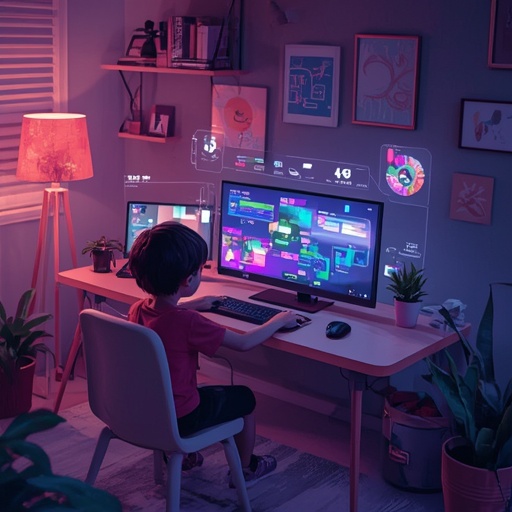
In a world increasingly shaped by artificial intelligence, a remarkable story of youthful ingenuity demonstrates how technology can become a canvas for creativity rather than a cause for concern. An 11-year-old child recently designed his very own video game using AI-based tools, merging youthful curiosity with advanced digital capabilities. This achievement exemplifies how AI can serve not as a replacement for imagination but as an expansive medium through which creativity can flourish beyond traditional boundaries.
What stands out even more is the perspective of his mother, who views her son’s foray into AI-assisted creation not as a risk or a symptom of excessive screen time, but as a profound educational opportunity. She recognizes, as many forward-thinking parents and educators increasingly do, that these new tools allow children to translate their abstract ideas into tangible, interactive experiences. Instead of discouraging experimentation, she encourages it, seeing technology as a partner in nurturing creative confidence and problem-solving skills.
This individual example serves as a microcosm of a broader transformation occurring in modern learning environments. The integration of AI into education and play is crafting an entirely new paradigm — one in which children can become active creators rather than passive consumers of technology. Through platforms that enable digital art, game design, storytelling, or coding, AI provides the scaffolding that allows imaginative concepts to come vividly to life, democratizing creative production in unprecedented ways.
The story invites us to rethink what it means to raise and teach future generations. Are we prepared to cultivate a mindset that treats AI not merely as a convenience or analytical tool, but as a collaborator in the exploration of art, science, and human expression? When a child can transform a spark of an idea into a fully formed digital world, guided by the invisible intelligence of algorithms yet powered by human imagination, the boundaries between learning and creation begin to dissolve.
Ultimately, this 11-year-old’s project stands as a joyful reminder that technology’s true potential lies not in automating tasks but in amplifying human creativity. What once seemed the realm of professionals with years of training is now accessible to a child driven by curiosity, illustrating that the digital frontier can become an inclusive playground for exploration, empathy, and innovation. By embracing AI in this spirit, we ensure that the next generation views technology not with fear but with excitement — as a limitless toolkit for building the future they can both envision and create.
Sourse: https://www.businessinsider.com/11-year-old-built-his-own-video-game-with-ai-2026-7