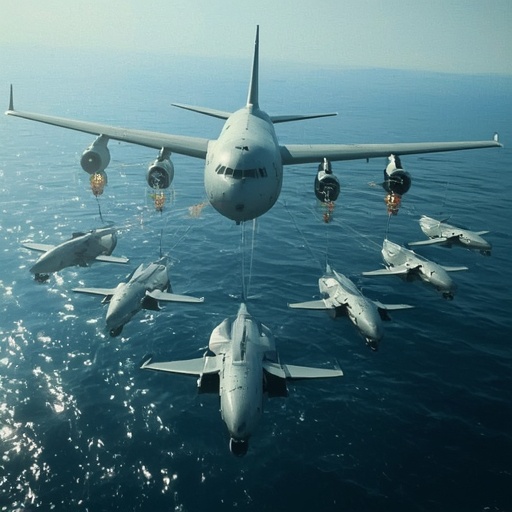
In a remarkable display of technological ingenuity and forward-thinking strategy, the Royal Navy has embarked on an extraordinary experiment that merges the realms of aviation and maritime innovation. By releasing massive 27‑foot autonomous K3 Scout sea drones from a height of approximately 1,300 feet using an Airbus A400 transport aircraft, the Navy has effectively demonstrated a new, more agile way of deploying unmanned systems at sea. This operation not only showcases the Royal Navy’s growing commitment to the advancement of automation and robotics but also signifies a pivotal evolution in how naval forces might conduct remote or rapid-response missions in the near future.
Traditionally, launching seagoing drones has required specialized vessels or on-site deployment platforms, often limiting flexibility and slowing reaction times in dynamic operational environments. The introduction of parachute-deployable sea drones addresses that challenge decisively. By taking advantage of aerial release, the Navy can now transport these autonomous craft over vast distances and place them directly into diverse maritime zones—from expansive open waters to more constrained or contested areas—almost instantaneously. This breakthrough capability could allow unmanned vessels to be inserted into critical missions within minutes, whether those missions involve reconnaissance, environmental monitoring, humanitarian support, or even battlefield surveillance.
This strategic leap builds upon years of research and testing in both unmanned aerial and maritime systems, uniting disciplines that were previously separated by logistical and technical barriers. The K3 Scout itself represents an advanced engineering solution: a robust, 27‑foot vessel designed to operate independently or in coordinated swarms, equipped to handle challenging sea conditions and communicate seamlessly with command networks. Dropping such units from an aircraft at altitude and having them transition smoothly from air to water demonstrates not merely mechanical resilience but also sophisticated systems integration, from stabilizing parachutes to automated sea‑entry procedures.
The image of a powerful A400M gliding high above the ocean and releasing these autonomous vessels encapsulates the spirit of a modern navy intent on adaptability and superiority through innovation. It signals how future operations might blend air, sea, and digital domains into a fluid and interdependent ecosystem of machines capable of extending human reach far beyond conventional means.
Ultimately, this feat reflects more than a technical demonstration—it is a defining statement about the Royal Navy’s vision for future warfare and maritime security. Leveraging unmanned systems that can be deployed from the sky enables unparalleled responsiveness and strategic versatility. The success of this experiment underlines the United Kingdom’s ongoing investment in defense technology and its determination to remain at the forefront of global naval capability. As defense organizations worldwide look to modernize, this initiative highlights how innovation, when combined with daring experimentation, can truly reshape the boundaries of what is possible on—and above—the world’s oceans.
Sourse: https://www.businessinsider.com/royal-navy-uk-uncrewed-surface-vessel-airdrop-solve-problem-kraken-2026-7