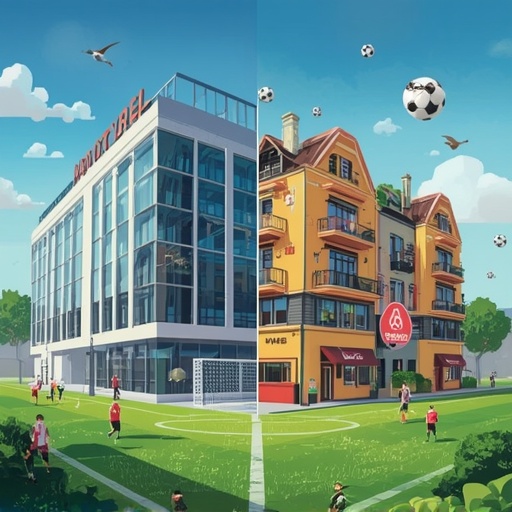
Across the globe, the World Cup has become not only a celebration of sport but also a fascinating experiment in shifting economic and cultural behaviors—particularly within the travel and hospitality sectors. During these high-profile international events, traditional hotels that once dominated the accommodation landscape are finding it increasingly difficult to compete with the modern allure of platforms like Airbnb. Travelers from every corner of the world, seeking greater flexibility, affordability, and a more immersive sense of local authenticity, are increasingly turning away from the conventional uniformity of hotel rooms. Instead, they are choosing private apartments, unique homes, and even creatively themed lodgings that allow them to step directly into the rhythm of the host city’s daily life.
This transformation reflects a profound evolution in traveler psychology. The modern guest no longer measures value solely by thread count or concierge service, but by how intimately a stay connects them to the culture, people, and neighborhoods around them. Airbnb has expertly leveraged this shift, positioning itself as more than just a lodging platform—rather, as a conduit for meaningful experiences shaped by community and individuality. This new ethos contrasts sharply with the standardized predictability that hotels offer, which, while reliable, often lacks the personal nuance today’s travelers crave.
Furthermore, during global phenomena such as the World Cup, demand for accommodation skyrockets, leaving hotels struggling to meet both volume and expectation. Their rigid infrastructure, limited inventory, and standardized operating models often restrict their ability to adapt swiftly to surges in demand or shifting guest preferences. Airbnb, on the other hand, with its decentralized supply chain of individual hosts, can dynamically expand to meet demand—from single spare rooms to entire villas—creating a vast and customizable marketplace of temporary homes. For travelers, this translates into both increased choice and wider access to price points that suit a broader range of budgets.
Economic pragmatism is only one side of the story. Cultural curiosity plays an equally significant role. A visitor staying in a family’s apartment near the stadium may experience the sounds, flavors, and daily interactions of local life—something that no luxury suite, however high-end, can fully replicate. This appeal to experience-driven travel has fundamentally rewritten the priorities of modern tourism. The worldwide success of Airbnb during events like the World Cup is thus not a mere fluke of convenience, but a manifestation of a cultural reorientation toward authenticity and personal connection.
For the hotel industry, the challenge is no longer about simply providing beds at scale, but about redefining relevance in a world that increasingly prizes individuality over uniformity. Many hospitality innovators are now experimenting with hybrid models—borrowing design cues, community integration, and flexible booking systems inspired by the sharing economy. Others are embracing sustainable practices or curating social experiences to rekindle emotional resonance with guests who might otherwise look elsewhere.
Ultimately, this evolving competitive landscape is less a tale of defeat and more one of transformation. The rivalry between hotels and Airbnb during major global spectacles such as the World Cup highlights a broader truth: the concept of hospitality itself is being reimagined. In this new era, success may no longer hinge on grandeur or star ratings, but on how deeply an accommodation choice can make travelers feel part of the world they’ve come to explore. The question that remains for traditional hotels is whether they can adapt swiftly enough to remain players in this new global game—or whether Airbnb’s model of flexibility, locality, and emotional engagement will continue to capture the hearts and itineraries of the modern traveler.
Sourse: https://gizmodo.com/hotels-are-losing-their-world-cup-matchup-against-bitter-rival-airbnb-2000784463