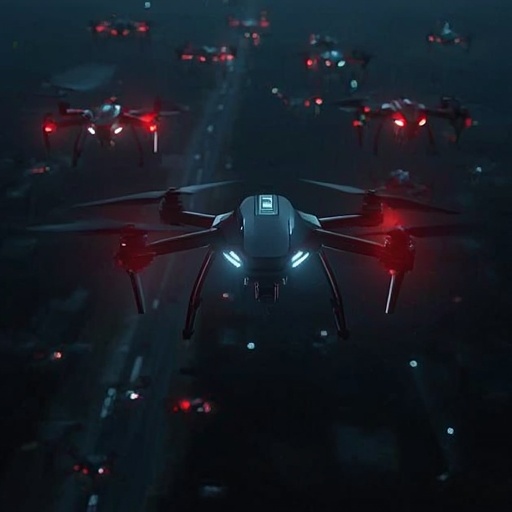
According to emerging analyses and preliminary intelligence summaries, multiple reports suggest that Ukraine has potentially employed a remarkable combination of unconventional transport mechanisms — balloons, ground-based trailers, and aerial drones — as part of an intricate operation to deliver AI-enhanced quadcopters far into Russian territory. This development, if corroborated, represents not merely a tactical innovation but rather a profound evolution in the methodology of technologically augmented warfare, where creativity in delivery intersects with the precision and autonomy made possible by artificial intelligence.
Observers have drawn comparisons between this alleged initiative and the earlier military campaign often referred to as Operation Spiderweb, during which a coordinated network of drones was utilized to target critical airbases and logistical centers. Such parallels invite speculation that Ukraine’s strategic blueprint continues to blend ingenuity, adaptability, and layered automation in pursuit of tactical advantage. The blending of analog conveyance tools, such as weather balloons and rolling transports, with cutting-edge AI drone systems epitomizes the asymmetrical nature of modern combat — a framework wherein improvisation can achieve strategic depth typically associated with heavily resourced militaries.
More broadly, this incident underscores how emerging technologies, especially those driven by artificial intelligence, have transcended the purely experimental phase to become practical instruments of national defense. Where once unmanned aerial vehicles served reconnaissance roles with limited autonomy, they now function as semi-independent agents capable of navigating dynamic airspace environments, identifying objectives, and responding to evolving battlefield variables. The implications of such developments are vast: they suggest a future in which technological creativity becomes as decisive as physical firepower, and where strategic victories may hinge on digital code as much as on conventional weaponry.
By innovatively employing nontraditional means of deployment, Ukraine appears to highlight not only its resourcefulness but also the shifting paradigm of global defense strategy. The intersection of AI, robotics, and logistics is redefining the operational theater, turning even mundane objects — a balloon, a truck, a commercial drone — into potential instruments of profound geostrategic influence. Whether this reported event is ultimately confirmed or remains within the realm of speculation, its symbolic power is undeniable: it signals that the fusion of artificial intelligence with tactical imagination is rapidly redrawing the boundaries of contemporary warfare and setting the stage for a new era in defense innovation.
Sourse: https://www.businessinsider.com/fsb-ukraine-balloons-trailers-drones-attack-quadcopters-airfields-russia-2026-7