In the wake of a severe gridlock incident caused by autonomous taxis, the city of San Francisco finds itself at the center of a renewed debate over the governance of rapidly expanding self-driving technology. Mayor Daniel Lurie has voiced an unequivocal call for state regulators to impose more stringent oversight on robotaxi firms—most notably targeting companies such as Waymo—which have become emblematic of both innovation and disruption in the realm of urban mobility.
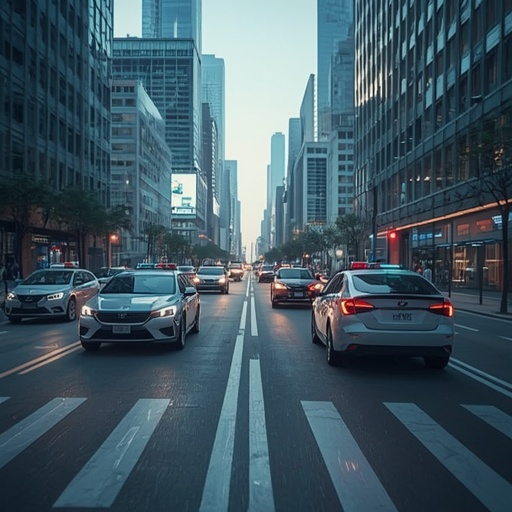
The mayor’s appeal arrives after a chaotic episode in which a cluster of driverless vehicles effectively paralyzed portions of San Francisco’s downtown core, transforming ordinarily fluid intersections into scenes of bewildering standstill. For many residents, the episode served as a vivid reminder of the challenges that accompany the adoption of cutting-edge automation on public roads. What was initially envisioned as a seamless integration of artificial intelligence into daily commutes instead exposed the limitations of current regulatory frameworks and the vulnerabilities inherent in the technology when unanticipated real-world circumstances arise.
Mayor Lurie’s stance underscores an increasingly urgent question confronting every metropolitan authority in the digital age: how can governments foster technological progress and private-sector ingenuity while maintaining a steadfast commitment to public safety and civic order? He insists that innovation should not advance at the expense of accountability, emphasizing that policies must evolve in tandem with technological capabilities. Achieving equilibrium between these competing imperatives requires nuanced legislation, transparent operational standards, and mechanisms for immediate intervention when systems fail or behave unpredictably.
The incident also spotlights a larger transformation taking shape across global cities—one in which human oversight and machine autonomy must coexist within shared infrastructure. The promise of driverless taxis once symbolized the future of sustainable, efficient transport: fewer accidents, reduced congestion, and optimized routes through algorithmic precision. Yet, San Francisco’s recent turmoil invites reflection on the societal costs of that promise realized too hastily. The spectacle of stalled robotaxis, inert amid waves of honking traffic, has become an emblem not only of technical malfunction but also of the gap between theoretical innovation and the messy unpredictability of urban life.
For citizens observing these developments, the question is no longer whether autonomous vehicles will define the future of mobility—they almost certainly will—but rather how human institutions will rise to the challenge of governing them. Mayor Lurie’s initiative signals a pivotal moment in that evolution, suggesting that the city’s leadership aims to redefine the parameters of responsibility in an era where algorithms, sensors, and decision-making code share dominance with municipal law. Policymakers now face the delicate task of designing governance that both enables technological ambition and instills public trust through clear, enforceable accountability.
As San Francisco, a longstanding symbol of technological ambition, contemplates its next steps, the entire debate over robotaxi regulation reverberates far beyond its fog-covered hills. The choices made here could influence how other cities—New York, Tokyo, London, and beyond—navigate the complex intersection of innovation, safety, and social equity in the coming decade. The mayor’s call for stricter oversight may therefore not simply address an isolated traffic event; it may mark the beginning of a broader, more disciplined chapter in humanity’s ongoing experiment with autonomous urban mobility, one where progress and precaution finally learn to move in thoughtful synchrony.
Sourse: https://techcrunch.com/2026/07/16/san-francisco-mayor-pushes-for-tougher-rules-after-the-waymo-traffic-fiasco/