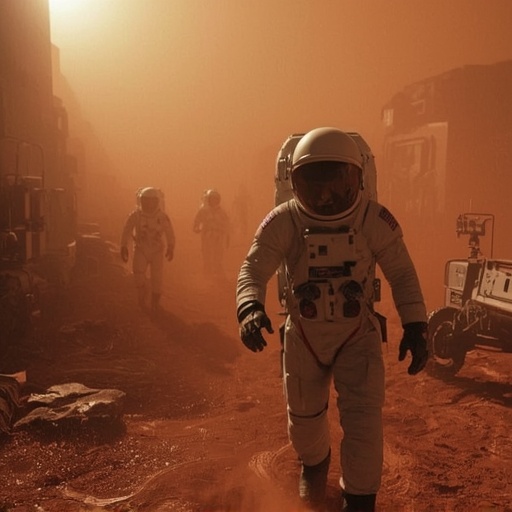
Humanity’s enduring fascination with Mars often conjures images of gleaming colonies, self-sustaining biodomes, and explorers boldly venturing across crimson valleys. Yet, beneath this compelling vision of progress lies an understated but formidable adversary—Martian dust. Far from the harmless powder that covers a desert dune, the pervasive red dust of Mars is ultrafine, chemically reactive, and remarkably invasive. A growing number of physicists and planetary scientists, including astrophysicist Adam Becker, are sounding the alarm: this element could represent the most significant barrier to sustainable colonization efforts on the Red Planet.
Unlike anything found in terrestrial environments, Martian dust consists of minute, sharp-edged particles infused with toxic compounds such as perchlorates and iron oxides. These microscopic grains are easily suspended in the planet’s thin atmosphere, remaining airborne for prolonged periods and infiltrating virtually every opening—whether in machinery, protective suits, or human habitats. The potential consequences are both technological and biological. For humans, inhaling or prolonged exposure to the dust could lead to severe respiratory complications or cellular damage, given its abrasive, chemically aggressive nature. For sensitive electronics and mechanical systems, the penetrating dust could degrade seals, jam instruments, and corrode vital components essential for survival.
What makes this challenge particularly insidious is its inevitability. Mars, with its dry terrain and unpredictable dust storms capable of engulfing the entire planet, offers no respite. Even the most advanced filtration and design systems humanity can conceive will have to contend with an environment where fine dust behaves almost like an atmospheric constant, threatening to obscure solar panels, damage equipment, and compromise human safety on a daily basis. Becker’s warning thus reframes the dream of Martian colonization—not as a simple feat of transport or engineering, but as a prolonged ecological confrontation with a foreign planet’s hostile microenvironment.
In essence, the dust problem underscores an important philosophical and practical truth: venturing beyond Earth does not free humanity from the realities of nature—it merely exchanges familiar challenges for unprecedented ones. Before we can truly call Mars a second home, science must find a way to negotiate with its most omnipresent element. The Red Planet’s fine, toxic veil is more than a material obstacle; it is a test of whether human innovation can withstand and adapt to an alien world’s relentless conditions without succumbing to them. Humanity’s journey to Mars, it seems, will hinge not only on ambition and technology, but on mastering something as deceptively simple—and profoundly treacherous—as dust.
Sourse: https://www.businessinsider.com/dust-could-sink-mars-ambitions-2026-7