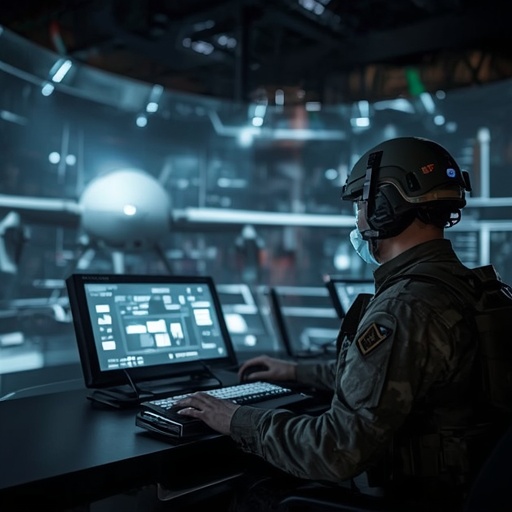
In today’s rapidly evolving technological landscape, a striking transformation is unfolding within the field of military aviation. United States soldiers are now being systematically trained to operate drones—sophisticated flying machines that they cannot physically touch or feel in the traditional sense. This profound shift in pilot training represents not merely the acquisition of a new skill but the complete reconfiguration of perception, cognition, and instinct. Traditionally, a pilot’s expertise relied on a visceral connection with their aircraft—the subtle vibrations through the controls, the resistance in the air, and the bodily sensations that informed every maneuver. In drone operations, however, that sensory feedback is conspicuously absent. Instead, soldiers must navigate complex aircraft remotely, depending entirely upon visual input from high-definition screens and an ever-growing intuition shaped by digital information rather than tactile experience.
This transition necessitates a deep rewiring of the human brain. Pilots must cultivate a heightened situational awareness and an intrinsic ability to interpret data streams as extensions of sensory input. Training programs are therefore designed not only to teach technical control of unmanned systems but to foster cognitive adaptation—the mental elasticity required to “feel” the aircraft through artificial cues. Over time, instinctive reactions that once stemmed from physical sensation are replaced by finely tuned mental calculations, pattern recognition, and predictive response. For example, a drone operator might learn to perceive subtle changes in environmental data, such as variations in wind direction or altitude readings, as emotional or physical signals, compensating for the loss of traditional sensory contact.
This new mode of flight also reshapes the relationship between human and machine. The boundary between the operator and the technology becomes simultaneously more distant and more intimate: distant, because the pilot is separated from the aircraft by vast physical space; intimate, because mastery requires complete mental synchrony with a digital interface. Thus, a unique form of human-machine symbiosis emerges—one founded on trust in technology, rapid adaptability, and refined concentration. It invites reflection on how future aviators may experience flight as an exercise not of bodily coordination but of cognitive extension and neural adaptation.
Ultimately, the American military’s drone training initiatives mark the dawn of an entirely new frontier in aviation. They illuminate a future where flight is no longer constrained by the limits of human physiology but empowered by the fusion of human intuition and technological precision. These soldiers are not only learning to control machines; they are pioneering a redefinition of what it means to fly—an evolution from physical sensation to intellectual and instinctive harmony with the digital realm. ✈️🤖 #DroneTraining #Innovation #FutureAviation
Sourse: https://www.businessinsider.com/us-army-soldiers-training-brains-fly-drones-different-to-aircraft-2026-7