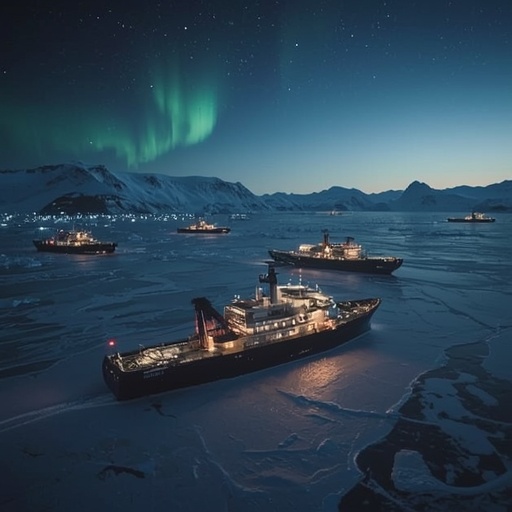
Recent high-resolution satellite imagery has unveiled a striking and accelerating transformation within the Arctic region—a place long defined by its remoteness, fragility, and icy expanse, but increasingly recognized as a crucible of geopolitical rivalry. In these images, Russia’s northern frontier unfolds as a landscape of expansion: newly constructed military installations, rejuvenated ports, extended shipping corridors, and an impressive fleet of modernized nuclear icebreakers. Together, these developments signal a deliberate and large-scale effort to consolidate strategic control over the frozen territories that flank the polar seas.
Meanwhile, across the ocean, the United States faces the urgent challenge of reasserting its own presence in the High North. Long focused on other regions, Washington now finds itself in a delicate position—racing to restore logistical capacity, renew neglected Arctic infrastructure, and strengthen partnerships with allies such as Canada, Norway, and other Nordic nations. The interplay between these two powers, each maneuvering for position in this once-isolated expanse, reflects far more than a contest over floating ice. It underscores a high-stakes struggle for influence, national security, and technological advantage in one of the planet’s last great frontiers.
Beneath the scientific and environmental veneer of Arctic exploration lies a complex calculus of power. Melting ice caps are not merely a symbol of climate change; they are altering the geography of global commerce and resource extraction. Newly accessible maritime routes—like the Northern Sea Route hugging Russia’s Siberian coast—offer immense economic promise, potentially shortening shipping times between Europe and Asia, while also generating opportunities for resource exploitation ranging from natural gas and minerals to critical rare earth elements. As a consequence, control of Arctic waterways has become intricately tied to questions of sovereignty, defense, and global market stability.
In this unfolding narrative, the Arctic functions as both a mirror and a magnifier of 21st-century geopolitics. Environmental transformation collides with strategic ambition, and the pristine wilderness becomes a stage for international competition. For Russia, supremacy in the Arctic is part of a broader assertion of its regional dominance, reflecting decades of investment in polar engineering and navigation expertise. For the United States and its allies, the imperative is not only to respond but also to redefine their strategic posture—ensuring that their interests, environmental commitments, and security frameworks remain resilient in an increasingly contested north.
Ultimately, the race for the Arctic is not simply a story about who can build the most icebreakers or deploy the most advanced satellites. It is about shaping the future balance of global power, determining how nations adapt to climate-driven realities, and deciding whether cooperation or competition will define humanity’s relationship with this rapidly changing edge of the world.
Sourse: https://www.businessinsider.com/satellite-images-how-russia-winning-race-arctic-united-states-behind-2026-7