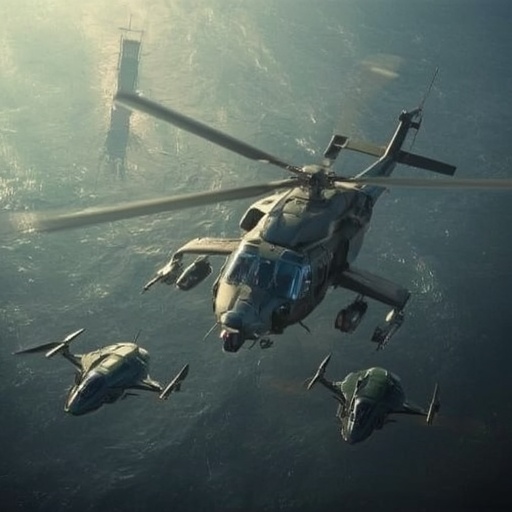
In a remarkable fusion of technological innovation and advanced tactical strategy, the United States Marine Corps has conducted a pioneering operation that demonstrates a dramatic shift in modern reconnaissance methods. In this exercise, FPV (first-person view) drones were launched from a helicopter in active motion, seamlessly integrating unmanned aerial systems with live special operations. This intricate maneuver was not merely an engineering experiment but a practical demonstration of how precision robotics and human expertise can intersect on the battlefield to reshape the tempo and accuracy of information gathering.
The ability to deploy lightweight, agile FPV drones from an aircraft in flight grants operational units an entirely new dimension of situational awareness. Traditionally, such reconnaissance relied on slower or more predictable means of observation, often constrained by distance, visibility, or timing. However, in this test scenario, the drones, guided remotely by expert operators, were launched to inspect and analyze a target ship intended for a special operations boarding mission. This operation allowed Marine Corps units to receive a live, detailed visual feed in real time, providing decision-makers and tactical teams with unmatched insights before engagement.
By executing launches from a moving helicopter, the Marines have effectively created a mobile reconnaissance platform — one that transforms both the speed and flexibility of intelligence-gathering in maritime and amphibious environments. It represents a harmony between robotics engineering, communications technology, and military precision that was previously difficult to achieve. The success of this mission underlines not only the expanding role of drones in modern warfare but also the growing emphasis on autonomy, rapid adaptability, and coordinated multi-domain operations.
Each advancement in this arena points toward a future where responsive, data-driven decision-making becomes central to mission execution. As unmanned systems evolve in design and capability, they are no longer supplementary tools but integral assets in real-time strategy, capable of operating in highly dynamic and unpredictable scenarios. The Marines’ demonstration vividly highlights how innovation continues to redefine the boundaries of reconnaissance, offering a glimpse into an era where human expertise and machine intelligence operate in perfect synchronization, ensuring safety, precision, and efficiency in the most challenging operational theaters.
Sourse: https://www.businessinsider.com/marines-launched-drones-from-a-helicopter-scouting-ships-in-training-2026-7