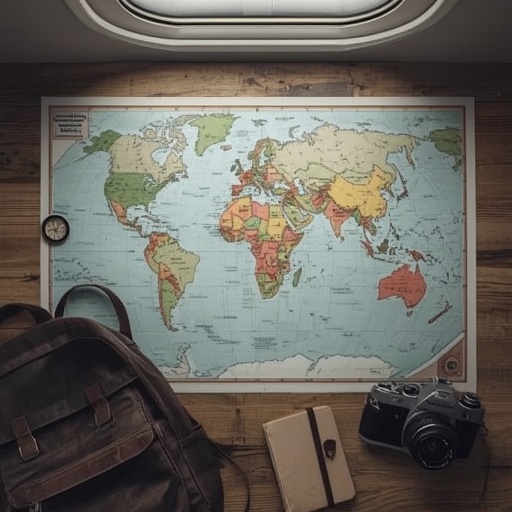
Embarking on a journey through thirty-eight different countries, entirely on my own, transformed into an education far richer than any travel guide could offer. Solo travel is a teacher that demands humility, adaptability, and self-awareness in every moment. Each destination invited me to examine not only the world’s breathtaking diversity but also the boundaries of my own comfort zone. In every wrong turn, missed connection, and overpacked itinerary, I found lessons that reshaped the way I approach both travel and life itself.
One of the earliest and most consistent errors I made was overplanning—trying to orchestrate every hour of my journey out of fear of wasting time or missing something important. Yet the irony was clear: in overengineering my adventures, I left little room for spontaneity, the very essence of travel. In countries as different as Morocco, Japan, and Iceland, I discovered that sometimes the best experiences don’t exist on an itinerary at all. A detour might lead to a hidden café, a local festival, or an unexpected friendship that can redefine how one perceives a culture. Over time, I learned to trust flexibility, to replace strict scheduling with intuitive exploration.
Another significant lesson came from neglecting simple safety measures—errors like walking home alone late at night or assuming every environment was automatically secure. These moments, though unnerving, revealed the delicate balance between courage and caution. Solo travelers, especially women, often learn that independence must be paired with mindfulness. Investing time in understanding local customs, trusted transport routes, and emergency contacts builds not just safety, but confidence. Preparedness, rather than fear, becomes the cornerstone of freedom.
I also discovered the importance of embracing imperfection. Early in my travels, I felt defined by my mistakes—missed buses, lost luggage, broken language exchanges. But as the miles stretched on, I came to see that each error was part of a broader education. Failure fostered resilience and sharpened my intuition. It taught me to adapt quickly, to communicate creatively when words failed, and to take ownership of my journey rather than blame circumstance.
Moreover, constant motion demanded introspection. Travel, I learned, is not always romantic; it can also be lonely and disorienting. Yet solitude, when embraced intentionally, provides rare clarity. Sitting quietly in train stations or watching unfamiliar skylines at dusk, I confronted parts of myself that routine life kept hidden. Traveling alone becomes an ongoing dialogue with one’s inner landscape as much as with the external world.
Ultimately, the most profound takeaway from these thirty-eight countries is the realization that mindfulness—not perfection—is the true measure of a good traveler. Attention to surroundings, respect for culture, and an openness to unplanned moments create the richest memories. Every mistake is not a setback but an initiation into wiser, more grounded travel.
For anyone considering setting out alone, my advice is this: prepare thoroughly, but hold your plans lightly. Let awareness guide each decision, and trust that the lessons gained from missteps will serve you long after your passport is tucked away. Solo travel is more than movement across maps—it is a deliberate act of growth, a deepening conversation between the self and the ever-unfolding world around it.
Sourse: https://www.businessinsider.com/travel-mistakes-lessons-learned-frequent-solo-traveler-2026-7