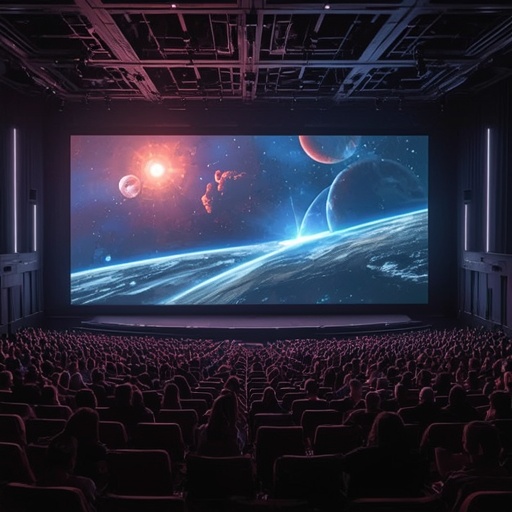
Christopher Nolan’s *The Odyssey* has achieved what few films in recent memory have managed—it has transformed even the most skeptical viewers into devoted champions of the IMAX experience. From the moment the lights dim and the colossal screen ignites with imagery that seems to envelop the audience, the film declares itself a symphony of visual power and emotional resonance. Each frame appears painstakingly composed to take full advantage of the expansive format, where minute details and vast movements occupy the same breathtaking frame. The ocean swells with such hypnotic realism that one can almost feel the spray of its waves, and the celestial panoramas vibrate with an intensity that transcends ordinary viewing. \n\nWhile the film’s technical mastery is striking, what makes it truly remarkable is its ability to merge visual grandeur with human vulnerability. Nolan crafts every sequence not merely as spectacle but as an exploration of perception itself—inviting viewers to witness the intersection of myth, emotion, and physical scale. The IMAX format here is not an accessory but an integral element of the storytelling language, expanding not only the image but also the emotional space in which the audience can dwell. Moments that might have seemed quietly intimate on a smaller screen gain an unexpected gravitas when rendered at true architectural size; every glance, every silence resonates like an echo across a vast temple of sound and light. \n\nYet, there are also instances when the overwhelming scope almost threatens to consume the narrative, as if the imagery itself becomes too luminous, too immense to contain. It is in these moments of near excess that the film’s visionary audacity becomes most apparent. By pushing the boundaries of what can be experienced within the cinematic medium, Nolan does not merely showcase technological triumph; he interrogates the very nature of our sensory engagement with art. What happens when cinema ceases to be something we simply watch and instead becomes an environment we inhabit? *The Odyssey* suggests that this transformation—this stretching of imagination beyond the comfortable limits of realism—is the natural evolution of film as an experiential art form. \n\nIn the end, to call IMAX a ‘format’ seems almost reductive in the context of *The Odyssey*. It becomes a vessel through which myth and meaning converge, a monument to how spatial scale can deepen emotion rather than diminish it. The film’s effect lingers long after the credits fade: a reminder that true cinematic mastery arises when vision, sound, and feeling unite within a space vast enough to hold both wonder and reflection. Through this union, Nolan reaffirms that IMAX may indeed be cinema’s truest and most resonant home.
Sourse: https://www.theverge.com/entertainment/968337/the-odyssey-imax-screenings-christopher-nolan