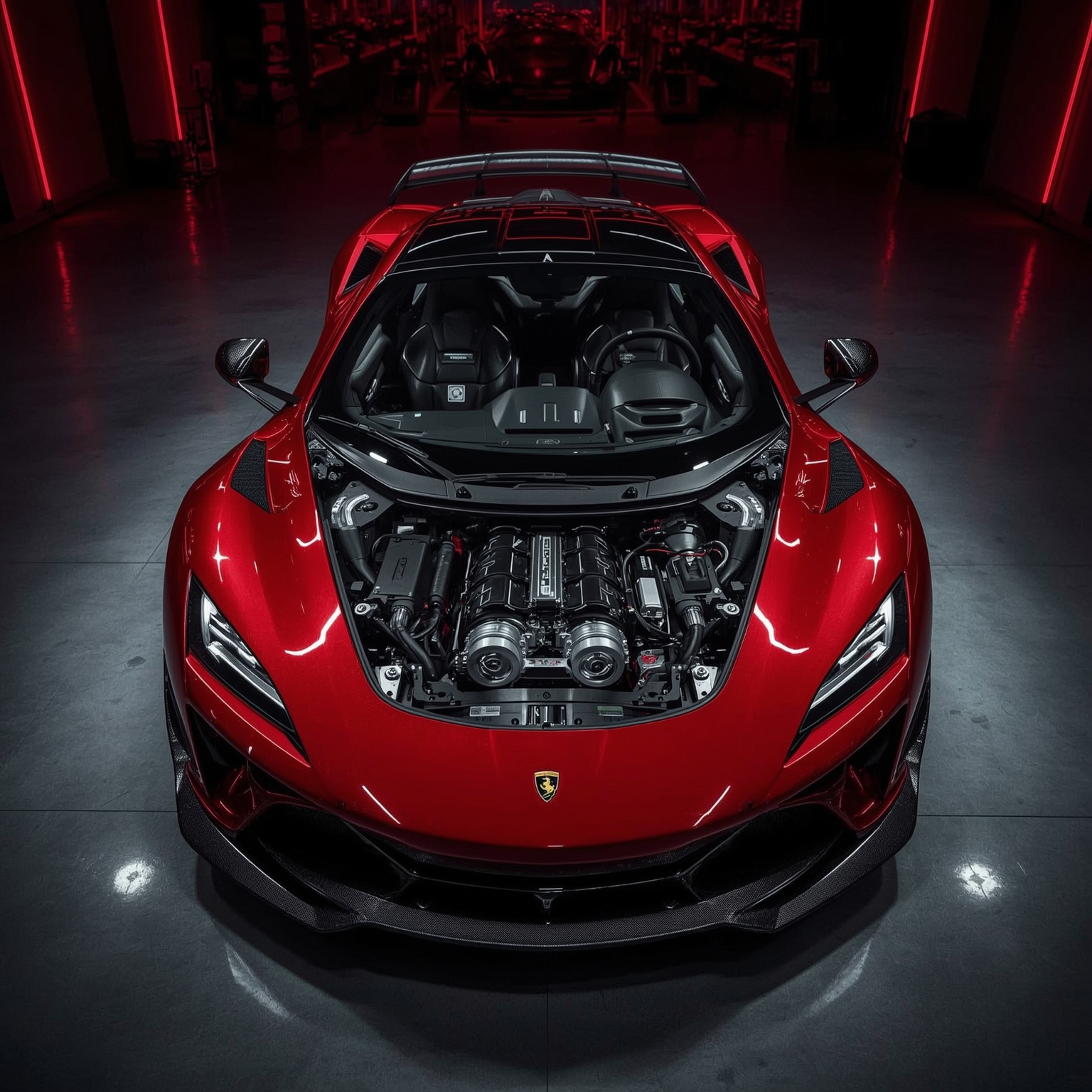
Introducing the Ferrari Elettrica — or, at least, a tantalizing preview of what is to come. The legendary Italian manufacturer, synonymous with artistry in motion and unrivaled engineering precision, has given the world its first substantial glimpse into the advanced technology destined to power its inaugural all-electric vehicle. This debut, which took place at Ferrari’s historic headquarters in Maranello, was not a full unveiling of the vehicle itself but rather a deep dive into the sophisticated components that will form its beating electric heart. Attendees were treated to a firsthand look at the meticulously engineered chassis and the intricately designed powertrain system, including the innovative battery pack and electric motors that promise to define the performance of this groundbreaking model. The finished car, however, remains shrouded in secrecy — its design and exterior form yet to be officially revealed.
Ferrari has indicated that the completed vehicle will be introduced sometime in the coming year, though essential details such as the final name and body configuration have not yet been confirmed. According to the company, the name “Elettrica” currently serves as a project placeholder, though it may ultimately adorn the production model if it captures the spirit of Ferrari’s evolving identity. Speculation within the automotive press has run wild: numerous publications and enthusiasts, guided by the sightings of heavily camouflaged test vehicles navigating Italian roads, have proposed that the forthcoming EV might take the form of a sleek shooting brake, a high-performance wagon, or perhaps a compact crossover. While Ferrari remains characteristically elusive about its exterior design, the automaker has shared several core performance metrics that reflect its commitment to maintaining the brand’s uncompromising speed and driving dynamics even in the electric age. The prototype’s target numbers are thrilling — a top velocity of 193 miles per hour, an astonishing 1000 horsepower available in boost mode, and a projected range of approximately 329 miles under the generous WLTP testing standard.
Although no photographs of the completed EV have yet emerged, Ferrari did showcase the physical base of what will become its next-generation supercar, offering glimpses of the mechanical foundation upon which the future of the marque will stand. In a move that separates Ferrari from many of its contemporaries, the company is not resorting to synthetic sound effects to imitate the growl of combustion engines. Instead, Ferrari engineers have devised a far more authentic auditory experience by channeling the natural mechanical vibrations of the powertrain itself. Using an accelerometer strategically mounted beneath the inverter, the system captures the genuine oscillations produced by the electric motors and processes them through a proprietary algorithm to amplify and broadcast a distinctive sound signature. This creates not an artificial simulation but an evolved extension of the car’s physical performance, preserving the visceral exhilaration that has always defined the Ferrari driving experience.
Beyond its sound and power, the Elettrica promises an array of driver-focused technologies that underscore Ferrari’s devotion to precision handling. The vehicle is expected to incorporate independent electric motors capable of delivering power with exceptional control, a rear-wheel steering mechanism to heighten agility at speed, and an active suspension system sophisticated enough to entirely eliminate the need for a conventional anti-roll bar. Unlike most Ferraris of the past, this electric model will feature four doors and a spacious four-plus-seat configuration, aligning it more closely with the Purosangue SUV than with the brand’s classic two-door lineup. In fact, this configuration will mark a historic milestone: Ferrari’s first-ever four-door production vehicle, signaling both evolution and expansion of the brand’s identity into new territory.
Naturally, exclusivity remains at the heart of the endeavor. Reports from Reuters suggest that the Elettrica will occupy the uppermost echelon of the automotive luxury market, with pricing expected to begin at around €500,000 — approximately $580,400. Constructed from a lightweight chassis composed of 75 percent recycled aluminum, the vehicle champions both sustainability and structural efficiency. Its fast-charging battery system will be seamlessly integrated into the floor of the car, a design approach that lowers the center of gravity to enhance stability, responsiveness, and road handling — key traits in Ferrari’s performance philosophy.
The Elettrica’s battery architecture is itself a technical masterpiece. It incorporates fifteen individual modules arranged around a nickel–manganese–cobalt composition, collectively offering a gross energy capacity of 122 kilowatt-hours. The battery cells, supplied by the advanced manufacturer SK On, are assembled entirely in-house by Ferrari technicians, demonstrating the brand’s desire to retain total control over the precision and quality of its electric systems. While Ferrari has not yet disclosed an official torque figure, performance expectations remain staggering: the Elettrica should be capable of accelerating from 0 to 62 miles per hour (100 kilometers per hour) in an astounding 2.5 seconds. Furthermore, the car’s 800-volt electrical platform will allow charging powers of up to 350 kilowatts, dramatically reducing recharging time and ensuring practicality does not compromise performance. Intriguingly, Ferrari engineers have also integrated a system designed to simulate the tactile sensation of gear shifting — not through physical gear transitions, but by manipulating regenerative braking to replicate that rhythmic, mechanical feedback familiar to traditional sports car enthusiasts.
Despite its heritage as a purist’s brand, Ferrari’s journey into electrification has been cautious and deliberate. Like other storied sports car manufacturers, it has approached the transition with deference to both tradition and evolving customer demand. The company recently confirmed that its second electric model has been delayed until 2028 due to market fluctuations and the still-nascent demand for high-performance EVs. Meanwhile, its rival Lamborghini has likewise postponed the debut of its inaugural electric model until 2029, demonstrating that even among the giants of Italian performance, the path toward electrification remains as complex as it is inevitable. With the Elettrica, however, Ferrari’s vision appears unmistakable: a synthesis of art, speed, and innovation that honors its illustrious past while boldly reimagining what a supercar can be in an electrified future.
Sourse: https://www.theverge.com/news/797746/ferrari-ev-motor-range-power-shifting