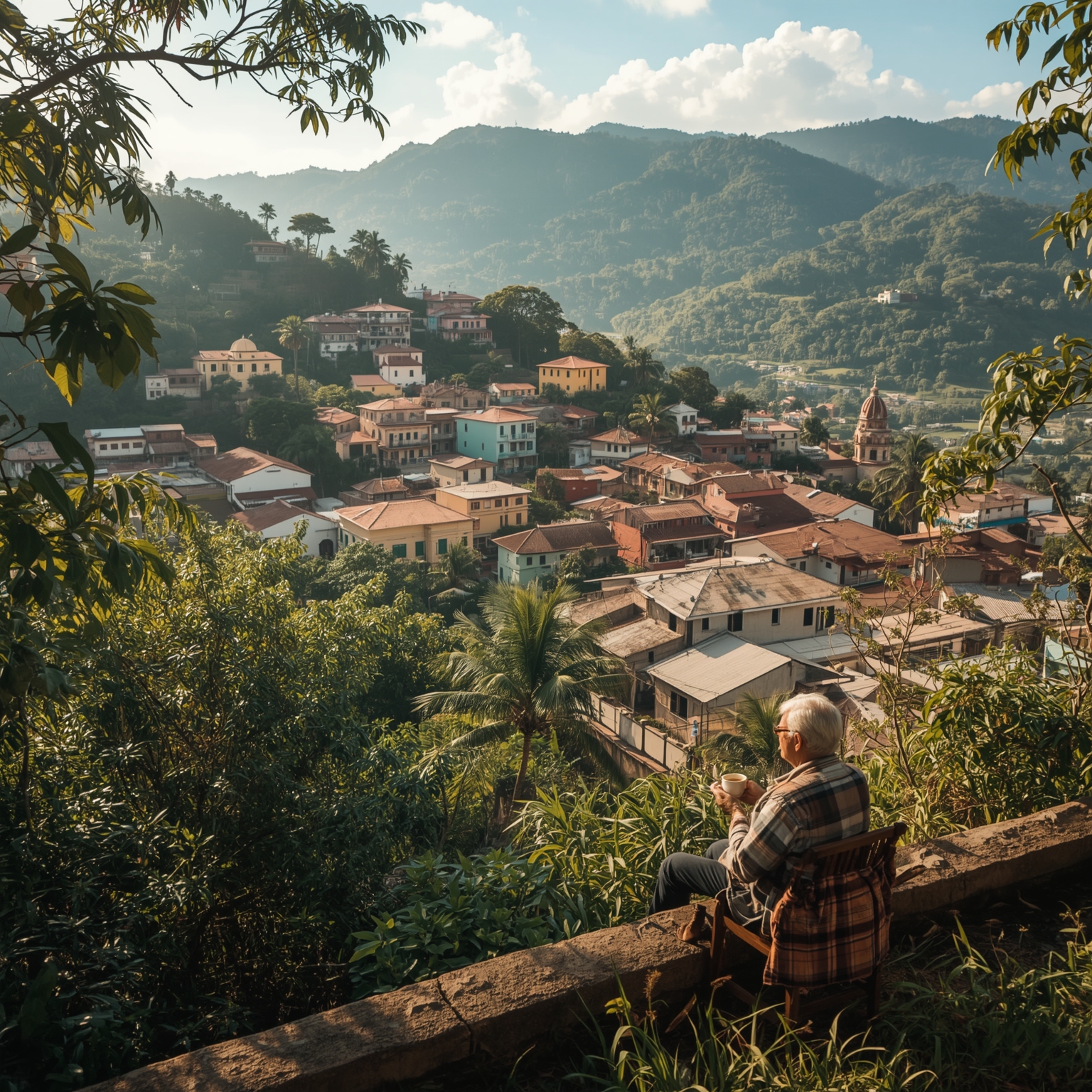
This first-person narrative is drawn from an extended series of conversations with Ron Podmore, a 58-year-old retired educator who made the unconventional yet deliberate decision to spend his retirement years in Guatemala. Although Ron still retains ownership of property in Washington State and divides his time between the Pacific Northwest and Central America, he is gradually transitioning toward full-time residency in Guatemala. His story—as edited for clarity, tone, and conciseness—offers a window into the personal, financial, and lifestyle considerations that shaped his unexpectedly international retirement journey.
Ron officially concluded his three-decade career in education in June 2023, marking the end of 32 years as a high school teacher. Choosing early retirement came with a mixture of liberation and financial constraint. Because he had not qualified for Social Security benefits at the time of retirement, he was eligible to collect only half of his pension. The remainder will begin disbursing in roughly six years, once he reaches age 65 or elects to draw from Social Security, whichever comes first. He describes this arrangement as a “mixed blessing”—not ideal, yet manageable, allowing him to enjoy a level of flexibility while maintaining long-term financial stability.
For Ron, the choice to retire early emerged from an acute awareness of how fleeting good health can be during one’s later years. He had witnessed colleagues diligently work until the conventional retirement age of 65, make immediate plans to access Social Security, and then, tragically, pass away within mere months. Determined not to follow that pattern, he decided to step away early rather than postpone the enjoyment of his post-career life. As he puts it, if he was going to “pull the plug” and stop teaching, he wanted to ensure that those ensuing years were lived fully, not deferred until exhaustion or declining health dictated the timeline.
Ron approached retirement from a carefully planned financial perspective, employing the principles of the FIRE movement—Financial Independence, Retire Early. For approximately two decades, he methodically reinvested every incremental salary increase into long-term investments. This disciplined strategy paid off, enabling him to build a solid financial foundation that would ultimately underpin his decision to relocate abroad.
Interestingly, his connection to Guatemala traces back to his time in the classroom. Around 2013, he began teaching a growing number of students who had recently immigrated from Central American nations such as Guatemala, Honduras, and El Salvador. Through conversations with these students, he began forming a more nuanced understanding of their countries and lives. Although he had previously assumed Guatemala to be plagued solely by corruption, poverty, and criminal activity—an image reinforced by decades of news headlines—his students challenged that perception. They insisted he reconsider, assuring him that their homeland was far richer and more complex than its negative reputation suggested.
Spurred by their encouragement, Ron decided to visit Guatemala for the first time around 2013 or 2014. That initial journey profoundly shifted his outlook, prompting him to return once or twice every year thereafter. The repeated visits eventually evolved from exploratory trips into a long-term relationship with the country, setting the stage for a more permanent relocation.
By 2018, Ron had taken a significant step forward: he purchased a small condominium in a working-class neighborhood of Guatemala City. His decision was pragmatic as well as visionary—he wanted a ready alternative should he choose, or need, to leave the United States permanently. Purchasing the unit before retirement allowed him to pay down the mortgage gradually, and his goal was clear: to have the property fully paid off by the time he officially retired. Through extra principal payments and disciplined budgeting, he succeeded, eliminating his mortgage within eight years. To finance the purchase, he utilized a home equity line of credit—commonly known as a HELOC—tied to his property in Federal Way, Washington, a suburb just south of Seattle. Because Guatemalan financial institutions typically require direct cash transactions for foreign property purchases, U.S.-based financing was the only viable option.
The Guatemala City condominium, a modest yet comfortable two-bedroom, one-bathroom unit valued at approximately $125,000, also includes underground parking, 24-hour security, and concierge services. The mortgage had originally been structured over a ten-year period, with monthly payments just under $1,500. For years the property stood unoccupied, awaiting the day when Ron would transition into full-time residency. In the interim, he gradually furnished it, acquiring essentials piece by piece—sofas, dining furniture, beds—spread over several years. Since each furnishing trip required flights from Seattle as well as delivery arrangements, the process took roughly two to three years to complete.
In August 2024, Ron finally began living in Guatemala nearly full time, initiating the legal residency process. He now holds a temporary visa that permits stays of up to six months at a time, while working toward permanent resident status—a process expected to take three to five years in total. Once completed, the status will grant him the right to reside in Guatemala indefinitely and with fewer bureaucratic limitations.
One of the key motivations reinforcing Ron’s decision to settle abroad has been the dramatic difference in healthcare costs and quality between Guatemala and the United States. He maintains a private medical insurance plan in Guatemala for approximately $315 per month—a policy that covers hospital care, diagnostic imaging, prescribed medications, and even inpatient stays without any deductibles or copayments. At the conclusion of a medical visit, no surprise invoices arrive in the mail. Even more striking to him than the affordability, however, is the quality of interpersonal care. He describes the system as more humane, where patients interact directly with doctors rather than navigating layers of administrative gatekeepers such as intake specialists or billing clerks. The experience, he notes, feels less transactional and more patient-centered.
Ron’s private plan does not cover optometry or dental services, yet even those expenses are remarkably affordable by U.S. standards. A standard dental cleaning in Guatemala costs him about $65 per session, compared to $800 or $900 for an equivalent procedure back in Washington. Even after factoring in partial coverage by his American dental insurance, his personal share often exceeded $200 per visit in the U.S.—three times the cost of private dental care in Guatemala. These savings, multiplied over years, represent not just reduced expenses, but also the freedom to obtain quality care without financial anxiety.
Ron’s lifestyle mirrors and extends a phenomenon familiar to many Americans described as “snowbirds”—retirees or semi-retirees who migrate seasonally to warmer, more affordable regions. On the West Coast, it is common for individuals in their fifties to retire early and relocate to southern states such as California, Arizona, or New Mexico, or even to communities along the Texas-Mexico border. Many do so precisely to access more affordable medical services and prescriptions just across the border. In emergencies, they would rather cross into Mexico than face exorbitant costs at home. Ron considers himself simply a “slightly more adventurous version” of that pattern. Instead of stopping at Mexico, he journeyed one country farther south—to Guatemala—where his dollar stretches further, the medical care is humane and accessible, and the climate and culture continue to enrich his new phase of life.
Sourse: https://www.businessinsider.com/retiring-early-guatemala-cheaper-healthcare-2025-10