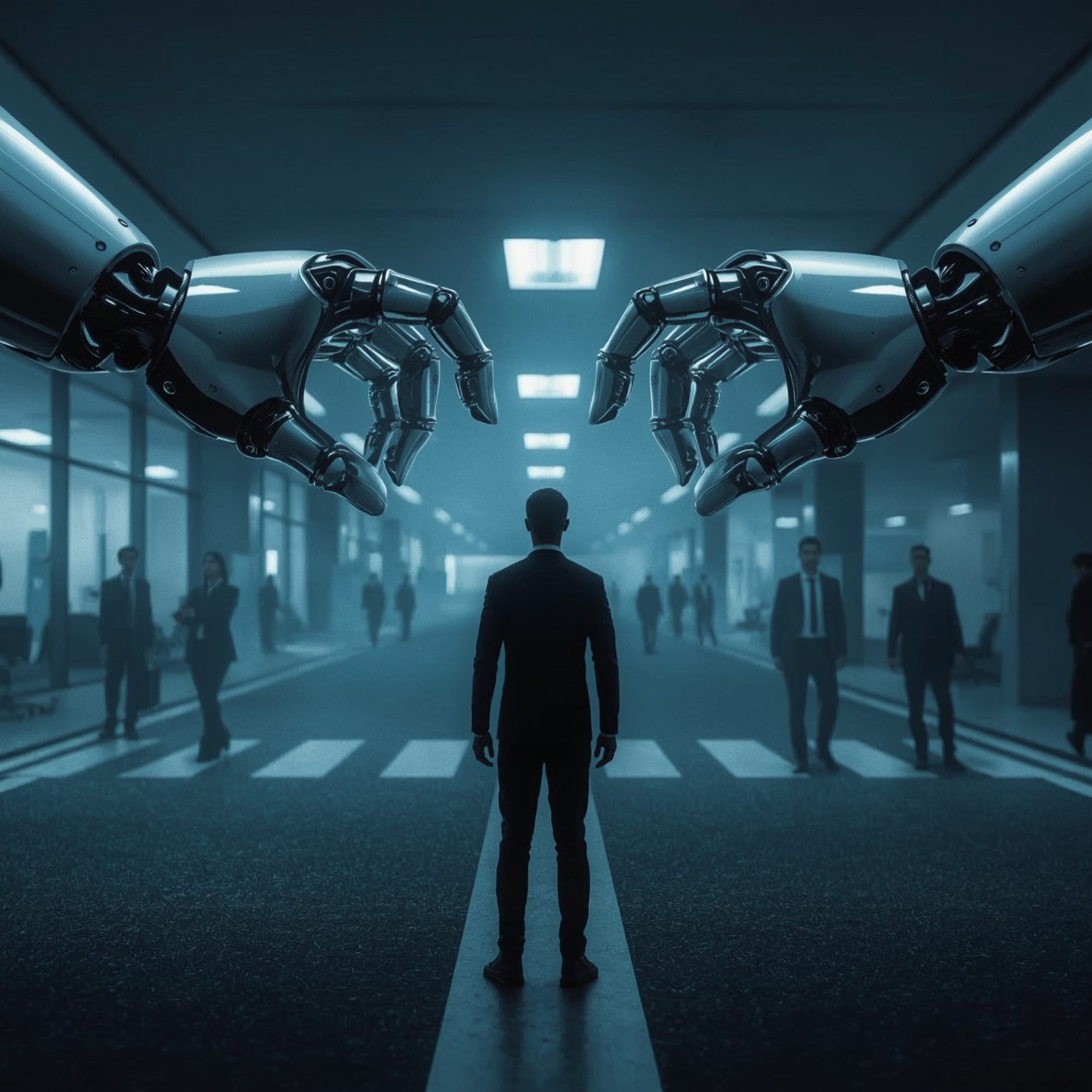
Many organizations that attribute their recent rounds of layoffs to the rapid rise of generative artificial intelligence may be overlooking a more subtle and psychologically complex explanation for their decisions. Thomas Roulet, a professor of organizational sociology and leadership at the University of Cambridge, suggested in a reflective post on LinkedIn that the narrative of AI-induced job losses is only part of the story. According to Roulet, numerous companies—particularly those operating in the technology and professional-services sectors—have pointed to the advent of generative AI as the primary justification for staff reductions. However, he argues that a more profound and less discussed motivation lies beneath the surface: an overwhelming fear among executives and HR leaders of making the wrong strategic move in an environment defined by unpredictable change.
In his commentary, Roulet emphasized that while the public conversation tends to focus on companies announcing layoffs as a direct consequence of automation, the underlying dynamic is often one of organizational paralysis rather than technological displacement. Firms, he explained, are becoming increasingly cautious about committing to human-resources decisions amid immense uncertainty about how AI will reshape business models, job functions, and long-term work structures. In essence, what appears to be proactive restructuring may, in fact, mask a defensive posture born from anxiety about the future. “We hear a lot about firms laying off workers while blaming GenAI,” he wrote, “but the broader perspective is that firms are reluctant to make any HR decisions with such a high level of uncertainty.” His observation captures a rarely acknowledged truth: the fear of being wrong can be more destabilizing to an organization’s workforce than the technology it claims to fear.
Roulet further warned that this hesitation to act decisively could produce extended and far-reaching repercussions, not only for the companies themselves but also for the employees who depend on stable career progression. If organizations delay investments in people or continually restructure under ambiguous rationales, workers may find it increasingly difficult to build wealth or confidently plan their professional trajectories. He noted that long-term career mobility—an essential component of human capital development—could be significantly impaired as firms oscillate between extremes of overreaction and inaction. Such patterns threaten to entrench economic inequality by reducing opportunities for advancement just when employees need adaptability the most. When approached by Business Insider for additional comment, Roulet did not immediately respond, leaving his initial reflections to speak for themselves.
His analysis comes amid a broader wave of layoffs across diverse industries, in which employers present markedly different explanations for their cost-cutting strategies. Within technology and professional services in particular, the rationale often centers on the supposed need to recalibrate workforces in response to AI-driven transformation. In companies that identify as being AI-first, these staff reductions are frequently framed as necessary retooling efforts aimed at preparing for an artificial intelligence–augmented future. For instance, Elon Musk’s xAI reportedly reduced its generalist data-annotation workforce by roughly one-third while multiplying the number of specialist AI tutor positions by a factor of ten to advance the training of its Grok model. Similarly, Snorkel AI eliminated about 13 percent of its staff as it deprioritized older business lines while maintaining and safeguarding roles most directly tied to AI development.
Major technology corporations have also adopted a dual approach—simultaneously cutting positions while touting expanded hiring in artificial intelligence. Microsoft and Salesforce, for example, announced layoffs even as they sought new talent to accelerate their portfolios of AI-enhanced products. Meta described its own measures as part of an effort to “raise the bar on performance,” stating its intention to part ways with employees deemed underperforming. Workday and Hewlett Packard Enterprise (HPE) echoed this strategic alignment narrative, portraying their job reductions as efforts to recalibrate cost structures in accordance with an AI-centered vision of operational efficiency.
Outside of the tech world, explanations often differ significantly. Some professional-services firms attribute workforce reductions not to technological change but to evolving workforce dynamics. PwC, for instance, dismissed approximately two percent of its U.S. employees in May, citing historically low attrition rates that left the organization with fewer natural departures and therefore an excess of personnel. Meanwhile, within the specialized realm of AI infrastructure and data labeling, companies such as Scale AI linked their downsizing to a combination of overhiring, profitability pressures, and shifting client demands—factors reflecting the volatility of a rapidly developing market rather than direct automation effects.
Taken together, these examples illustrate the complexity of the current employment landscape: while AI serves as an easy and media-friendly scapegoat, the underlying motivations often lie in human emotion and strategic ambivalence rather than in machine logic. Roulet’s insights highlight a crucial paradox of leadership in the digital age: that the more uncertain the future becomes, the more tempting it is for decision-makers to ground their choices in fear masquerading as foresight. In doing so, organizations risk undermining the very adaptability they need to survive in an AI-transformed economy.
Sourse: https://www.businessinsider.com/firms-blaming-ai-for-layoffs-driven-by-fear-work-guru-2025-10