Low-cost carrier Avelo Airlines is fundamentally redefining the composition and strategic direction of its aircraft fleet, signaling a decisive step forward in its evolution within the competitive U.S. aviation landscape. In a landmark agreement announced in September, the rapidly expanding airline entered into a substantial $4.4 billion contract with the distinguished Brazilian manufacturer Embraer. This deal secures the purchase of fifty of Embraer’s most advanced jets—the E195-E2 model—with deliveries scheduled to commence in 2027. These state-of-the-art aircraft will complement Avelo’s existing stable of Boeing 737s, operating alongside them to enhance versatility and efficiency across the airline’s route network.
The contract marks not only a pivotal moment for Avelo but also an important milestone for Embraer and for U.S. civil aviation more broadly. Avelo, which began commercial service in 2021, has become the first American airline to formally acquire the next-generation E2 series. For Embraer, this breakthrough ends a prolonged absence of momentum in the American market, long hindered by union-based contract stipulations. The major obstacle had been the regional pilot unions’ so-called “scope clause,” a contractual limitation put in place to protect job security for mainline pilots employed by large carriers such as Delta Air Lines and United Airlines. These clauses restrict outsourced flying by partner airlines to aircraft with a maximum takeoff weight of less than 86,000 pounds—well below the E195-E2’s specifications—thereby excluding regional affiliates from operating the model. As a result, only independent, non-affiliated carriers such as Avelo are free to integrate the E2 into their fleets.
During Embraer’s Investor Day, Arjan Meijer, the president and CEO of Embraer Commercial Aviation, emphasized that the E2 series offers a technological and passenger-experience advantage unmatched by competing regional aircraft. The jet, he explained, operates more quietly than its peers, consumes significantly less fuel per seat, and features a thoughtfully designed 2×2 cabin configuration that completely eliminates the middle seat—an amenity that passengers frequently cite as one of the most uncomfortable aspects of air travel. According to Meijer, these traits combine to create a more environmentally efficient, passenger-friendly, and economically sustainable solution for airlines.
Hunter Keay, Avelo’s chief financial officer, elaborated on how the jet’s engineering capabilities, including an automated takeoff system, will enable the airline to extend its network to smaller, underserved secondary airports. Because of its ability to operate on shorter runways—many of which are inaccessible to the Boeing 737s currently in Avelo’s fleet—the E2 opens up possibilities for expansion into entirely new destinations. Keay noted that several of these potential markets presently lack any commercial air service at all, giving Avelo a first-mover advantage in connecting overlooked communities with affordable air travel.
Avelo’s decision to select the E2 over its principal rival, the Airbus A220, was made after careful evaluation. The A220 offers a longer operational range and greater seating capacity, but industry-wide supply chain constraints have extended delivery timelines for Airbus jets. For a nimble operator eager to grow quickly, the E2 represented a more practical choice, allowing Avelo to balance technological sophistication with fleet availability. Business Insider was given the opportunity to examine the E195-E2 firsthand at the 2024 Farnborough Airshow in England, offering insights into the passenger experience this new aircraft will deliver.
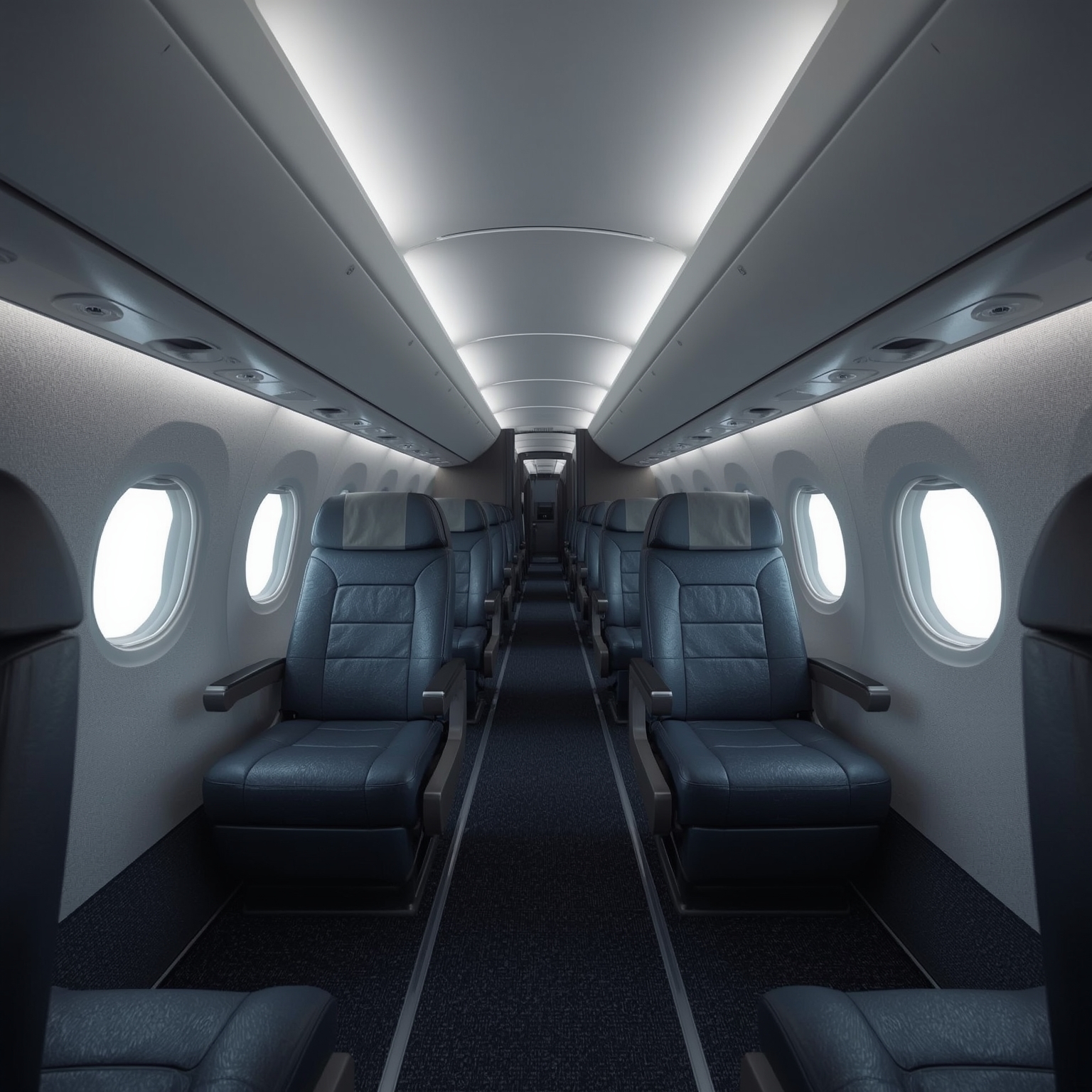
Inside the cabin, the absence of a middle seat immediately defines the E2’s interior character. The aircraft’s 2×2 configuration—with two seats on each side of a single central aisle—establishes a sense of openness uncommon for a regional jet. The specific seats displayed at the Airshow were Embraer’s own demonstration models, complete with adjustable headrests, though Avelo’s implementation will likely reflect its straightforward, no-frills ethos. For comparison, the competing Airbus A220 features a 3×2 arrangement, used by carriers including Delta and Breeze Airways, meaning that the E2 will stand apart for prioritizing a more spacious and symmetrical passenger layout.
In addition to its seating design, Embraer has integrated a new overhead bin concept that maximizes storage efficiency. These larger bins align seamlessly with the ceiling when closed and allow modern carry-on luggage to be stored upright, wheels first. This simple yet effective improvement is expected to reduce the number of gate-checked bags—an operational inefficiency that affects both boarding times and passenger satisfaction.
Powering the E2 are two Pratt & Whitney PW1900G geared turbofan engines, a next-generation propulsion system known for its reduced fuel consumption and lower carbon emissions. These engines contribute substantially to the jet’s favorable operating economics. However, much like the engines installed on certain Airbus A220 aircraft, these units have encountered technical difficulties that have temporarily grounded portions of some airlines’ fleets, including KLM Cityhopper. Despite these challenges, the E2 remains a compelling aircraft built primarily for regional connectivity, targeting short- to medium-haul routes that bridge smaller city pairs.
Avelo’s operational strategy aligns neatly with this profile. The airline already focuses on markets where competition is light or altogether absent, allowing it to establish dominance on niche yet profitable routes. For instance, Avelo is currently the only airline serving flights between New Haven, Connecticut, and San Juan, Puerto Rico, as well as from Hartford, Connecticut, to Montego Bay, Jamaica. The addition of the E2 will likely strengthen this strategy, enabling the carrier to link other underserved destinations.
Nevertheless, integrating the E2 into Avelo’s operations also introduces a measure of complexity. Typically, low-cost airlines maintain a fleet composed of a single aircraft type—a model followed by industry leaders such as Southwest Airlines, which operates exclusively Boeing 737s, and ultra-low-cost airlines like Spirit and Frontier, which rely solely on Airbus A320 family aircraft. This single-fleet strategy keeps maintenance, training, spare parts, and crew operations standardized, dramatically reducing costs. Deviating from this approach by adopting two aircraft types from different manufacturers inherently complicates scheduling, maintenance, and crew certification logistics. Yet Avelo seems confident that the strategic benefits of diversifying its fleet outweigh these new operational challenges.
Despite the modernity of its new aircraft, Avelo remains steadfast in adhering to its core no-frills business model. Passengers boarding an Avelo E2 flight should not anticipate a dramatic overhaul of the onboard experience. As CFO Keay clarified, the airline’s brand identity remains centered on affordability and simplicity. Thus, travelers will continue to encounter tightly spaced seating—around 29 inches of pitch, the same as on the airline’s current Boeing 737s—and the absence of complimentary entertainment or Wi-Fi service. The airline’s approach is consistent with other cost-conscious models that reduce operating expenses to sustain low fares.
Nevertheless, Embraer offers flexibility in cabin configuration, including the option to install premium seating. At the Farnborough Airshow, the displayed E195-E2 featured an arrangement of premium seats providing enhanced cushioning and increased legroom relative to economy-class configurations. This trend mirrors a growing tendency among budget carriers such as Spirit and Frontier to introduce more comfortable, higher-priced service tiers, offering passengers a modest upgrade while maintaining a low base fare. It remains uncertain whether Avelo will follow this emerging model, though the airline currently provides limited upgrade options, such as bulkhead rows with extra legroom or blocks of seats with the middle position unoccupied.
Perhaps the most notable distinction of the forthcoming Avelo E2 fleet is its exclusivity within the U.S. market. Aside from Avelo, no American airline has yet adopted the E2, making this aircraft a singular presence in domestic skies. Internationally, carriers including Brazil’s Azul, Canada’s Porter Airlines, KLM, Singapore’s Scoot, and Virgin Australia operate variations of the E2 family, but within the United States, dominance remains with the Airbus A220. Carriers such as Breeze Airways and JetBlue have chosen the European-built aircraft, partly due to the absence of restrictive union scope clauses for larger airlines.
Meanwhile, the older generation of Embraer E-Jets is nearing retirement among U.S. budget airlines. JetBlue had already withdrawn its final Embraer E190 from operations as of September, while Breeze Airways plans to phase out its remaining Embraer aircraft by mid-2026. Avelo’s adoption of the E2, therefore, not only revives Embraer’s presence in the U.S. market but also underscores a bold strategic bet on efficiency, passenger comfort, and operational flexibility—all while retaining the essential promise of low fares that defines the carrier’s brand. As Avelo awaits delivery of its E195-E2s, its move signals both a daring technological embrace and a reaffirmation of the budget airline’s ongoing mission: to make air travel accessible, dependable, and refreshingly straightforward for communities that commercial aviation has too long overlooked.
Sourse: https://www.businessinsider.com/avelo-airlines-buys-embraer-e195-e2-jets-regional-airport-photos-2025-10