Widely regarded as one of the most quietly powerful voices in contemporary American cinema, Kelly Reichardt has long been celebrated for her understated storytelling and meticulous craftsmanship. Yet, with her newest project, *The Mastermind*, she appears to have orchestrated an unexpected transformation of her artistic persona. This latest film, while still bearing the marks of her introspective style, represents the loudest, most ambitious, and financially substantial production of her career. Centered around an art theft that spirals spectacularly out of control, it demonstrates Reichardt’s capacity to operate in a larger, more flamboyant cinematic register without sacrificing the personal and reflective tone that defines her oeuvre.
Reichardt, whose previous works — including *First Cow*, *Showing Up*, and *Wendy and Lucy* — are celebrated for their quiet emotional depth and minimalist beauty, initially set out to create something vastly different. She envisioned a film distinct from the contemplative rhythms that have characterized her earlier explorations of human resilience and failure. Yet, as she recounts with humor and self-awareness, once she returned to the editing room, she recognized her unmistakable artistic fingerprint once again emerging from the footage: “There it was,” she mused, “just another one of my films.” It is a telling realization that, even when she aims to deviate from her accustomed style, her signature perspective — one deeply rooted in character study and moral tension — persists.
At its core, *The Mastermind* is less a conventional crime thriller than a layered exploration of character and consequence. The film stars Josh O’Connor — familiar to audiences from *Challengers* and soon to be seen in projects led by Steven Spielberg and Joel Coen — as J.B. Mooney, a dimly lit and morally conflicted thief whose charm and good looks have long cushioned him from failure. O’Connor, poised on the threshold of major stardom, delivers a performance that delicately balances charisma and fragility. Mooney’s privileged background, as the son of a powerful local judge, has taught him how easily charm can mask ineptitude. Yet, in Reichardt’s interpretation of the genre, no amount of privilege or personal magnetism can shield him from the inevitable collapse that follows his botched attempt at criminal brilliance. Hence, the director has aptly defined the film as an “unraveling” — an “anti-heist,” in which the theft itself serves merely as the prelude to an intimate dissection of downfall.
The film opens with a carefully orchestrated, somewhat impromptu art heist — a thrilling sequence inspired by a real 1972 theft of Arthur Dove paintings from the Worcester Art Museum. What begins as a satisfyingly choreographed caper soon becomes something entirely different: a portrait of dissolution, where the challenge lies not in stealing the paintings but in holding onto them, both literally and morally. As Mooney’s schemes begin to deteriorate, Reichardt’s camera lingers less on the spectacle of the crime and more on the quiet erosion of confidence, integrity, and self-delusion that follow.
In a conversation with *The Verge*, Reichardt revealed how her habitual restraint as a budget-conscious filmmaker shaped every creative choice. Scenes involving car work or night shoots — inherently expensive undertakings — required extraordinary planning and precision. She collaborated closely with longtime cinematographer Chris Blauvelt, with whom she shares an intuitive understanding of rhythm and structure. Together, they discussed the edit as they constructed scenes, ensuring that the film’s aesthetic cohesion would survive the constraints of shooting schedules and limited resources. Although Reichardt often finds discovery in editing, here she had little room for improvisation; the complexity of the shoot demanded clarity from the outset.
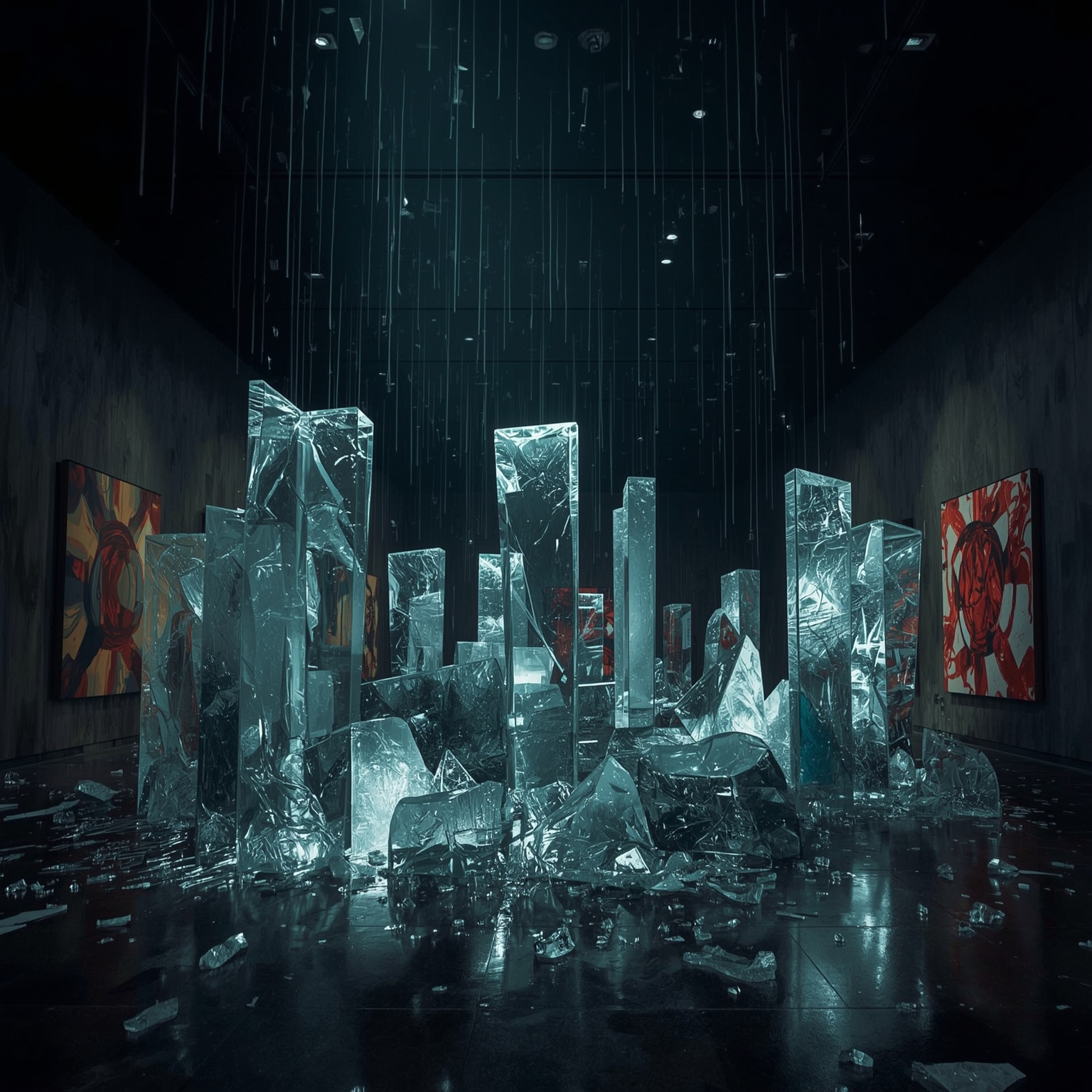
Part of the film’s production also entailed a rare venture for Reichardt: the construction of a built set, an interior replica of a museum assembled in an old warehouse in Cincinnati. For a director accustomed to working on location, this was both thrilling and taxing — a logistical experiment that reflected a heightened level of production scale. She described the experience with visible enthusiasm, recalling how even on frustrating scouting days, the incremental construction of the “museum” set carried its own momentum and excitement, transforming the space into a living artistic microcosm. Yet the process was equally daunting: the set’s completion ran right up to the first day of shooting, depriving her of the luxury to fully pre-plan every shot. The experience, she admitted, illuminated both the creative potential and the financial burden of constructed environments.
When asked about categorizing *The Mastermind* as a heist film, Reichardt cautioned against that label, insisting that such terminology breeds misleading expectations. Her intent was not to romanticize or glorify the mechanics of theft but to explore the emotional and existential aftermath. In her words, it is less a story about executing a plan than about watching someone’s identity crumble once the illusion of control dissolves. The film’s latter sections evolve into what she calls an “aftermath film,” tracing Mooney’s physical and psychological drift across the American landscape after his ambitions collapse — a familiar territory in Reichardt’s cinematic world, where directionless travel often mirrors inner crisis.
The screenplay, developed in close dialogue with her long-term collaborator Jon Raymond, underwent numerous revisions, particularly in its challenging third act. Reichardt confessed that the structure repeatedly “kept becoming a new first act,” as though the story resisted closure. With Raymond’s help, she refined the material into something more open, raw, and consistent with her thematic aspiration toward fragmentation and dissolution. The final product, she says, reflects a process of learning to let the story unravel instead of rebuilding it into something neater or more conventionally satisfying.
Looking back, Reichardt identifies the film’s central thread not as the crime itself but as the portrait of a man exhausted by his own failures and illusions. *The Mastermind* thus unfolds as an examination of the ways individuals depend on larger systems — whether social, familial, or economic — to maintain stability. In Mooney’s case, both those systems and his personal relationships fail him, leaving him stripped of support. The film, therefore, becomes an allegory for disconnection in a world that increasingly fails to catch those who falter.
Set against a historical backdrop rather than in the immediate present, *The Mastermind* gains a reflective distance that, according to Reichardt, enables political and emotional clarity. She acknowledges the difficulty of portraying the contemporary moment directly, noting that she is “not ready to find irony” in current events or to translate present instability into art without the passage of time. Looking to other filmmakers, such as Sean Baker and his *Red Rocket*, she praises works that manage to feel politically urgent without overt rhetoric. By situating her film in a past era, she explores analogous conditions — ambition, disillusionment, and fading idealism — without succumbing to nostalgia or melancholy.
Reichardt’s personal recollections of her formative political memory — watching President Nixon resign as a child, pulled from the swimming pool to witness history unfold — tie her creative perspective to a broader meditation on civic awareness. That childhood image, of being confronted with the nation’s moral reckoning, resonates quietly throughout her work, which consistently grapples with questions of individual agency and systemic failure. Even so, she refuses to romanticize the past, insisting that her interest lies in understanding how social inertia differs between eras. Reflecting on the present moment, she voices perplexity at modern political disengagement, contrasting it with earlier periods of protest and collective action. Her observation of a solitary man standing daily with a “stop authoritarianism” sign in Portland crystallizes her unease: where, she asks implicitly, have the crowds gone?
Ultimately, *The Mastermind* stands as both an expansion and a reaffirmation of Kelly Reichardt’s cinematic identity. It is a departure in scale and texture, but a continuation in spirit — a meditation on fragility, illusion, and aftermath, rendered through the unflinching gaze of one of America’s most introspective filmmakers. By constructing a narrative around the failure of mastery itself, Reichardt has made her most paradoxically eloquent statement: that even in chaos, her quiet artistry endures.
Sourse: https://www.theverge.com/entertainment/801651/the-mastermind-kelly-reichardt-director-interview