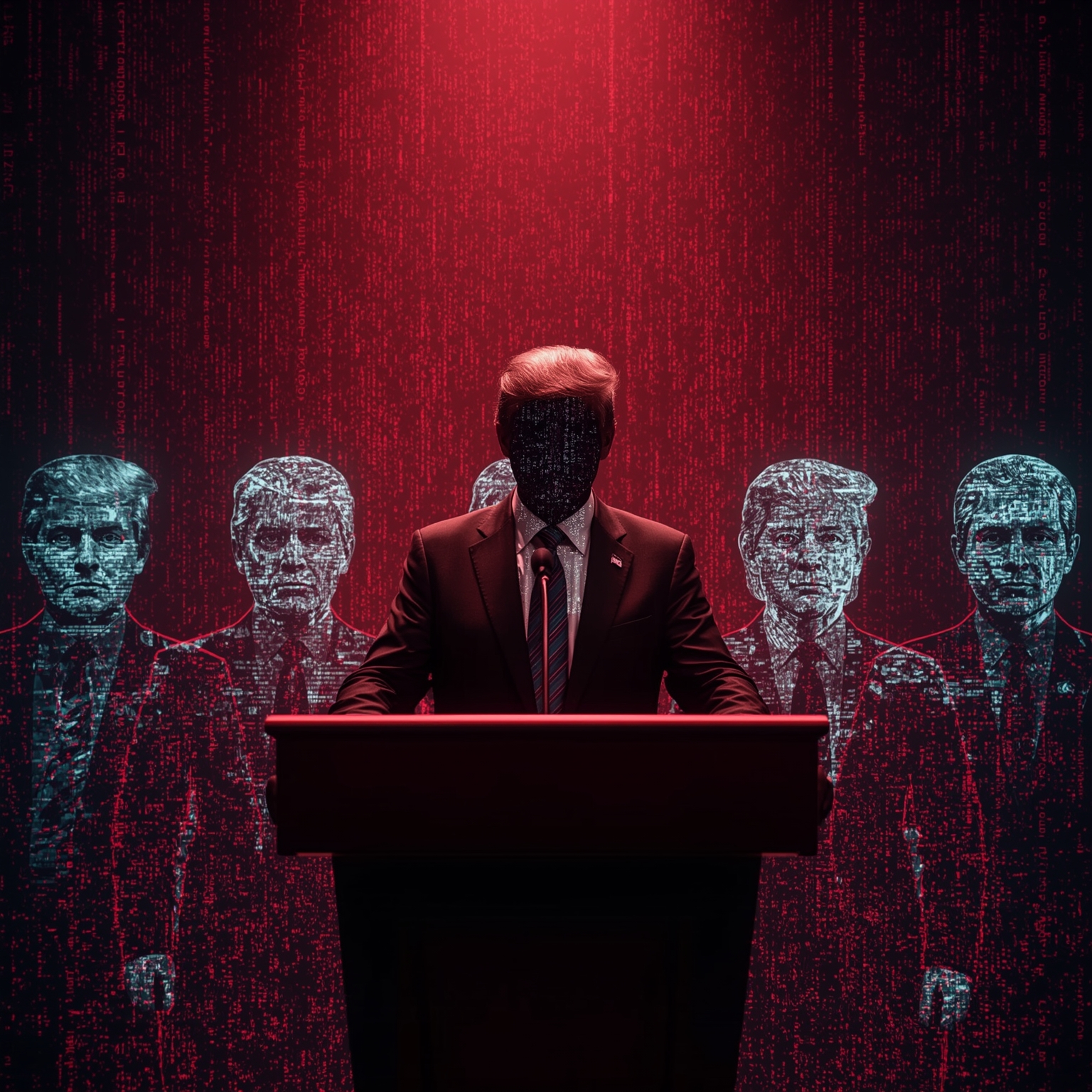
Senate Republicans recently circulated an AI-generated deepfake video depicting Senator Chuck Schumer, the Democratic leader in the Senate, in a manner that misrepresented his views and actions. This fabricated clip sought to portray Schumer and his fellow Democrats as gleefully celebrating the continuation of an already-prolonged government shutdown, which has stretched for sixteen days without a resolution. The intent behind the visual manipulation appeared to be the amplification of partisan narratives, utilizing technology to distort political reality and influence public perception.
In this particular deepfake, an artificially constructed likeness of Schumer continually repeats the phrase “every day gets better for us.” While the words themselves are genuine, they were lifted entirely out of their original journalistic context. The quotation had first appeared in a legitimate Punchbowl News piece that covered Schumer’s conversation about the Democrats’ broader legislative approach during the impasse. In that authentic discussion, Schumer emphasized his party’s refusal to bow to Republican strategies of exerting pressure and spreading confusion—methods he described as relying on intimidation and “bamboozling.” Thus, the phrase, when isolated and reused in manipulated form, severely distorted the meaning and tone of his statement.
The stalemate underlying the shutdown stems from the inability of Democrats and Republicans to reach consensus on a funding bill necessary to sustain government operations through October and beyond. At the core of the disagreement are significant policy priorities. Democratic lawmakers have sought to preserve critical tax credits designed to make health insurance more affordable for millions of American families, to restore funding cut from Medicaid programs under former President Donald Trump’s administration, and to protect the budgets of public health agencies against impending reductions. Republicans, by contrast, have resisted these proposals, creating a legislative deadlock that has effectively paralyzed federal funding.
The doctored video was published on a Friday through the official X account of Senate Republicans. According to X’s stated policies, the platform explicitly forbids the “deceptive sharing of synthetic or manipulated media” when such content has the potential to cause harm. The policy defines harm broadly to include not only physical or reputational damage but also the spread of misinformation capable of misleading individuals or generating confusion around issues of public concern. Violations of this rule may trigger enforcement measures such as the removal of offending content, the addition of warning labels alerting users to manipulation, or the deliberate reduction of that content’s visibility in user feeds. However, as of the time this report was written, X had not taken any action to remove the deepfake nor had it appended a visible warning label to the post. The only acknowledgment of the video’s artificial nature was a small embedded watermark indicating that it was AI-generated—a detail that many casual viewers could easily miss.
This episode marks not the first instance in which X has permitted the circulation of synthetic political videos featuring prominent public figures. In late 2024, Elon Musk, the owner of X, personally shared another manipulated video depicting former Vice President Kamala Harris during the lead-up to the national elections. That earlier case sparked a heated debate over whether social media platforms are capable of balancing principles of free expression with the need to maintain truthful public discourse and protect voters from strategic misinformation campaigns.
TechCrunch has reported on this controversy and has reached out directly to X’s corporate representatives for official comment, although as of now, the platform has not provided a public response.
Parallel to these events, a growing number of U.S. states have begun to legislate against political deepfakes in an attempt to curb their misuse during elections and government campaigns. As of today, up to twenty-eight states have enacted statutory restrictions addressing the creation or dissemination of AI-generated videos that imitate real political candidates or elected officials. The majority of these laws allow for deepfakes only if they carry a clear and prominent disclosure identifying the material as synthetic; yet some states have enacted firmer prohibitions. Among them, California, Minnesota, and Texas have passed legislation explicitly banning deepfakes that aim to manipulate election outcomes, deceive the electorate, or deliberately harm a candidate’s reputation.
The recently circulated video involving Schumer also arrived just a few weeks after former President Donald Trump used his own social media platform, Truth Social, to post AI-generated deepfakes depicting both Schumer and House Minority Leader Hakeem Jeffries making false remarks about sensitive issues such as immigration and voter fraud. These recurrent incidents underscore how advanced generative technology has quickly become a political weapon, enabling the rapid proliferation of misleading imagery that can easily outpace efforts at fact-checking.
When confronted with mounting public criticism over the ethics of promoting such misleading content, Joanna Rodriguez, the communications director for the National Republican Senatorial Committee, provided a succinct but revealing comment. She stated, “AI is here and not going anywhere. Adapt & win or pearl clutch & lose.” Her response encapsulated a pragmatic, albeit controversial, attitude toward the irreversible integration of artificial intelligence into political messaging—a stance that reflects the tension between technological innovation and moral accountability in the digital political era.
Sourse: https://techcrunch.com/2025/10/17/senate-republicans-deepfaked-chuck-schumer-and-x-hasnt-taken-it-down/