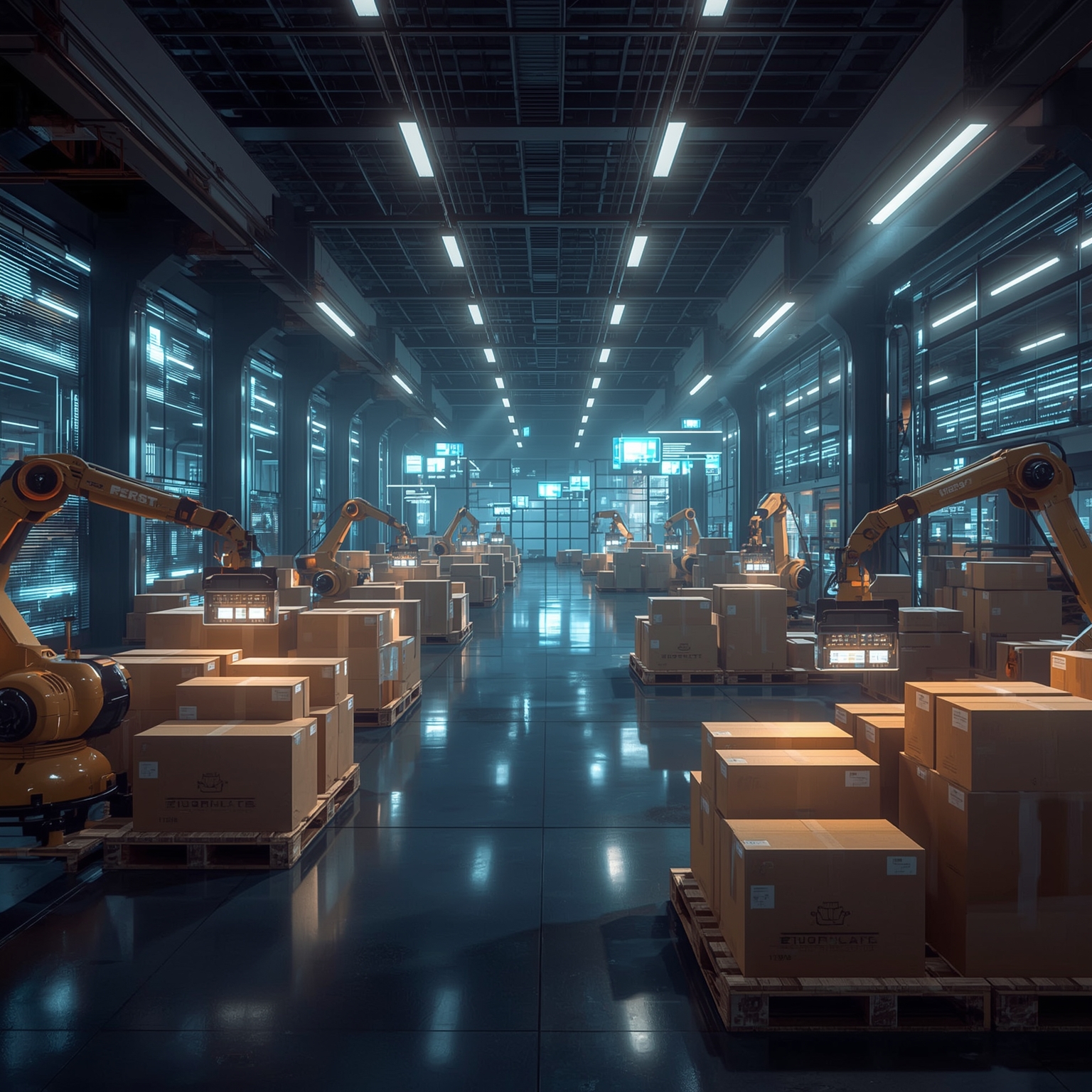
A recent investigative article published by The New York Times on Tuesday referenced confidential internal Amazon documents, revealing that the company has been emphasizing its expanding investment in automation technologies as a mechanism to drive greater sales growth without the necessity of proportional increases in human staffing. Yet, only a day later, Amazon has released a sweeping and distinctly optimistic public relations announcement that paints a far more positive and confident portrait of its ongoing robotics and delivery technology initiatives. This communication exudes enthusiasm about the company’s latest innovations, portraying automation not as a replacement for human labor but as an instrument for improved efficiency, collaboration, and workplace transformation.\n\nIn its announcement, Amazon offered glimpses into futuristic concepts such as experimental augmented reality smart glasses integrated with artificial intelligence, designed to support and potentially enhance warehouse operations, as well as immersive virtual reality training programs created to improve the preparedness and safety of delivery drivers. Beyond these early previews, the company formally unveiled a collection of ten advanced robotic systems that are either already operational within its facilities or currently undergoing active field testing. Amazon, however, notably refrained from addressing whether any of these intelligent machines experienced disruptions during the recent outage that affected Amazon Web Services (AWS), an omission that quietly underscores the company’s desire to focus public attention on innovation rather than operational vulnerabilities.\n\nAmong the highlights of its detailed blog posts is a feature on Blue Jay, a highly adaptable robot Amazon describes as “an extra set of hands” engineered to support employees with physically demanding tasks like reaching, lifting, and moving objects throughout a warehouse environment. The company positioned Blue Jay as an exemplar of human–machine collaboration, emphasizing its purpose as a complementary aid rather than an autonomous replacement for human workers. Accompanying Blue Jay is Amazon’s internally developed agentic AI software known as Project Eluna—a system intentionally conceptualized as an intelligent digital colleague that monitors workflow patterns, alleviates cognitive strain for human employees, and dynamically optimizes item sorting processes to reduce congestion or inefficiencies within fulfillment centers.\n\nAccording to Amazon’s own technical disclosures, Blue Jay is capable of manipulating and transporting roughly seventy-five percent of the item types that the company currently stores and ships, signifying a broad operational reach across its warehousing infrastructure. Over time, the company envisions Blue Jay evolving into a foundational or “core” technology that will underpin the efficiency of Same-Day delivery locations, central to Amazon’s promise of ever-faster customer fulfillment. Engineers claim that the robot was conceptualized, designed, and fully developed in just over a year—a rapid timeline made possible through the integration of artificial intelligence, virtual modeling via digital twins, and the continuous collection of performance data from Amazon’s existing fleet of robotic systems. These inputs collectively produced a sophisticated platform capable of orchestrating multiple robotic arms to carry out several warehouse functions simultaneously. By consolidating what previously existed as three independent robotic workstations into a single streamlined unit, Blue Jay’s system can now perform the picking, stowing, and item consolidation processes in one unified operation, dramatically minimizing spatial and temporal inefficiencies.\n\nIn the same update, Tye Brady, Amazon Robotics’ chief technologist, articulated a message meant to reframe public perception. “The real headline isn’t about robots,” he wrote, emphasizing that the ultimate narrative centers on people—the employees— and on the evolving future of work that Amazon envisions building through cooperation between human ingenuity and machine precision. Brady’s commentary serves not only as a defense of the company’s automation strategy but also as an assurance that the integration of robotics remains guided by principles of empowerment rather than displacement. Reinforcing this sentiment, the post reiterates the company’s official response to critiques raised in The New York Times report, underscoring that, according to Amazon’s figures, no organization in the United States has generated more job opportunities over the past ten years. In a further demonstration of its continuing commitment to employment, the company affirms its intention to fill roughly 250,000 seasonal positions for the forthcoming holiday period—a statement designed to underline that workforce reductions and job creation can, at least temporarily, coexist within a single expanding enterprise.\n\nNevertheless, a somewhat different tone was present in CEO Andy Jassy’s internal letter distributed to Amazon employees in June. In that message, Jassy adopted a characteristically measured and candid approach regarding the implications of improved efficiency and the deepening incorporation of artificial intelligence technologies. He acknowledged that generative AI will inevitably transform the company’s internal labor structure, explaining that Amazon will likely require fewer individuals to perform certain kinds of repetitive or administrative tasks presently handled by large teams while simultaneously necessitating more personnel with skills suited to newly emerging categories of work. Jassy conceded that predicting the exact long-term outcome of this transformation remains challenging. Still, he projected that within the next several years, Amazon’s total corporate workforce would likely decline to some extent as a direct consequence of the productivity gains realized through extensive and strategic deployment of AI throughout every division of the organization.\n\nEchoing Jassy’s broader perspective, The New York Times report interprets Amazon’s robotics strategy as part of the same overarching plan—a coordinated effort to trim e-commerce operational expenses while continuing to enhance profitability and speed. The report outlines how warehouse modernization efforts have produced new fulfillment centers capable of processing increasingly vast volumes of merchandise more swiftly, yet employing noticeably fewer workers, who are progressively dedicating their roles to maintaining, troubleshooting, and overseeing the automated machinery itself. This shift effectively signals a gradual redefinition of the human worker’s position within Amazon’s logistical ecosystem: from manual laborer to technological custodian and collaborator. While the company’s official communications emphasize optimism and opportunity, the underlying story, as both the Times and Jassy’s remarks suggest, remains one of calculated transformation, where automation stands simultaneously as a promise of progress and a challenge to the traditional relationship between people and their work.
Sourse: https://www.theverge.com/news/805098/amazon-robots-ai-warehouses