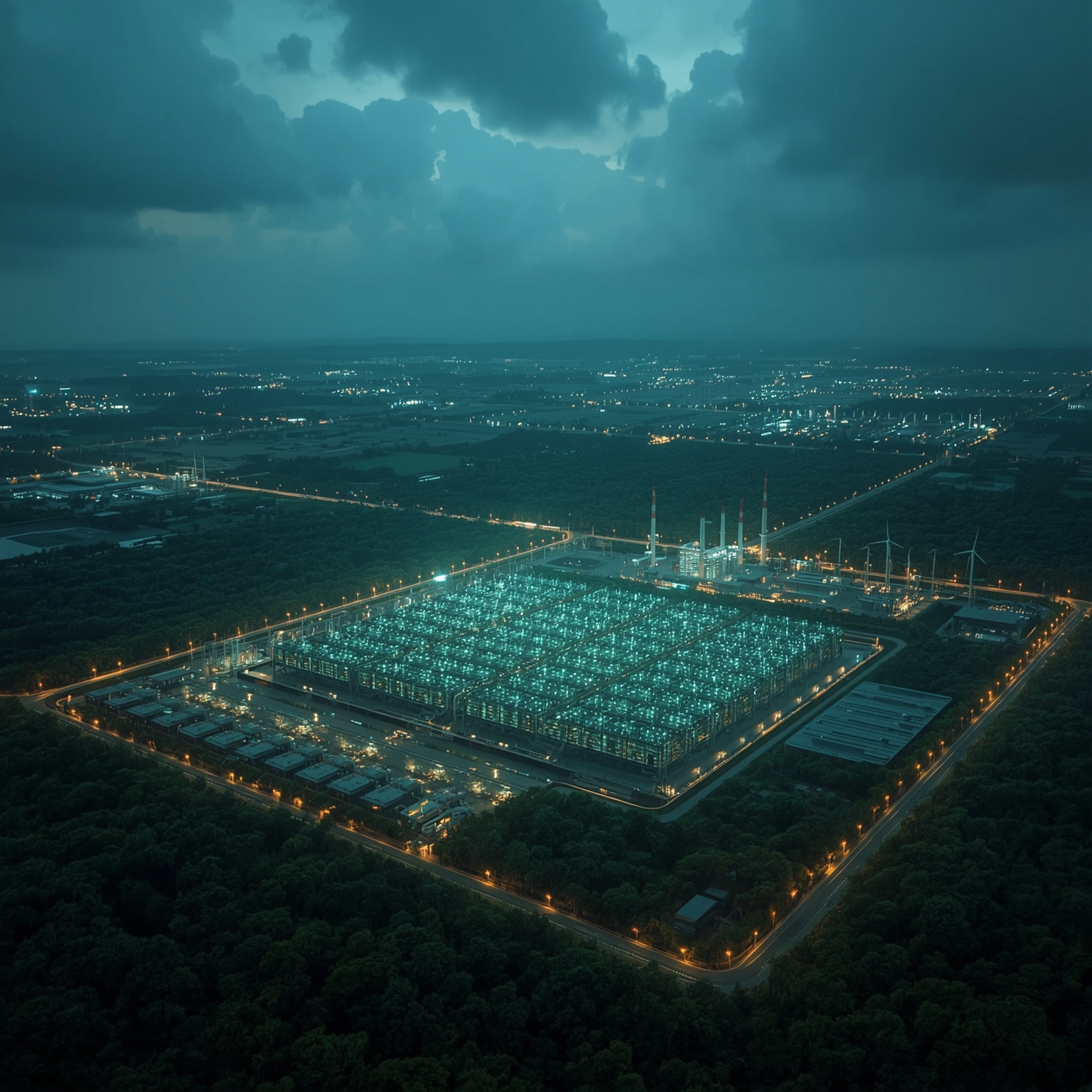
Google’s newest commitment to advancing clean energy solutions has drawn both attention and controversy because, rather unexpectedly, its latest investment focuses on a gas-based power venture. Specifically, the technology giant has pledged support for a gas-fired power facility equipped with sophisticated carbon filtration systems intended to capture and store the plant’s greenhouse gas emissions deep underground. This initiative, though presented as part of the company’s broader sustainability strategy, has prompted widespread debate: is it a clever attempt to reconcile energy reliability with environmental responsibility, or merely another fossil fuel enterprise disguised in eco-friendly rhetoric?
The project in question is the Broadwing Energy Center, a proposed gas-fired power plant located in Illinois. Google recently entered into an agreement to facilitate the development of this facility, which will employ carbon capture and storage (CCS) technology. The principle behind CCS is deceptively simple but technically complex: carbon dioxide released during energy generation is trapped before it enters the atmosphere and then stored safely beneath the Earth’s surface. By doing so, developers aim to prevent the steady accumulation of heat-trapping gases that accelerate planetary warming. Conceptually, CCS could help avert catastrophic climate tipping points—from rising sea levels that threaten to displace coastal populations to oceanic temperature surges that devastate coral ecosystems. Yet, despite its promise, this technology remains burdened by skepticism regarding its technical reliability, economic feasibility, and potential to prolong fossil fuel dependence rather than promote genuine renewable energy transformations.
Under the terms of this arrangement, Google intends to purchase the majority of the electricity generated by the 400-megawatt Broadwing plant once it commences operations, currently projected for 2030. The company has positioned this investment as part of its strategy to accelerate the commercialization of emerging CCS methods while gaining insights into their practical application. In its statement, Google emphasizes a commitment to innovative energy practices and a willingness to experiment with transitional technologies in pursuit of long-term carbon neutrality.
However, past attempts to implement CCS in the United States have not inspired confidence. According to a detailed 2021 report by the Government Accountability Office, the Department of Energy had spent approximately $684 million on six major CCS demonstration projects at coal plants, of which only one successfully reached operational status. The remainder succumbed to budget overruns, unviable economics, and technical complications. The same report concluded that DOE funds had been largely exhausted without corresponding progress, underscoring the fragile financial foundation upon which many CCS projects rest.
Independent cost assessments further highlight another barrier: electricity produced from CCS-integrated power stations generally costs between one-and-a-half and two times more than energy derived from wind, solar, or even conventional gas and coal plants without carbon capture. Such expenses are hardly trivial at a time when U.S. power consumption—driven in part by the data-hungry operations of cloud computing and artificial intelligence—continues to rise, contributing to higher utility prices for consumers and businesses alike.
The sole DOE-backed CCS plant that achieved full operation in the U.S. came online in 2017 but was subsequently shut down during the pandemic years, when collapsing oil prices rendered its business model untenable. That project’s profitability depended on selling captured CO₂ for “enhanced oil recovery,” in which the gas is injected underground to push out stubborn oil reserves. When oil demand plunged, the economic rationale vanished, exposing fundamental contradictions in a system that seeks to mitigate emissions by simultaneously enabling more fossil fuel extraction.
The Broadwing Energy Center, by contrast, differs in important respects. Its feedstock is natural gas, which remains cheaper and somewhat less carbon-intensive than coal in the U.S. market. Moreover, the captured CO₂ will not be marketed for use in enhanced oil recovery but will instead be injected into a dedicated well roughly a mile underground, where it is expected to remain permanently sequestered. Google and its partners claim that this facility will capture and store up to 90 percent of the carbon dioxide it produces—a level of efficiency surpassing that of most previous CCS undertakings. If successful, the project could potentially demonstrate a model for integrating lower-carbon operations within the natural gas sector.
Yet serious environmental concerns persist. Natural gas, despite its cleaner-burning reputation, largely consists of methane—a greenhouse gas with a far greater short-term warming potential than carbon dioxide. Methane leakage frequently occurs throughout drilling, transportation, and storage processes, meaning that reductions achieved at the power plant level may be offset by upstream emissions. Additionally, gas plants emit other pollutants such as nitrogen oxides and particulate matter, which can adversely affect air quality and public health in neighboring communities.
By contrast, solar and wind energy developments do not generate comparable air pollution risks. In recent years, their deployment costs have fallen substantially, to the point that renewables now outcompete fossil fuels on price in many regions. Google has long been a leading global purchaser of renewable electricity, using its corporate power to accelerate the expansion of clean technologies that have become the fastest-growing contributors to new energy capacity worldwide.
However, conspicuously absent from Google’s latest announcement is any acknowledgment of this prior renewable energy leadership. This omission may reflect shifting political currents in the United States. Under the Trump administration, fossil fuel executives were appointed to senior government roles, funding for renewable programs was curtailed, and several offshore wind initiatives faced regulatory halts. Simultaneously, tax incentives for solar and wind are being phased out, whereas similar fiscal supports for CCS remain intact. Such policies have created a more favorable landscape for projects like Broadwing, which depend heavily on financial subsidies to remain commercially viable.
Ultimately, Google’s participation in this venture represents both an opportunity and a risk. On one hand, the company seeks to secure reliable energy supplies for its rapidly expanding data centers, whose electricity demand has surged in parallel with intensified artificial intelligence development. On the other, it exposes Google to criticism that its pursuit of technological innovation is entrenching reliance on fossil infrastructure just when the world needs to double down on renewable deployment. Whether this experiment will advance genuine decarbonization or simply polish the image of traditional energy production remains an open—and deeply consequential—question for the future of corporate climate responsibility.
Sourse: https://www.theverge.com/news/805682/google-data-center-gas-power-plant-carbon-capture


