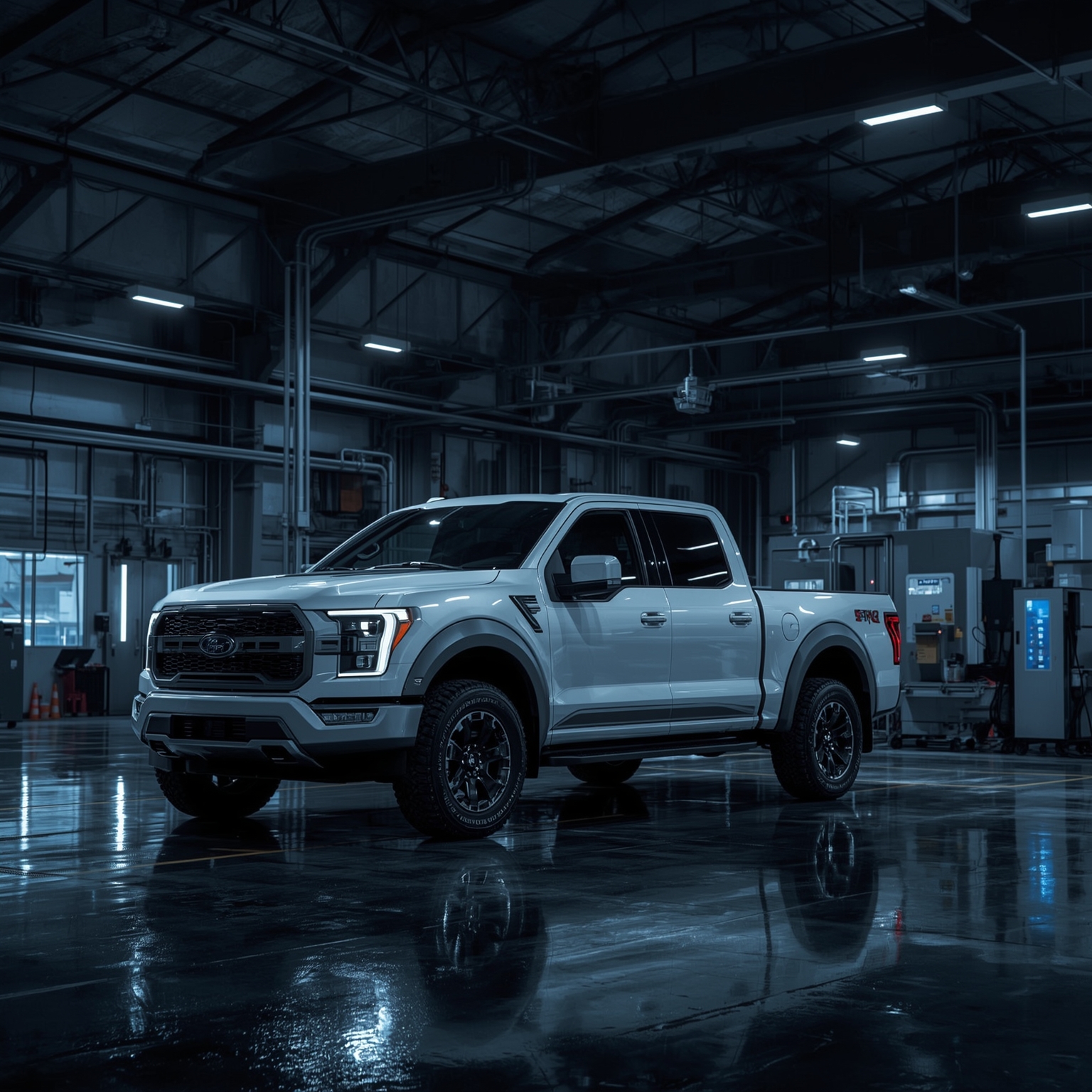
Ford Motor Company has elevated its gas-powered and hybrid versions of the F-150 and F-Series Super Duty trucks to the top of its production agenda, a deliberate move designed to mitigate the financial fallout stemming from a devastating blaze at a key aluminum supplier’s facility. This strategic reprioritization underscores Ford’s intent to stabilize operations and restore profitability while navigating supply chain turbulence triggered by the fire. The company’s flagship all-electric pickup—the F-150 Lightning—has notably been excluded from these production priorities, signaling a calculated pause on its manufacturing line.
On Thursday, Ford disclosed that the assembly of the F-150 Lightning, normally carried out at the Rouge Electric Vehicle Center in Dearborn, Michigan, would remain on hold until further notice. The reasoning behind this pause, according to the automaker, lies in the differing economic and material realities between its electric and traditional models. Gasoline and hybrid-powered F-Series trucks deliver substantially higher profit margins and require significantly smaller quantities of aluminum—an important consideration given the constrained metal supply resulting from the supplier fire. This resource-focused decision aligns with Ford’s broader financial prudence as the company seeks to balance innovation in electric mobility with the tangible profitability of its conventional product lineup.
Although the company has repeatedly emphasized the rising sales trajectory of its all-electric F-150 Lightning, those figures, when juxtaposed with its gasoline-driven counterparts, remain modest. In the third quarter, Ford managed to sell 10,005 units of the F-150 Lightning—an impressive 39.7% increase compared to the same period the previous year. Yet this growth is marginal when contextualized within Ford’s overall production volume of 545,522 vehicles during that quarter, of which an overwhelming 207,732 were F-Series trucks. As of 2025, cumulative Lightning sales reached 23,034 units, reflecting a year-to-date uptick of approximately 1% over the first nine months of 2024. These numbers, drawn from Ford’s latest sales data, illustrate both the progress of the automaker’s electrification efforts and the relative dominance of its internal combustion vehicle segment.
A Ford spokesperson clarified that, despite the F-150 Lightning’s status as the top-selling electric pickup in the United States, the company’s current operational focus is firmly oriented toward producing gas and hybrid F-Series models. This shift, the spokesperson explained, directly responds to the repercussions of the September 16 fire at Novelis’ aluminum plant in Oswego, New York—a critical supplier whose damaged hot mill has disrupted supply continuity. Novelis, in its own statements, has indicated that it aims to restart operations by December 2025, offering Ford a timeline for eventual recovery of its aluminum sourcing pipeline. “We currently have sufficient inventory of the F-150 Lightning and will restart the Rouge Electric Vehicle Center when market conditions and supply stability align, although no precise date has yet been set,” said Ian Thibodeau, Ford’s representative, encapsulating the company’s patient but deliberate stance.
The fire at the Novelis facility has proven exceptionally costly for Ford, both financially and strategically, by hampering the production of its most lucrative vehicles. According to Ford’s third-quarter earnings report, the incident could diminish fourth-quarter earnings by up to $2 billion. Compounding this challenge is a further financial strain of approximately $1 billion in tariff-related headwinds. These combined pressures compelled Ford to revise its projected full-year profit for 2025 downward—from an earlier forecast of $6.5 billion to a more conservative $6 billion. This adjustment reflects the company’s pragmatic recalibration of expectations in light of unforeseen external disruptions.
In response, Ford has devised a recovery plan centered on bolstering output of its core F-Series models. The automaker intends to expand production volume by more than 50,000 additional trucks in 2026 through the introduction of a third manufacturing shift. This operational expansion is anticipated to generate as many as 1,000 new jobs and will reassign all hourly employees from the temporarily idled Rouge Electric Vehicle Center to the nearby Dearborn Truck Plant, where the increased shift will take place. Through this initiative, Ford aims to not only offset losses incurred from the fire but also reinforce its dominant position within the U.S. truck market, reaffirming its commitment to sustained growth even amid industrial adversity.
Sourse: https://techcrunch.com/2025/10/23/ford-isnt-going-to-make-more-f-150-lightnings-for-a-while/


