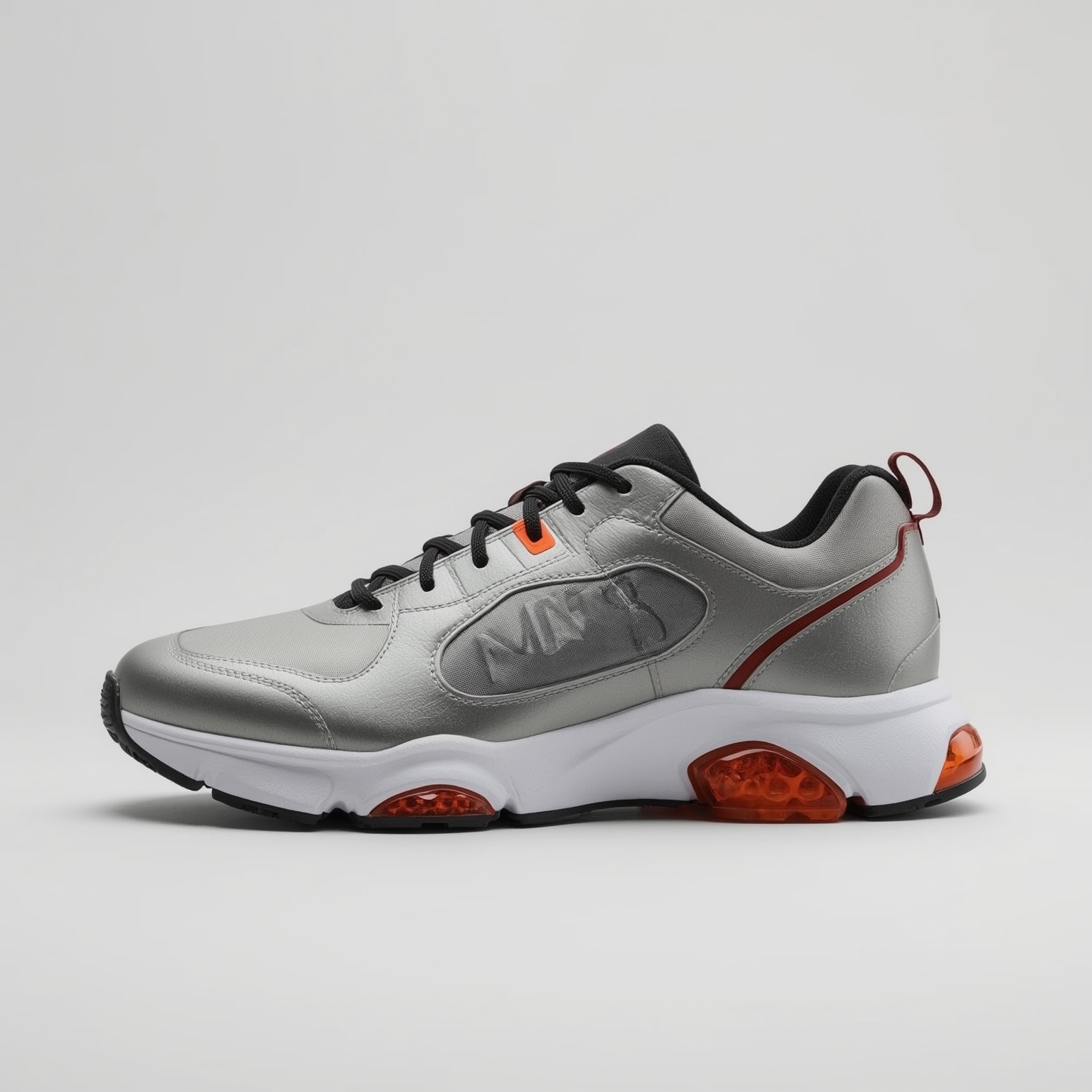
Nike’s latest creation, a new line of neuroscience-inspired footwear, represents a bold intersection between advanced cognitive research and athletic performance design. This innovative collection is meticulously engineered to stimulate an athlete’s brain activity both before the commencement of a competitive event and following its conclusion. Comprising two distinct models—the Mind 001, a slip-on mule priced at $95, and the Mind 002, a lace-up sneaker retailing at $145—the collection showcases a striking feature: each sole contains twenty-two vivid orange foam nodes strategically embedded and purposefully configured to respond uniquely to movement.
According to Nike, these soft yet resilient nodes are not merely aesthetic components but are designed to function dynamically and independently, moving vertically in ways reminiscent of miniature pistons and gimbals. This intricate mechanical behavior aims to reproduce the nuanced sensation of natural ground contact as the wearer walks or shifts their weight. The company asserts that this sensory simulation is underpinned by scientific principles indicating that stimulating the nerve endings in the foot can, in turn, activate specific regions of the brain associated with sensory perception and coordination. In essence, Nike’s new footwear seeks to create a feedback loop that enhances bodily awareness and mental engagement, reinforcing the connection between physical movement and cognitive readiness.
While Nike has not yet released the detailed scientific documentation supporting these claims, a company representative, Jay Paavonpera, stated in an interview with *The Verge* that an official white paper elaborating on the underlying technology is expected within several weeks. He emphasized that the prototype and final product designs were shaped through extensive research involving hundreds of athletes and thousands of cumulative hours of testing under real and simulated performance conditions. Such rigorous experimentation was intended to ensure that the footwear performs consistently across diverse athletic contexts, offering both comfort and neurological stimulation.
The concept and structure of the foam-node system were developed by the Mind Science division within the Nike Sport Research Lab—a specialized department devoted to exploring the relationship between biomechanics and cognitive processes. The company revealed that this team employed one of the handful of mobile imaging facilities in existence capable of simultaneously monitoring brain and body responses during motion. Graeme Moffat, the principal investigator of Mind Science, explained that the spatial distribution of the nodes was calculated so that wearers could experience distinct tactile feedback from each one. This precise placement accounts for the greater distance between nodes under the heel, where broader support is required, and their closer configuration beneath the ball of the foot, where finer sensation and control are essential.
Eric Avar, Nike’s vice president of innovation and creative director, describes the Nike Mind collection as a sensory-footwear concept designed to “reawaken” the natural communication pathways linking the foot, body, and mind. The shoe’s function, he explains, transcends traditional notions of cushioning and support by seeking to prime neural and physical readiness simultaneously. Historically, many of Nike’s designs have favored the maximization of comfort through plush materials and ergonomic contours; however, in response to a rising interest in minimalist styles such as Vibram FiveFingers or Crocs, Nike has also pursued products that reintroduce a more natural and proprioceptive experience, exemplified by the earlier Nike Free line. The new Mind range continues this evolution, merging sensory awareness with performance enhancement.
Visually, the Mind 001 will be available in a muted gray complemented by red accents, while the Mind 002 will debut in a classic gray tone. Both models will appear on Nike’s website under the category of “pregame” footwear—a designation emphasizing their function as mental and physical preparation tools rather than mere fashion statements or competitive gear. The shoes are slated for official release in January 2026, offering athletes the opportunity to explore how the intersection of neuroscience and design might redefine warm-up routines and recovery practices alike.
Sourse: https://www.theverge.com/news/806259/nike-mind-neuroscience-footwear-foam-nodes


