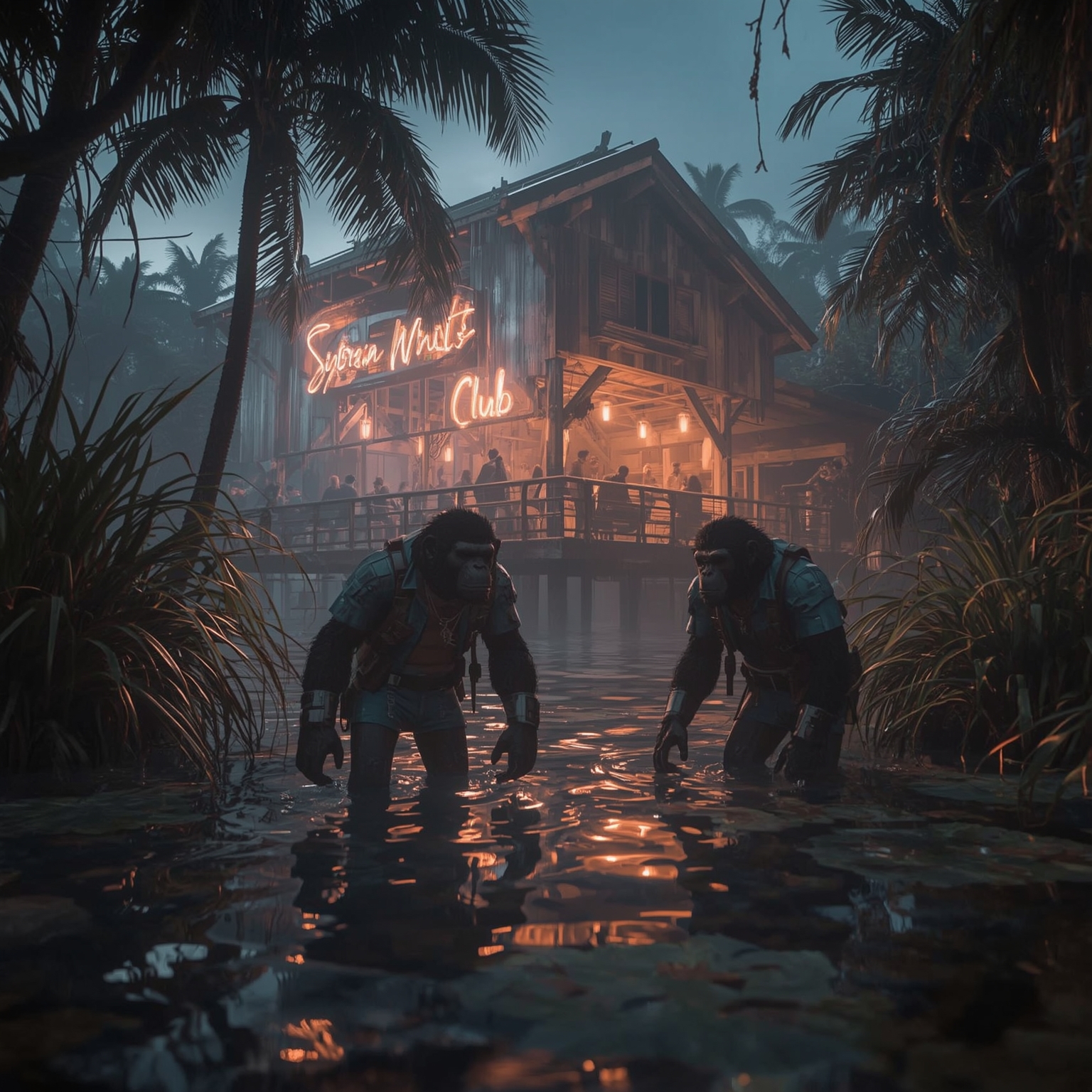
The evening descends into a dusky, humid haze, and the gentle chorus of insects fills the air with an irregular yet perpetual rhythm. I find myself meandering through a vast, simulated swamp — a surreal digital expanse where technology recreates the organic, every pixel dripping with an artificial kind of life. Off in the hazy distance, a deep, resonant thumping of bass reverberates through the virtual mud and mist, steering my path toward its mysterious source. Around me, little exists besides a sparse congregation of digital trees swaying in phantom breezes, and a few other wanderers whose flickering avatars shimmer faintly in the half-light. For the most part, it’s an experience of solitude — just me, my footsteps echoing softly, and that alluring pulse of sound emerging from a monumental, light-strung wooden structure perched farther into the swamp’s heart.
As I eventually draw near, the building looms above me like a relic of a bygone era given an uncanny electronic afterlife. This is the official clubhouse of the Bored Ape Yacht Club — a digital temple to one of the most notorious symbols of the NFT boom. I instinctively move toward its doorway, expecting entry into some hidden social chamber or interactive hub. Yet, the illusion quickly falters: the lights within gleam invitingly, but the doors remain firmly shut. No animation, no access, no interactivity. In that anticlimactic realization, there’s simply nothing to do but stand before a luminous, impenetrable monument to exclusivity.
These hesitant virtual steps mark my initiation into a world built around the once-ubiquitous cartoon primates that epitomized the excess and optimism of the NFT mania. While the speculative frenzy surrounding NFTs has cooled dramatically, Yuga Labs — the company that conceived the Bored Ape Yacht Club along with several other collections — is preparing a renewed foray into the digital frontier. Their latest endeavor reimagines another hype-laden term from the early 2020s: the metaverse. This new platform, aptly titled Otherside, aims to merge gaming, community, and digital ownership into a shared virtual realm.
Otherside’s gestation period has been long and scrutinized. Yuga Labs first revealed its intention to build it after securing a staggering $450 million in funding back in 2022. At the time, one of the project’s co-founders articulated an ambitious vision — an online world that would be “interoperable,” “gamified,” and “decentralized.” Those three promises hinted at a metaverse untethered from any one corporate ecosystem, where digital assets might move freely between different environments. Yet since that high-profile announcement, Yuga had been largely silent, until earlier this year when the company embarked on an early alpha test. Then, at the Las Vegas ApeFest — their annual community gathering — they finally confirmed a concrete launch date: November 12th will mark Otherside’s official debut.
“This is one of the most audacious and technically challenging ventures ever attempted in this space,” explained Michael Figge, Yuga Labs’ chief product officer, in a conversation with *The Verge*. “And at long last, it’s starting to take tangible shape.” His words convey both the scale of Yuga’s aspirations and the weight of expectation borne from years of anticipation.
Simplifying the concept, Otherside might best be described as a crypto-infused version of expansive digital platforms like *Roblox* or *Fortnite*. Within its interconnected virtual environments, users can embody NFTs as avatars and explore elaborate worlds conceived by both Yuga Labs and its broader player community. Entry into Otherside is designed to be flexible: participants can connect via a cryptocurrency wallet — a nod to the Web3 ethos — or bypass it entirely, logging in through standard credentials such as an email address. “Our philosophy is to create an environment with an exceptionally low barrier to entry,” Figge elaborates. “Once someone steps inside, they can begin to understand, almost intuitively, what it means to truly own digital property.”
Everywhere you turn within Otherside, the influence of blockchain culture is omnipresent. NFT-based avatars, tokenized parcels of virtual land, and cryptocurrencies pulsate through its economic core. Yuga’s aspiration is to cultivate a thriving creative economy built around these assets — one that rewards builders more generously than its competitors by ensuring that digital items are not confined within a single ecosystem. In principle, what you craft or acquire in Otherside could accompany you elsewhere. Yet, for users uninterested in blockchain complexities, the company insists participation need not be technical. You can simply run, explore, socialize, and entirely ignore the deeper webs of crypto mechanics.
Beyond the section I first visited — the murky yet eerily serene biome known as The Swamp — the full version of Otherside will feature more elaborate hubs. Chief among them is the Nexus, envisioned as a bustling central world connecting countless player-made experiences. Already, Yuga is highlighting community creations such as *Bathroom Blitz*, a chaotic shooter humorously advertised as “action so explosive you’ll be clenching cheeks the whole time,” and *Otherside Outbreak*, a game where players fight swarms of the undead. Additionally, creators can design their own “Bubbles,” sound-based social zones akin to Clubhouse or X Spaces, facilitating conversation within the 3D metaverse.
Figge believes the creative potential here is immense: “We see a tremendous opportunity for anyone interested in designing new experiences inside Otherside. Competing with industry giants in the user-generated space — names like *Roblox* or *Minecraft* — is no small ambition, but we think many creators are eager for fairer terms and new economic models.”
Yuga’s expansion also includes strategic collaborations: their in-game avatars, called Voyagers, are 3D manifestations of user-owned NFTs. “Any NFT collection can apply to have its avatars integrated into Otherside,” says Figge. Two early partnerships set the tone for this initiative. One, in collaboration with renowned digital artist Daniel Arsham, produces a limited run of 300 avatars; the other, a surprising alliance with Amazon, introduces *Boximus*, a tongue-in-cheek design composed entirely of stacked Amazon boxes. Figge confirms that this Amazon-branded avatar will even retail directly on the company’s main e-commerce site.
These Voyagers won’t be free, but Yuga intends them to mirror the familiar concept of purchasable “skins” from mainstream gaming. Although pricing has not been disclosed, Figge insists they will be “reasonable and affordable.” Their blockchain foundation, however, gives them a crucial differentiator — these avatars can be resold, an ability typically barred in traditional centralized games.
In my brief hands-on exploration of The Swamp, I felt as though I were navigating an oversized 3D social lounge more than a game. There were minimal mechanics — no combat, objectives, or structured progression — only open terrain for idle wandering and light conversation through text or voice chat. Judging a pre-launch build can be precarious, yet the experience evoked an uncanny similarity to Meta’s *Horizon Worlds* or the ephemeral, visually impressive but ultimately hollow “metaverse fashion shows” that once trended online, rather than the instant gratification of something like *Fortnite*’s dynamic multiplayer arenas.
The Swamp itself offered little beyond a handful of environmental curiosities: a locked outhouse sitting by stagnant waters, a dilapidated platform beside nonfunctional train tracks marked with a faintly glowing “out of order” sign, and the distant whisper of unseen wildlife. Just as I turned away from the platform, to my astonishment, a train roared past unexpectedly. I tried to chase it, but my avatar moved too slowly to catch up. Finding a nearby glowing portal, I leapt through, catapulted toward the speeding train — only to misjudge the landing and plunge inelegantly back into digital muck.
Assuming technical imperfections will be ironed out before release, and even imagining bustling crowds populating its regions, the fundamental question remains whether Otherside can transcend the limitations that plague many social-oriented 3D environments. Historically, such worlds — with the notable exception of breakout successes like *VRChat* — attract niche followings rather than broad audiences. The giants of the genre, *Roblox*, *Minecraft*, and *Fortnite*, succeed precisely because they blend social interaction with compelling gameplay loops. Without that crucial interplay, a metaverse risks feeling directionless, no matter how visually rich.
With its heavy emphasis on crypto and digital ownership, Otherside may initially struggle to capture that same mass appeal. Still, there’s room for cautious optimism: many of today’s juggernaut platforms began as modest experiments that evolved organically into cultural touchstones. Perhaps Yuga Labs can replicate that trajectory, transforming Otherside into something genuinely engaging and sustainable. For now, though, skepticism lingers — and for my part, I doubt you’ll find me spending too much time on the other side.
Sourse: https://www.theverge.com/tech/806492/bored-ape-yacht-club-bayc-crypto-metaverse-otherside-yuga-labs


