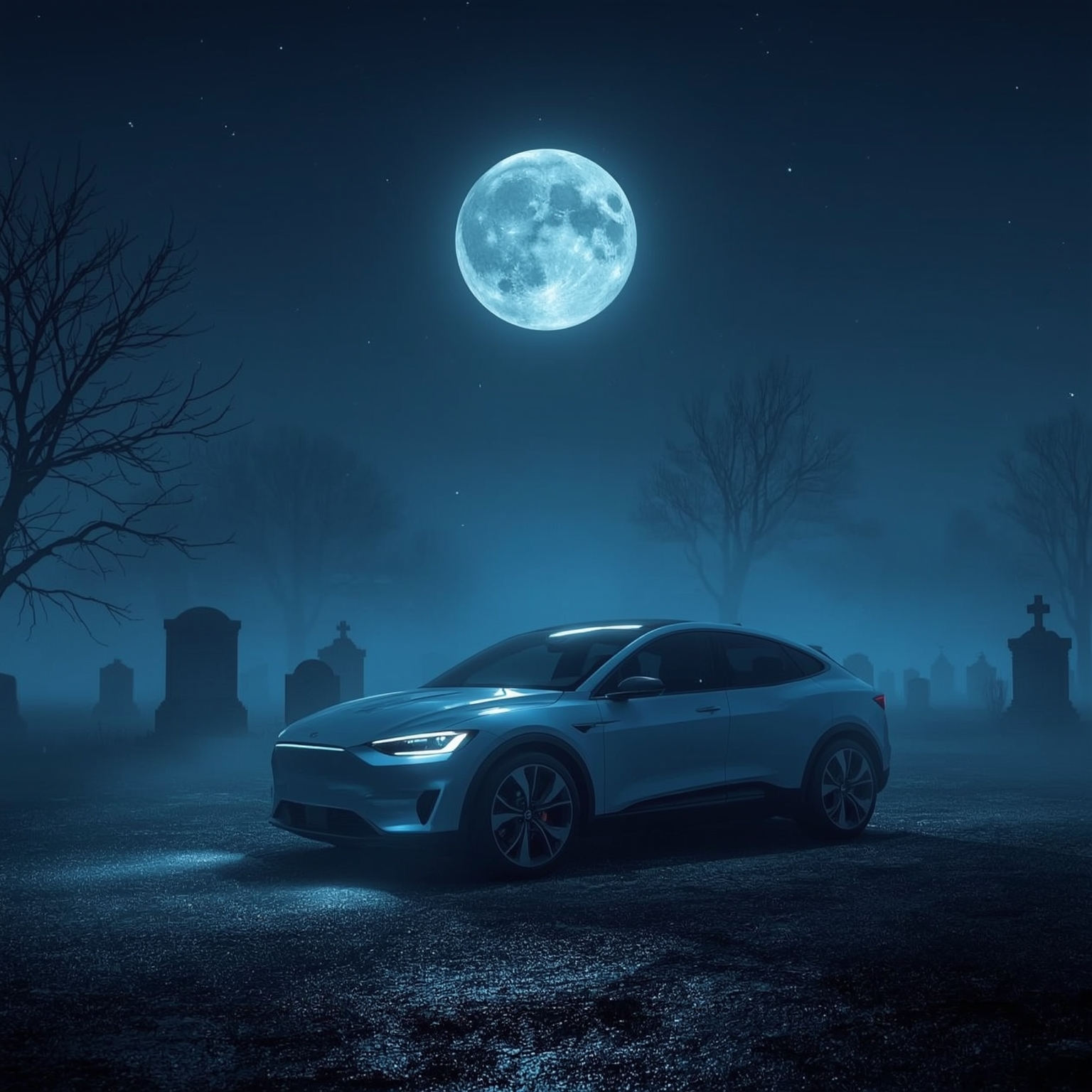
Just last week, a short but wildly popular TikTok video captured the internet’s imagination by featuring a man theatrically pretending that his Tesla’s array of exterior cameras allowed him to glimpse spectral figures—ghosts, supposedly—appearing on the car’s infotainment display. The timing, of course, coincided perfectly with the Halloween season, adding to the clip’s playful eeriness and viral appeal. To date, this amusing piece of digital theater has attracted roughly eleven million views, a testament to the public’s enduring fascination with both technology and the supernatural. So, a festive Halloween greeting to that imaginative driver—and to you as well.
Now, if you happen to be a seventeen-year-old plotting a mischievous thrill for your younger sibling this week, you might be tempted to replicate the viral stunt by driving your parents’ Tesla through the silent rows of a local cemetery, gleefully pointing to the so-called “ghosts” that seem to materialize on the vehicle’s display. While I can’t, and certainly won’t, forbid you from doing so, I would politely urge caution—not for reasons of safety, but for the sake of logic, even within the realm of ghost stories. Cemeteries, with their tombstones and decaying remnants, may be natural habitats for zombies, ghouls, or skeletons in popular imagination, as these creatures belong to the domain of the physically reanimated dead. Ghosts, however, are something different: lingering spirits of the departed, typically tethered to places charged with personal meaning or trauma—houses they once inhabited, hospitals where they took their final breath, or even sites of sudden tragedy such as car accidents. But perhaps we need not dwell too long on that particular example.
Interestingly, this intersection between automotive technology and imagined hauntings isn’t entirely new. Back in 2021, a Tesla driver visiting a cemetery posted footage online claiming that the car had mistakenly identified a graveside flower arrangement—essentially a vase of blooms—as a walking pedestrian. The creator’s post suggested a spooky malfunction, and the eerie tone resonated across social media, earning an astonishing twenty-three million views. What might have looked like an unnerving ghost detection was almost certainly a simple technical misinterpretation. Teslas, after all, lack LIDAR—laser-based sensing capable of generating three-dimensional environmental maps—and rely instead on cameras and ultrasonic input. This design decision increases the possibility of visual confusion: mistaking upright, object-shaped forms such as floral tributes, lampposts, or roadside signs for human figures. The company itself acknowledges such limitations. As the Tesla Model 3 owner’s manual plainly states, the vehicle’s collision-avoidance system cannot reliably identify all objects, pedestrians, cyclists, or other vehicles, and users may occasionally receive inaccurate alerts or miss genuine hazards because of imperfect data interpretation.
It’s reasonable, then, to assume that the system in 2021 was simply erring on the side of caution—an algorithmic overreaction born of uncertain inputs. Such false positives, while arguably harmless in isolated moments, can hint at more disquieting systemic issues. In fact, that same year, Tesla temporarily recalled nearly twelve thousand vehicles from its fleet because software errors in the object-detection framework sometimes triggered abrupt and unnecessary braking events during assisted driving mode, or what the company branded at the time as the “Full Self-Driving Beta.” The phenomenon—appropriately nicknamed “phantom braking”—caught the attention of the U.S. National Highway Traffic Safety Administration (NHTSA), which launched an investigation after numerous users reported startling and unexplained decelerations. Members of the Tesla Motors Club forum described their experiences in detail, explaining that the cars occasionally reacted to illusory threats, like fleeting shadows or shifting light patterns, that any human driver would have recognized as harmless. One memorable account involved a shadow cast by a bird soaring overhead—perhaps something a raven might contribute to a Halloween narrative—but the poster refrained from embellishment.
Fast forward more than four years, and Tesla’s sensing technology has once again evolved, shedding some of its earlier hardware components. Most notably, the company’s current vehicles have eliminated ultrasonic sensors, a change Tesla describes as a leap toward higher precision. According to a recent update on Tesla’s official website, the revised system now provides Autopilot with improved spatial awareness, greater range of visibility, and an enhanced ability to distinguish between different types of objects. On paper, this marks a significant refinement in perception capabilities, promising both heightened accuracy and efficiency in automated driving.
Yet with these improvements comes, ironically, the next generation of allegedly supernatural glitches. The new viral videos depict cars that, under the cover of night, confuse headstones or decorative cemetery features for moving pedestrians—a continuation of the same comedic misunderstanding, but with upgraded equipment. The influencer behind the most recent Halloween-themed TikTok, it should be noted, had already produced a similar video earlier in the season, this time as part of an advertising partnership for festive decorations. In that earlier instance, too, the Tesla’s vision system supposedly mistook prop skeletons and ornamental figures for living people, offering further proof that the car’s ghost-detecting reputation remains very much alive in the public imagination.
Gizmodo has since contacted Tesla seeking clarification on whether recent software or hardware modifications could account for these persistent misinterpretations and whether additional safeguards are in place to prevent them. For now, the company has yet to comment—but even without an official explanation, one can safely conclude that these pixelated “spirits” haunting Tesla screens are born not of the supernatural, but of the fascinating imperfections that still accompany advanced machine perception.
Sourse: https://gizmodo.com/tesla-ghosts-halloween-2000675877


