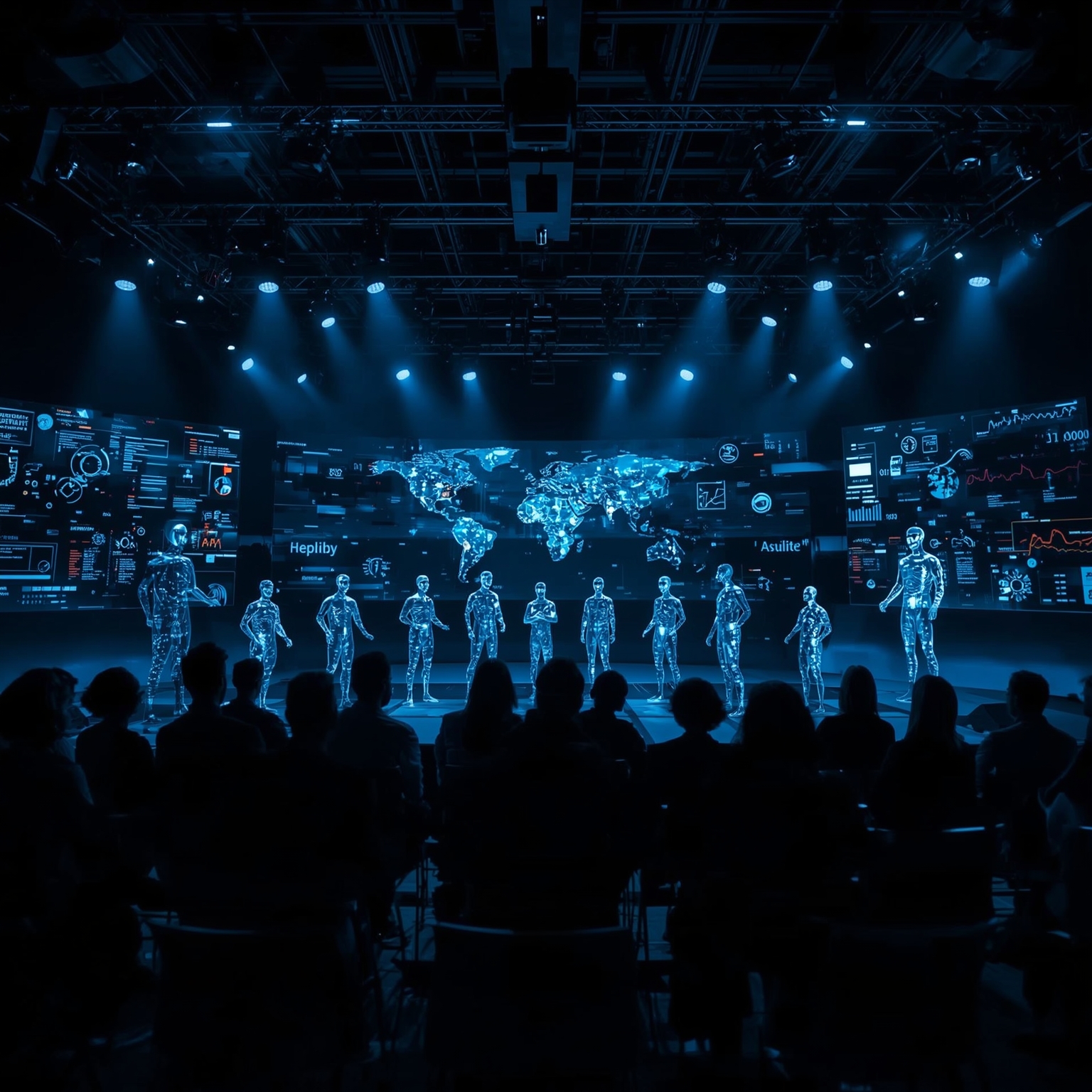
The HLTH conference has long been recognized as one of the healthcare industry’s most spectacular and attention-grabbing gatherings, a stage where innovation meets grandeur. Unsurprisingly, the 2025 edition stayed true to its reputation, overflowing with anticipation and exuberance for the rapidly advancing world of health-focused artificial intelligence. Yet, beneath the glossy surface of futuristic optimism and polished showmanship, a subtler and more complex current pulsed through the event — a collective sense of weariness toward AI’s relentless momentum, apprehension about emerging power players, and an uneasy awareness that the sector might be floating precariously within an inflated bubble.
Venture capital investing in healthcare technology now mirrors the tech industry’s paradoxes almost uncannily: immense opportunity shadowed by market saturation and strategic fatigue, though the scale is smaller by hundreds of billions of dollars. Investors are eagerly channeling vast sums into startups claiming that their algorithms will revolutionize operations and unlock enormous efficiency gains. Critics, however, question whether these systems will deliver tangible value or merely inflate expectations through glossy marketing. Meanwhile, established technology titans such as Google and Microsoft are exerting growing pressure on the ecosystem, joined by the formidable new generation of AI powerhouses like OpenAI and Anthropic, whose accelerating pace threatens to absorb or outcompete smaller innovators. Voices are also rising to warn that entire subsectors — notably hospital administration automation — may already be overcrowded, trapping new entrants in an echo chamber of indistinguishable solutions.
Amid all this tension, HLTH 2025 in Las Vegas appeared determined to maintain its characteristic effervescence. The exhibition floor gleamed with companies showcasing ever-more ambitious AI agents, each promising personalized insight and intelligent assistance. Banners and booths shouted slogans such as Innovaccer’s confident declaration, “Your data. Our agents. Real outcomes.” SoundHound beckoned attendees to interact with its vocal AI assistants tailored specifically for healthcare applications. Regal, another enterprise AI contender, lured visitors with cheerful promises of free popsicles for anyone curious enough to call and speak with its automated voice agent. At the heart of the venue, a sprawling “AI Zone” — complete with an “AI Theater” dedicated to startup showcases — symbolized AI’s omnipresence to the point of redundancy, a spectacle within a spectacle.
The repetition was draining for many attendees. One executive from a major health system, choosing anonymity to avoid conflicts with internal communication rules, summarized the mood bluntly: countless vendors offered vague, enterprise-wide solutions so uniform and exaggerated that one could feel physically ill from the sameness. What professionals truly wanted, the executive stressed, was not another visionary narrative but evidence of concrete, real-world impact — assurances that these tools function today, not promises of what might arrive tomorrow.
Given the surge of financial flows, this monoculture of messaging was anything but unexpected. According to data from Rock Health, healthcare-oriented AI startups attracted a staggering $6.4 billion in venture capital during the first half of 2025, with nearly two-thirds of that funding going exclusively to AI-driven enterprises. Still, the optimism among investors faces difficult realities: incumbent organizations are entering the field with increasing assertiveness. Epic Systems, the omnipresent medical records giant, skipped exhibition booths this year, yet its shadow hung unmistakably over the discussions. In August, Epic revealed plans to market its own AI-driven healthcare tools, including a digital scribe designed to rival Abridge — a company once partly owned by Epic before the firm divested its stake. Meanwhile, OpenAI made its most visible foray yet, with its new head of healthcare strategy, Nate Gross, sharing the stage with senior executives from Microsoft, Google, and Nvidia. Although Gross offered few concrete details, his mere presence signified how seriously the organization now regards healthcare as a domain of expansion and influence.
Investors acknowledged that OpenAI and Anthropic are now perceived as existential threats to the startup landscape. NEA partner Blake Wu observed that entrepreneurs view these AI juggernauts as more menacing disruptors than even Amazon or Microsoft — companies historically regarded as the ultimate competitive giants — largely because the newer players have advanced into numerous categories with unprecedented speed.
HLTH, as always, carried an aura of paradox. Hosted in the extravagant Venetian Resort, the event merged healthcare innovation with Las Vegas spectacle: late-night gatherings intermingled with the constant hum of casino floors, the scent of tobacco drifting through networking sessions. The setting itself seemed to embody the contradictions of the industry — innovation entangled with risk. Between panels, attendees could unwind by playing pickleball at a court sponsored by WeightWatchers, pet dogs in a “puppy park” promoted by Zelis Healthcare, or pose alongside oversized unicorn mascots symbolizing billion-dollar valuations. As one participant quipped, HLTH has essentially become the Dreamforce of healthcare — an immersive, exuberant manifestation of an industry chasing transformation while savoring its own showmanship.
AI pervaded every corridor, conversation, and showcase, intensifying the déjà vu of abundance. Although the healthcare sector has avoided the kind of speculative bubble engulfing the broader tech economy, investors continue to fund AI-centric ventures with fervor. Notable announcements included OpenEvidence’s $200 million raise at a $6 billion valuation — the largest at the conference — and Hyro’s $45 million round, led by Healthier Capital under the guidance of One Medical’s former CEO Amir Dan Rubin. Panel discussions revealed stark contrasts: some venture capitalists championed aggressive investment as essential for dominance, while others urged caution as deep-pocketed incumbents like Epic and OpenAI began encroaching on territory previously safe for startups. Anthropic’s launch of its “Claude for Life Sciences” platform underscored the biotech turn of large-scale AI firms, while OpenAI hinted at ambitions spanning from consumer wellness to hospital workflow enhancement.
Gross noted that ChatGPT now attracts approximately 800 million weekly users — an audience that no single health organization could ever dream of reaching. This immense user base, he explained, creates possibilities for continuous engagement, enabling AI systems to refine their accuracy through longitudinal interaction with patients and consumers. Yet not everyone in healthcare views this progression with optimism. Experts like Mary Beth Navarra-Sirio of UPMC Enterprises reminded attendees that the history of tech’s attempts to disrupt healthcare is littered with failed experiments. Superior algorithms alone, she warned, cannot succeed unless they fully grasp and support the intricate realities of clinical practice.
By the final day of HLTH, participants found camaraderie in commiserating about the incessant repetition of AI themes. A viral social media post captured the sentiment: “Every booth at HLTH sounds exactly the same. ‘AI-powered platform for healthcare transformation.’ Cool. So does literally everyone else here.” Even the event organizers acknowledged this saturation, devoting an entire session to the provocative question, “If Everything is AI, Then Nothing is AI.” The panel description openly recognized the peak of the AI gold rush — when every startup touting a cursory ChatGPT integration claims AI expertise and every presentation overflows with buzzwords.
Despite this, highlights of genuine progress emerged. Representatives from major biopharmaceutical companies such as GSK, Novartis, and City of Hope shared specific examples of AI reshaping research and streamlining clinical trial recruitment. Meanwhile, women’s health received long-overdue attention, with companies focusing on menopause and other underserved areas earning a spotlight. Digital campaigns for Midi Health, led by CEO Joanna Strober, illuminated HLTH’s hallways, embodying this renewed visibility. In parallel, responsible innovation took center stage: startups like Spring Health unveiled systems to benchmark mental health chatbots, while the American Heart Association announced a dedicated laboratory to scrutinize predictive AI models for cardiovascular risk, partnering with Dandelion Health.
In the words of Milad Alucozai of Pamir Ventures, the most discerning investors are now prioritizing responsibility over speed. The prevailing sentiment among this thoughtful minority was clear: success in healthcare AI will no longer be measured by how quickly a product ships, but by how safely and intelligently it serves real human needs. Thus, HLTH 2025 distilled a powerful paradox — an ecosystem shimmering with excitement yet shadowed by exhaustion, as the promise of intelligent healthcare confronts the sobering reality of trust, risk, and regulation.
Sourse: https://www.businessinsider.com/hlth-the-dreamforce-of-healthcare-ai-hype-met-fear-2025-10


