The Metro North train bound for New York City came to an unexpected halt when torrential rain flooded the tracks, leaving passengers, myself included, immobilized for hours. The timing could not have been worse: I missed one of the few weekly ‘Ladies Night’ open mic sessions—a small but precious window for stage time. Typically, I devote three hours for a round-trip journey and pay five dollars for the privilege of performing for exactly five minutes. Yet that evening turned into an ironic marathon: five hours of travel undertaken only to miss those elusive five minutes behind the microphone. In an act of consolation, I exchanged my five-dollar stage fee for a beautifully brewed cup of coffee at Grand Central Terminal. Standing beside fellow stranded commuters, I sipped that rich, aromatic drink and thought about how life, much like comedy, finds peculiar ways to subvert expectation.
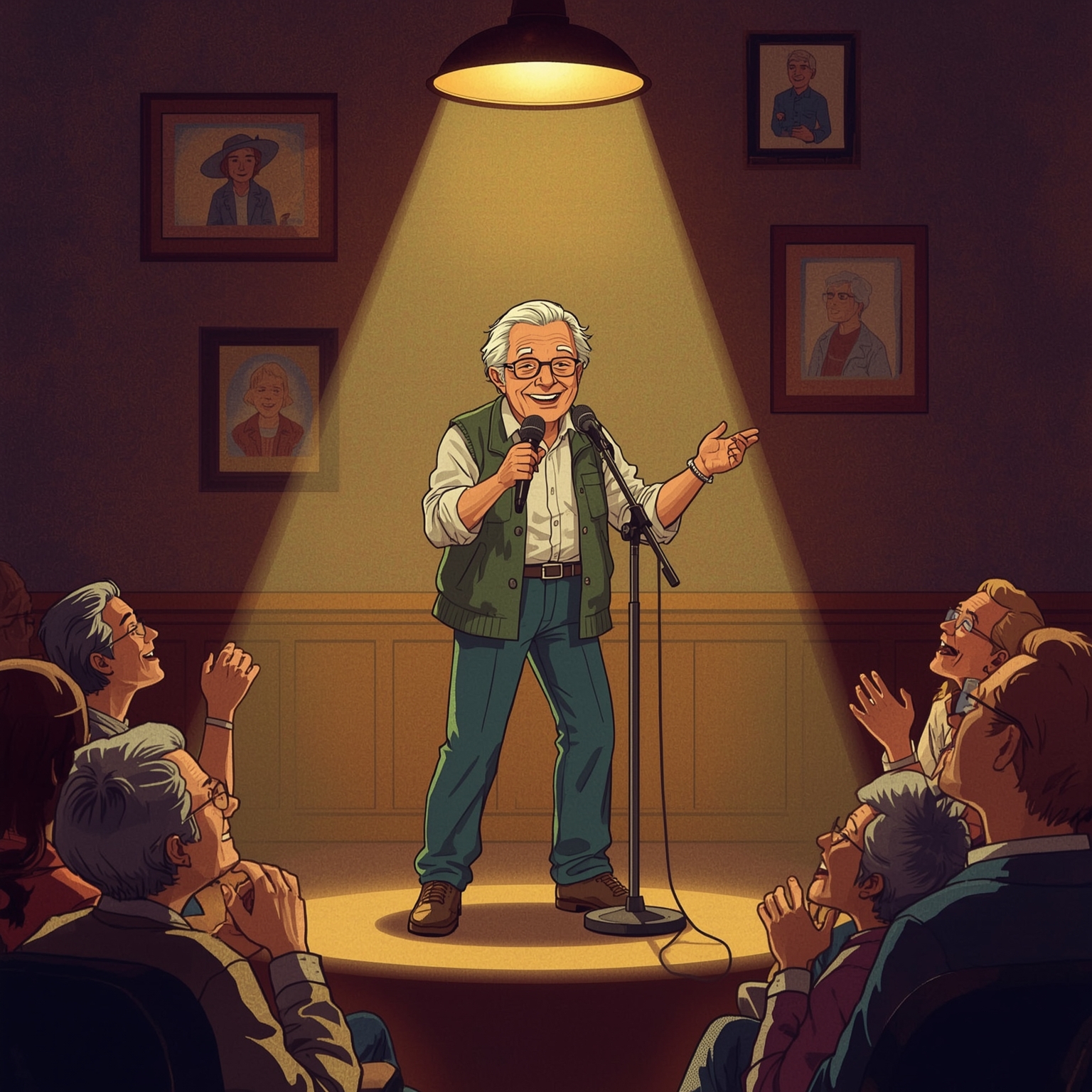
Now, at sixty-eight, I find myself embarking on what feels simultaneously like an improbable and exhilarating venture—a formal career in comedy. The decision may seem impulsive to some, yet it’s the culmination of a lifetime of quiet preparation. For forty-two years, I labored within the rigid structures of Information Technology, mastering various roles from technical writer to systems analyst. Despite my long tenure, even my closest acquaintances—let alone my parents—never entirely grasped what I did for a living. They only knew that I paid the bills, raised a family, sustained a mortgage, and kept life running smoothly. While the world saw a reliable professional, beneath that surface lived a secret performer—a person who scribbled jokes in margins, crafted humorous essays no one read, and performed for tiny crowds in dimly lit community spaces for little more than applause.
These days, as many of my contemporaries are discovering the thrill of pickleball, crossing oceans to explore Portugal, or fine-tuning their golf swings under serene blue skies, I find myself keeping company with an eclectic mix of would-be comics: high schoolers practicing timing between math homework, ex-lawyers reinventing themselves, Wall Street refugees chasing creative redemption, tired homemakers reclaiming agency, and silver-haired dreamers like me. We gather in the neglected corners of bars thick with stale beer and ambition, where microphones hum and laughter—when it comes—feels like gold. Each night, amid the haze and heckling, I practice shaping the raw clumsiness of my jokes into something sharper, funnier, more alive. For the first time in decades, I feel not older, but newly awakened, as if my life is only beginning to unfold.
As a child, humor was already my native language. Among five siblings, I occupied the precarious middle spot—the only one with extra baby fat and an insatiable need for attention. To stand out, I became the household clown, the purveyor of punchlines, the miniature master of ceremonies keeping parental fatigue at bay with exaggerated gestures and quips. In that chaotic sea of competition, laughter became my currency and survival tool. My family delighted in my antics, cheering me on whenever I commandeered the makeshift stage of the local Y’s multipurpose room. Those small moments foreshadowed something I would not recognize until much later—that comedy was not merely a hobby but a calling.
Even during my corporate years, I could not suppress my humorous instincts. My creative outlet took the form of parody songs composed on weekends while I navigated the more sober and precise demands of Information Technology. My professional titles—technical writer, promotional copywriter, quality assurance analyst, project manager—painted the picture of a logical mind, yet beneath the spreadsheets and system tests, a mischievous sense of irony waited for release. That duality defined much of my adult life: responsible breadwinner by day, humble jester by night.
When people now ask why I waited so long to embrace stand-up full-time, I can only smile and say it’s because I have long been a devout lover of creature comforts—and those comforts require financing. I have a weakness for shopping at places like Whole Foods and Williams Sonoma, and I confess I prefer dining out to cooking, lest my prized sauté pan lose its near-mythical shine. The steady rhythm and predictability of office work, though sometimes stifling, financed my penchant for indulgence and funded a family life that brought stability and purpose.
Even within that structured environment, humor seeped through the cracks. I still remember my very first professional job: a glass cubicle in a psychologically toxic office where the fluorescence flickered like bad mood lighting. My survival mechanism was snark. My running commentary on managerial absurdities amused my cubemate so profoundly that he began recording my quips in what we called the ‘quote log.’ That coworker eventually became my husband; decades later, we remain inseparable—and yes, we still have that notebook, yellowed at the edges but brimming with laughter that marked the beginning of our shared story.
Over the years, I have filled drawers, shelves, and countless notebooks with half-finished jokes and random one-liners. Comedy, I’ve discovered, is a paranoid artist’s pursuit—the fear of forgetting a truly good line never fades. Often, I stumble across those abandoned fragments while searching for something entirely mundane, like a missing tax receipt or my phone charger, and those rediscovered scraps bring back flashes of inspiration.
So why now? Why begin anew when so many peers are winding down? Perhaps because the last few years—marked by menopause, a global pandemic, and an honest reckoning with my financial planner—have reorganized my sense of what truly matters. The planner, to my astonishment, predicted that I could maintain my lifestyle until the age of ninety-six, even after adjusting my overstated income. That revelation, paired with the relief of emerging intact from a worldwide crisis, granted me the freedom to finally turn toward the thing that had waited patiently for decades: comedy.
I do not, however, enter this late-life endeavor with naive optimism. I am acutely aware that comedy is hard, merciless work. Becoming good is a feat. Becoming great is nearly miraculous. Every laugh must be earned through repetition, revision, and ruthless editing. Crafting a five-minute set demands months—sometimes years—of trial and error: cutting the flab, sharpening the rhythm, rehearsing until spontaneity looks effortless. A comedian who appears to improvise is, in truth, performing an intricate symphony of memory and timing. Yet within that structure must live the capacity to seize the unexpected—to transform the room’s energy, a misplaced glass, or a stray audience murmur into gold. Comedy, paradoxically, is written like prose but lived like poetry.
Many people, understandably, drop out long before mastery. Rejection, silence, or mild chuckles grind away ambition. But I persist, dragging my protesting body—plantar-fasciitis feet and arthritic hips included—through doorways sticky with beer for the faintest chance to improve. Ironically, those physical indignities have become part of my routine, folded into my act alongside my age, my body, and my long-suffering husband. Experiencing discomfort, it turns out, gives one an endless reservoir of material.
What astonishes me most, however, is discovering that I am not alone. On many nights, I’m not even the oldest performer on the lineup. A lively subculture of retirees and midlife dreamers now populates comedy clubs, trading pensions for punchlines. We are all chasing the same shimmering ideal—the moment when an observation lands perfectly, connecting the deeply personal with the universally recognizable. Those moments are the purest form of human alchemy, and when they happen, the rush is electric.
And so, with microphone in hand and an unshakeable spirit, I have joined the modern-day gold rush—not for wealth, but for laughter. It is a treasure mined from vulnerability and persistence, and each laugh feels like proof that it’s never too late to begin again.
Ivy Eisenberg, writer and resident of White Plains, New York, continues to hone her voice both onstage and on the page. She is currently crafting a memoir chronicling her upbringing amid the groovy yet tumultuous 1960s in Queens, a borough that, much like her, has always balanced grit with humor.
Sourse: https://www.businessinsider.com/i-am-launching-stand-up-comedy-career-in-my-sixties-2025-10


