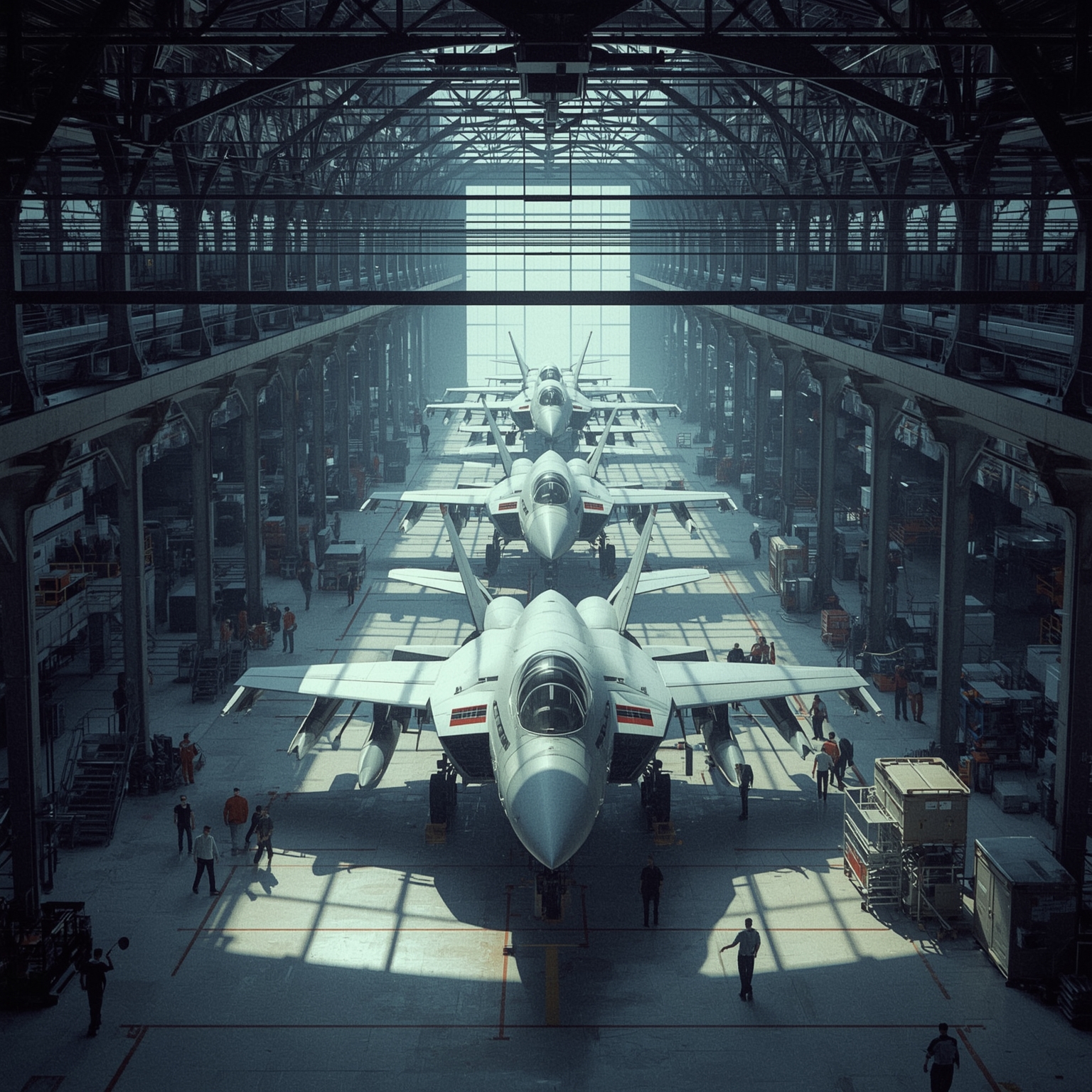
A prolonged labor dispute at Boeing’s major defense manufacturing facilities in the American Midwest has now entered its third consecutive month, marking one of the most enduring and consequential worker walkouts in the company’s long industrial history. Approximately 3,200 skilled machinists employed across three key Boeing plants located in Missouri and Illinois have remained on strike since the early days of August, withholding their labor from production lines that are central to the construction and maintenance of vital U.S. military assets such as the F-15 Strike Eagle, the F/A-18 Hornet, and several advanced missile components. The sustained absence of this workforce has increasingly disrupted operations that directly influence national defense readiness and the timely delivery of high-performance aircraft to the Pentagon.
The International Association of Machinists and Aerospace Workers (IAM), the powerful union representing these employees, announced on Sunday that its membership had decisively rejected Boeing’s latest proposed labor contract. In a sharply worded statement, union leaders argued that the company’s offer demonstrated a fundamental “disrespect” toward the very employees whose technical precision and professional discipline are responsible for keeping America’s aerial combat fleet airborne and combat-ready. The union further warned that the continuing strike poses a tangible “threat to military readiness,” emphasizing the broader national security implications of the stalled negotiations.
IAM President Brian Bryant elaborated on these grievances, stating that Boeing’s claims of listening to employee concerns ring hollow. “The results of today’s vote,” Bryant asserted, “make abundantly clear that Boeing’s corporate leadership has failed to seriously engage with the workers who design and assemble the world’s most sophisticated military aircraft—machines that directly protect both our service members and our country’s strategic interests.” He went on to urge Boeing to abandon what he characterized as a cost-cutting mentality and instead negotiate a contract that meaningfully recognizes the workforce’s exceptional expertise, loyalty, and sacrifice. “It is long past time for Boeing,” he added, “to stop shortchanging the very individuals whose dedication underpins its success and to agree to a fair, honorable deal.”
Throughout this impasse, union representatives have consistently demanded improvements to several core elements of the proposed contract. These include substantially higher employer contributions to workers’ retirement plans, wage increases that align with current inflation rates, and the extension of a $12,000 ratification bonus—already granted last year to Boeing’s commercial aircraft employees in the Pacific Northwest following their own major labor strike. According to IAM officials, the enhanced contract terms they have requested would require Boeing to spend an additional $50 million spread over four years, a sum they pointedly note equates to roughly half the manufacturing cost of a single F-15 fighter jet produced by these same unionized workers.
For Boeing’s part, the corporation expressed disappointment at the vote’s outcome, emphasizing in its official response that the result was extremely close—failing by a razor-thin margin of 51 percent to 49 percent. “The union’s public statement misrepresents the nature of the result,” Boeing commented, “as the final tally shows just how evenly divided members were on this latest contract proposal.” The company stressed that it is now preparing to implement the next phase of its contingency plan in order to support critical defense customers and maintain key production schedules. Boeing further maintained that it has been hearing from an increasing number of employees who are expressing a desire to return to work, indicating growing recognition of the offer’s financial value and long-term benefits.
Boeing’s most recent counterproposal featured a 24 percent cumulative wage increase to be implemented over five years, along with improved vacation and sick leave benefits. It also included a $1,000 retention bonus after four years of service and $3,000 worth of Boeing stock, vesting over a three-year period, designed to foster long-term employee investment in the company’s future success. Additionally, the proposal featured a $3,000 ratification bonus intended as an immediate goodwill gesture upon contract approval. Despite these offers, neither Boeing nor the IAM leadership responded to journalists’ follow-up requests for comment.
The ongoing strike comes just days before Boeing is scheduled to release its third-quarter earnings report on Wednesday—a time when analysts and investors are particularly focused on operational stability across its divisions. The company’s defense, space, and security units collectively account for roughly one-third of Boeing’s total corporate revenue, underscoring how crucial continued production is to both government contracts and shareholder confidence. The current standoff also follows on the heels of an even larger labor strike last fall, which saw approximately 30,000 machinists in Boeing’s Pacific Northwest commercial aviation plants reject their own contract proposal, leading to a seven-week work stoppage that ultimately concluded in November 2024.
Despite the scale and duration of the present conflict, Boeing CEO Kelly Ortberg attempted to downplay the potential repercussions during a July earnings call, suggesting that the Midwest strike’s magnitude is “much, much less” significant than last year’s mass labor action. “I wouldn’t worry excessively about the strike’s overall impact,” Ortberg remarked confidently. “We have contingency measures in place, and we will manage our way through this situation.” Meanwhile, Boeing has emphasized on its website that production continues at its St. Louis facilities—its primary hub for military aircraft manufacturing—thanks to the efforts of non-striking employees. This site is expected to play a pivotal role in producing the company’s next-generation F-47 air superiority fighter, a sixth-generation jet intended to bolster future U.S. aerial capabilities.
Many of the striking machinists also contribute to the development of other strategically important defense projects, including the T-7A Redhawk advanced training aircraft and the MQ-25 Stingray, an unmanned aerial refueling drone currently undergoing testing for the U.S. Navy. The timing of this labor dispute coincides with Boeing’s broader corporate campaign to rehabilitate its public and industry reputation after a series of high-profile safety failures in its commercial aviation division. These include three devastating crashes involving its 737 Max and 787 Dreamliner models since 2018 and the widely publicized mid-flight door plug failure in early 2024. Against this backdrop, Boeing’s recent success in securing the F-47 fighter contract from the Trump administration has been viewed as a rare and strategic victory, signaling a crucial opportunity for the aerospace giant to reaffirm its credibility and reliability within the defense sector.
Sourse: https://www.businessinsider.com/boeing-strike-drags-on-f-15-hornet-defense-plants-midwest-2025-10


