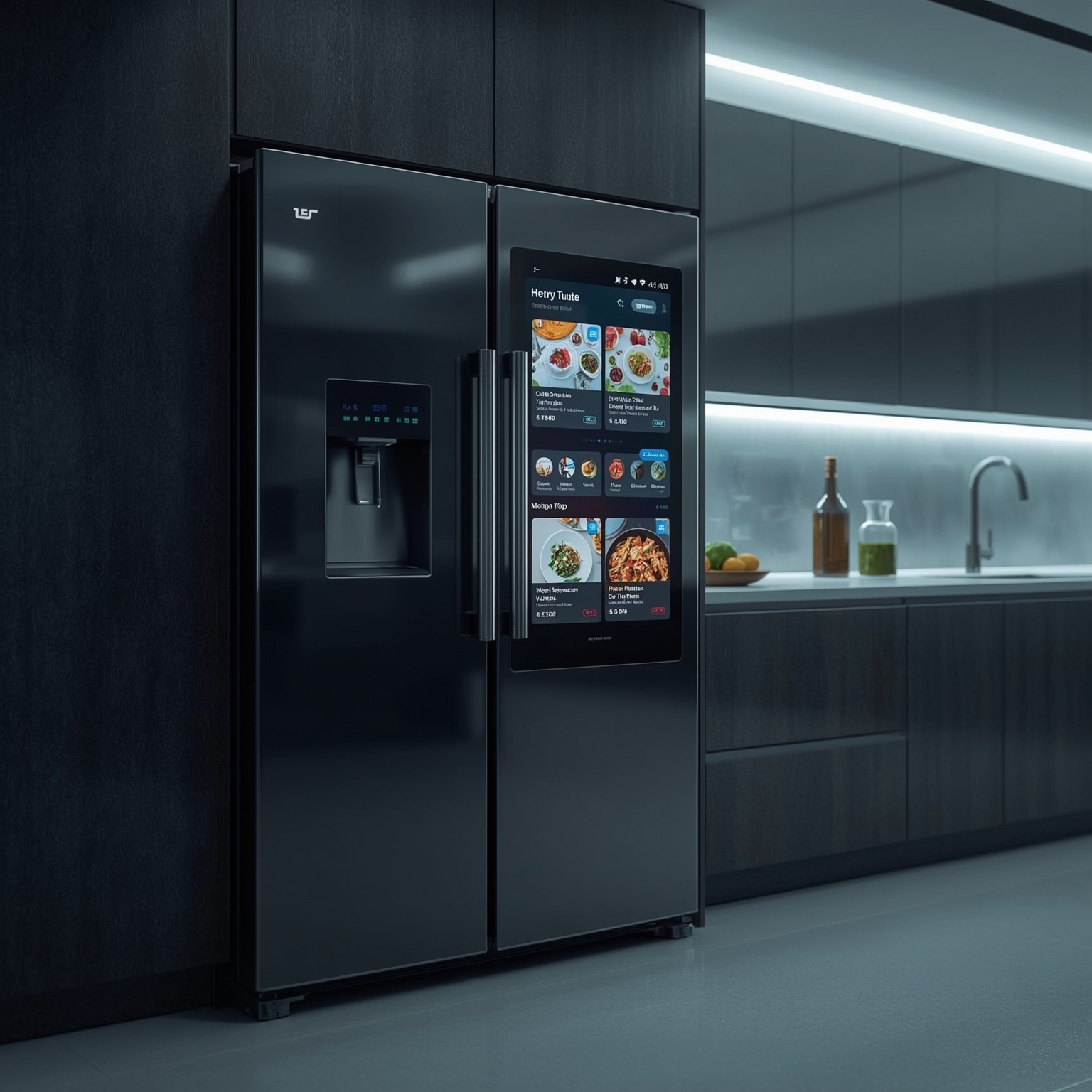
Last month, Samsung issued a cautionary notice that its Family Hub smart refrigerators—those high-end, multi-thousand-dollar appliances that double as giant Android tablets—would soon begin displaying advertisements. Since that announcement, many owners, myself included, have watched our glossy screens with a mix of curiosity and apprehension, knowing this development was inevitable. Now, the rollout of these ads is finally at hand. Beginning November 3rd, Samsung’s connected refrigerators, which retail for well over $2,000, will receive a software update adding a new feature: a digital widget specifically designed to deliver promotional content. Shane Higby, who leads the Home Appliance Business at Samsung Electronics America, confirmed this timeline and functionality in a statement to *The Verge*.
This advertising component will be integrated into certain “Cover screen themes” of the Family Hub’s interface—essentially the digital home screens that operate much like those on tablets or smartphones. Samsung previewed the widget before its official announcement, revealing that it cycles between four distinct panels: one presenting news updates, another displaying upcoming calendar events, a third showing localized weather forecasts, and the fourth dedicated entirely to what the company describes as “curated advertisements.” A demonstration GIF shared by Samsung illustrates how the widget transitions smoothly from one screen to the next every ten seconds, offering a seamless rotation of information and marketing content beneath the surface of a seemingly functional interface. The widget occupies roughly the lower third of the refrigerator’s expansive touchscreen, although users can manually swipe to advance through the panels if they wish to navigate faster.
According to Samsung, the advertising widget will appear exclusively within the Weather and Color theme layouts, leaving the Art and Album themes free from promotional material. Similarly, while a newly introduced Daily Board cover screen omits the rotating widget, it will nonetheless feature a single ad displayed within one of its six available tiles. The software update enabling this new functionality will begin its distribution across all U.S.-based Family Hub refrigerators equipped with the larger 21.5- and 32-inch screens on Monday, October 27th. Users can expect to see advertisements populate these widgets approximately a week later as the rollout completes.
For many long-time owners, this marks a striking departure from how these appliances have operated up to now. In the five years I have owned my own Family Hub fridge, it has never once displayed an advertisement. That era of uninterrupted digital domestic calm appears to be ending. Combined with the recent appearance of full-screen ads on Amazon’s Echo Show smart display sitting on my office desk, the trend feels indicative of a broader shift: any device in my home that includes both a screen and an Internet connection may soon become fair game for advertising. Indeed, my Echo Show has recently begun surfacing prominent full-screen product promos—such as one for elderberry supplements—making me wonder how long it will take before similar imagery greets me each morning on the refrigerator door.
The real concern here extends beyond the mere presence of advertisements. The troubling aspect lies in their sudden arrival *after* purchase. When consumers buy a pricey connected appliance—particularly one meant for personal or domestic use—they expect it to remain fundamentally as-advertised, not to evolve into an ad-supported platform long after installation. If I had voluntarily signed up for something like the free “Telly” television set—a device financed by its permanent built-in ad display—I could hardly complain. In that instance, the trade-off is explicit from the start. But with products such as Amazon’s Echo Show or Samsung’s Family Hub refrigerator, buyers never agreed to such terms. The introduction of these ads thus raises ethical questions about consumer consent and post-sale product transformation.
Still, at least in its current incarnation, Samsung’s widget feels slightly less intrusive than Amazon’s dramatic full-screen takeovers. Yet context matters: a nearly 32-inch refrigerator screen commands far greater presence in the home than an 8-inch countertop display. According to Higby, the initial phase will limit advertising strictly to Samsung-related products and services—items such as replacement water filters for the company’s own refrigerators—shown tastefully within the demo materials. Even so, it’s difficult not to imagine a future where this “pilot” expands to include third-party campaigns, turning the family kitchen into another node in the global digital ad network.
Hints of that possibility already exist. Higby acknowledged via email that while current promotions emphasize Samsung’s own appliance care and accessory offerings, “future promotions will depend on the feedback and insights gained from the program.” Moreover, a presentation delivered earlier this year by Samsung Ads executive Travis Scott Howe positioned the initiative as a novel way for brands to bring “their message to every screen in the connected home,” strongly suggesting a broader commercial ambition underlying the pilot.
For those who find this prospect intrusive, Samsung has at least implemented an opt-out mechanism. The advertising widget will be activated by default but can be disabled entirely through in-device settings. Navigating to the refrigerator’s Settings menu, selecting “Advertisements,” and then toggling them off removes the feature altogether. Users who wish to retain access to the non-commercial elements—such as the news, weather, and calendar panes—can also close individual ads by selecting the small “X,” though doing so will simply make room for new ones to appear later.
It is worth noting that the rollout applies solely to U.S. refrigerators with the large-format screens; units equipped with smaller 9-inch panels are excluded. Likewise, Samsung’s recently introduced AI Home screens—7- and 9-inch displays embedded in new Bespoke AI ovens, washers, and dryers—are not currently included in this advertising pilot. When I previously spoke with Jeong Seung Moon, head of research and development for Samsung’s Digital Appliances division, he insisted that there were “no plans” to bring ads to those AI Home screens. Yet, as this update demonstrates, corporate intentions can evolve rapidly. While Samsung maintains that the Family Hub display technically does not fall under the “AI Home” classification, the practical distinction remains fuzzy even to company representatives, suggesting the expansion of these ads to other appliances might be a matter of time rather than principle.
When asked to justify this new direction, Higby explained that the pilot aims to explore how connected appliances might provide “genuinely useful, contextual information,” positioning the refrigerator as a natural household hub capable of delivering relevant updates alongside promotional content. He described it as an experiment in designing a “responsible, user-controlled” ecosystem that keeps the interface informative while also supporting new engagement models. This rationale closely mirrors remarks made by Panos Panay, Amazon’s head of Devices and Services, who recently defended Echo advertisements as a way to “elegantly elevate” the information users receive. Both companies argue that their advertising systems are carefully curated, contextually sensitive, and potentially even beneficial when showcasing features users might otherwise overlook.
However, even a sympathetic interpretation of these arguments cannot disguise the growing tension between usefulness and intrusion. It is one thing for a smart fridge to recommend a compatible water filter replacement or surface an overlooked recipe function—it’s another entirely for it to display unrelated product promotions in your kitchen. While companies insist their systems are limited to non-personalized, contextual ads today, consumer unease lingers over what will happen tomorrow as these devices inevitably collect more behavioral and usage data. The slippery slope metaphor feels apt: once a screen inside your home becomes an advertising surface, rolling back that precedent may prove impossible.
This leads to a broader issue—trust. Samsung claims that its Family Hub screens will not track individuals or collect personally identifiable information to tailor ads. Yet users are rightly skeptical. Over the past decade, data harvesting by connected devices has blurred the boundary between convenience and surveillance. Unlike a smartphone ad or a browser cookie that quietly tailors your web experience, a refrigerator screen sits at the physical center of domestic life. Personalized ads appearing there could inadvertently expose private preferences, purchases, or medical hints to anyone sharing the household. Past examples, such as well-known retail analytics incidents, underscore the unintended consequences that can arise when algorithmic targeting reaches beyond the private device and into family spaces.
Higby reiterated that this remains, for now, a pilot program focused on testing responsibly, collecting feedback, and learning what genuinely adds value for customers. Samsung plans to monitor reactions through customer service channels and its various social-media platforms—including Instagram, Threads, and X—actively encouraging public input. Those displeased by the notion of ads in their kitchen are invited to make their opinions known.
To balance out the less-welcome advertising component, the latest over-the-air Family Hub update includes genuinely practical enhancements. Among them, improved AI Vision technology can now recognize a wider array of both fresh and packaged foods—adding dozens of new items such as apples, cherries, cucumbers, and kiwis. Bixby now supports voice identification, enabling the system to recognize which member of the household is speaking and to tailor results accordingly for tasks like checking calendar entries or locating a misplaced phone. Samsung’s signature One UI design, introduced on its 2025 models, is being backported to the 2024 lineup, creating visual continuity between fridges, TVs, and tablets and introducing the new Daily Board cover interface. Additionally, SmartThings services—covering Pet Care, Home Care, and Family Care modules—are being extended to more models, and advanced security options now include encrypted Credential Sync, Passkey integration, and a newly added Knox Security Dashboard for monitoring the safety status of connected devices.
This comprehensive update will begin rolling out to U.S. Family Hub owners starting Monday, October 27th, via on-screen notifications. And so, as these refrigerators grow smarter, more intuitive, and—yes—more commercialized, they exemplify the modern paradox of connected living: with each new convenience comes a fresh negotiation between utility, privacy, and the silent creep of monetization into the sanctum of the home.
Sourse: https://www.theverge.com/report/806797/samsung-family-hub-smart-fridge-ads-opt-out


