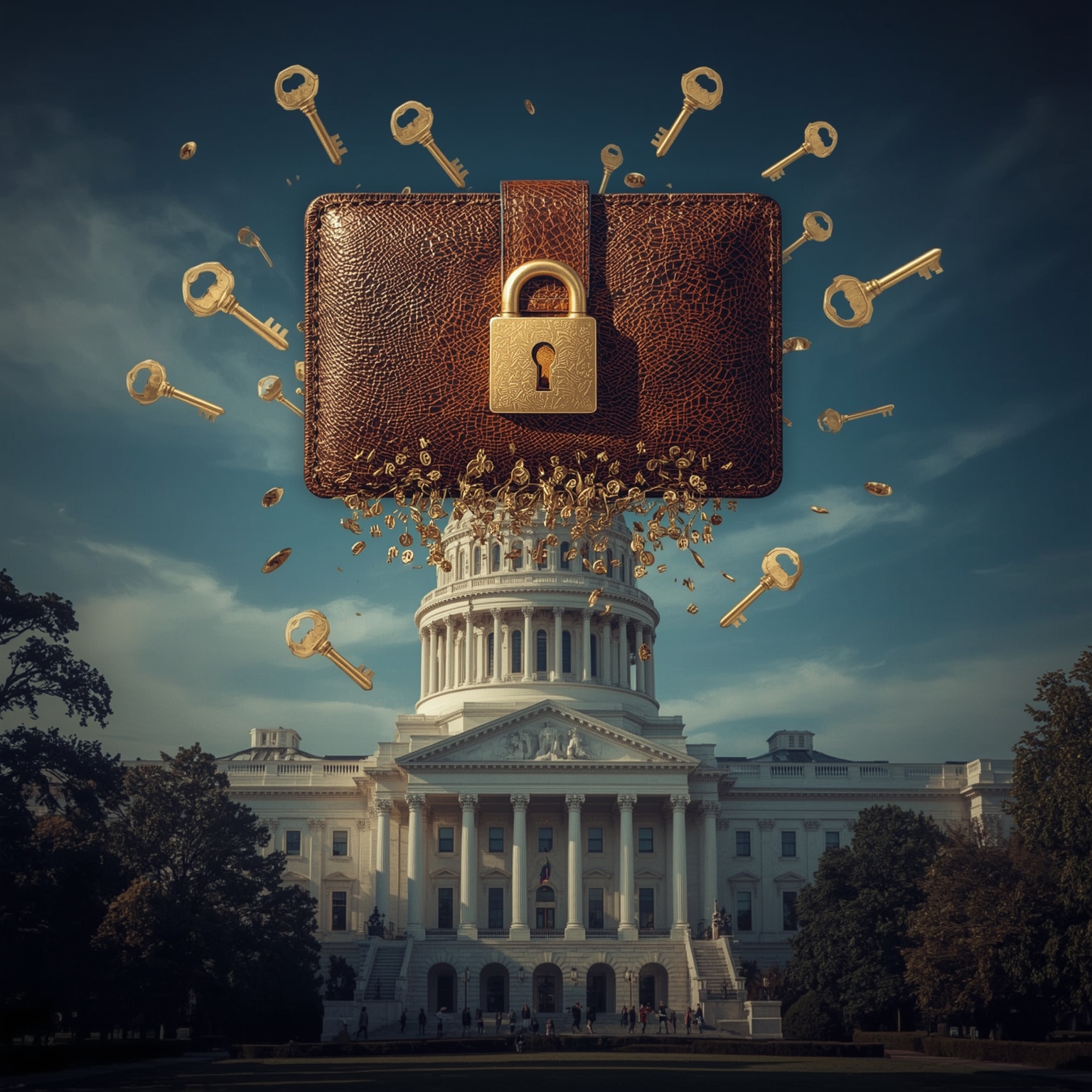
President Donald Trump has moved to assert an intensified degree of control over the financial mechanisms of the United States, in effect positioning himself as the principal decision-maker behind the nation’s monetary flows. As the federal government shutdown stretches into its fourth week, bringing a paralysis in Congress’s ability to pass a cohesive budget, the president’s actions have underscored his determination to expand executive power at a moment when legislative gridlock has immobilized normal governance. In doing so, he has bypassed traditional congressional authorization and has begun exercising unilateral authority to shape fiscal and policy outcomes, an approach that is reverberating through Washington’s institutional framework.
Traditionally, the power of the purse—the constitutional prerogative to approve spending and appropriate funds—has rested firmly with Congress. Yet Trump’s recent maneuvers have disrupted that long-standing equilibrium. Without awaiting legislative endorsement, he has initiated extensive policy changes and spending directives, including authorizing the continuation of military and law enforcement pay during the shutdown, greenlighting the termination of certain federal employees, and commencing an ambitious construction project to build a 90,000-square-foot White House ballroom. These moves, bold in scope and symbolic in intent, have unsettled lawmakers across the political spectrum, who view them as an overt challenge to Congress’s constitutional supremacy over fiscal matters.
Legal experts and policy scholars interviewed by Business Insider have described Trump’s initiatives as a potential stress test for the United States’ checks-and-balances system. Walter Olson, a senior fellow at the libertarian-leaning Cato Institute, articulated the core concern succinctly: Congress’s control over spending acts as a defining restraint on executive action, allowing legislators to curtail or redirect presidential initiatives simply by withholding funding. If that restraint is negated or circumvented, he warned, the president effectively transforms into a financial sovereign, bypassing accountability and diminishing Congress’s oversight role.
Beyond domestic budgeting decisions, Trump’s actions have reverberated throughout international markets and economic institutions. His unpredictable trade strategies—marked by abrupt tariff announcements and shifting foreign policy stances—have shaken global markets and influenced investor behavior. Tensions have also escalated within his own administration: after a weak July employment report, the president dismissed the nonpartisan head of the Bureau of Labor Statistics, a move widely interpreted as politically motivated. Meanwhile, his ongoing public clashes with Federal Reserve Chair Jerome Powell over interest rate policies further underscore his inclination to exert personal influence over traditionally independent economic bodies.
When analysts were asked to identify historical or legal precedents for the president’s current course, their consensus was ambivalent at best. Under normal circumstances, Congress dictates precise spending patterns through “appropriations”—explicit allocations that specify when, where, and how each federal dollar may be used. Altering or repurposing these funds typically necessitates a new act of Congress. Trump’s recent decisions, however, have circumvented that process, substituting executive memoranda and direct orders for legislative consent.
In its official statements, the administration has framed this behavior as a necessary response to partisan obstruction. An October 22 press release accused Democrats of deliberately prolonging the shutdown to maximize political damage, while praising the president’s efforts to protect essential functions such as military compensation and food assistance for low-income families. The White House’s argument hinges on portraying executive intervention as an act of patriotic stewardship rather than overreach.
One of the most consequential decisions was the authorization of continued military pay during the funding lapse. In an October 17 memorandum, the administration justified this step by asserting that, as Commander in Chief, the president holds authority to redirect existing appropriations toward vital defense-related expenses when no other funding is available. This justification, though thinly rooted in precedent, allowed the military payroll to proceed despite a legislative freeze. Reports suggest that the funds were drawn from the Pentagon’s research and development budget, though the administration has provided limited transparency regarding the exact source or implications of this reallocation.
While service members and select law enforcement personnel have continued receiving paychecks, the majority of civilian federal employees and contractors remain unpaid until the government reopens. Historically, Congress has shown bipartisan willingness to guarantee troop pay even during shutdowns, underscoring the politically sensitive nature of military compensation. Further complicating the picture, the Pentagon announced that it had received an anonymous $130 million private check for military salaries, which Trump attributed to “a friend” —a gesture that raised questions about transparency and propriety in government financing.
Policy specialists such as Devin O’Connor of the Center on Budget and Policy Priorities have sharply criticized the administration’s actions, arguing that such unilateral expenditures set a hazardous precedent. O’Connor warned that bypassing congressional funding authority “opens up an enormously dark space,” both legally and ethically, by normalizing executive disregard for statutory limitations when political expediency demands it.
Beyond the military, the White House also arranged supplementary compensation—so-called “super checks”—for certain federal law enforcement groups, including border patrol agents, deportation officers, and Secret Service personnel. The Department of Homeland Security confirmed that these payments draw from allocations embedded within the One Big Beautiful Bill Act, a multi-year law providing funds for border security activities through 2029. Yet analysts stress that without detailed disclosures from the administration, it remains unclear whether the use of these funds adheres to legal boundaries or stretches them to the point of illegitimacy.
Another prominent example of unorthodox executive action emerged when the administration redirected roughly $300 million in tariff revenue to sustain the Women, Infants, and Children (WIC) nutrition program during the shutdown. Former Office of Management and Budget officials noted that while existing law technically allows certain transfers among nutrition-related programs, the optics of using trade-generated revenue for this purpose appear politically calculated. Sam Berger of the CBPP remarked that while the move may be legally permissible, it simultaneously serves to amplify a narrative of decisive presidential action amid legislative dysfunction.
In a more personal manifestation of Trump’s financial autonomy, the president also initiated construction of a vast East Wing ballroom within the White House complex—a project valued at approximately $250 million. Although minor property renovations fall within executive discretion, such large-scale undertakings traditionally involve congressional funding. Trump, however, declared that this endeavor would be financed through alternative means, including a personal legal settlement and donations from supportive business figures. In a public statement on Truth Social, he identified the contributors as “patriotic” donors and corporate allies, with executives from companies such as Blackstone, Lockheed Martin, and Palantir rumored to attend a private donor gala linked to the project.
Observers note that the president’s assertive use of fiscal discretion has not been limited to new spending initiatives; it has also included the withholding or rescinding of congressional appropriations. Legal frameworks like the Impoundment Control Act and the Anti-Deficiency Act were designed specifically to prevent such unilateral interference with established budgets. Nonetheless, Trump’s previous cancellations of USAID foreign aid packages and infrastructure funds for New York City exemplify his willingness to test the limits of executive impoundment powers.
While the concept of presidential autonomy in emergencies is not unprecedented—past presidents have also acted unilaterally to respond to crises—the current scale and frequency of Trump’s interventions are remarkable. Analysts caution that this incremental expansion of executive control over public finance could permanently redefine the institutional balance between Congress and the presidency if left unchallenged.
For lawmakers seeking to restore congressional primacy over the federal purse, several remedies remain available. Scholars like Berger and O’Connor have advocated the introduction of legislative “guardrails,” including proposals that would require a 60-vote supermajority in the Senate to authorize any executive-imposed cuts to key programs. Additional constraints could make it procedurally harder for future presidents to suspend or redirect grant funding unilaterally. Likewise, Olson emphasizes that Congress bears a constitutional duty to enforce the law by asserting its appropriation powers, reminding both branches that fiscal governance is not a matter of personal discretion but of democratic design.
Although Congress or affected organizations could theoretically sue to halt presidential overreach, experts acknowledge that the judicial system’s slow pace often renders such efforts moot. Court rulings delivered years after contested funds have been spent cannot undo the practical consequences of executive action. As O’Connor observed poignantly, the courts “are not structured to prevent illegality in real time; they can only declare its existence after the fact.” In the meantime, as the shutdown persists and temporary budgets languish unresolved, the fundamental question remains: how much authority can a president claim over the nation’s wallet before the delicate architecture of American checks and balances begins to fracture?
Sourse: https://www.businessinsider.com/trump-has-been-making-major-funding-decisions-without-congress-2025-10


